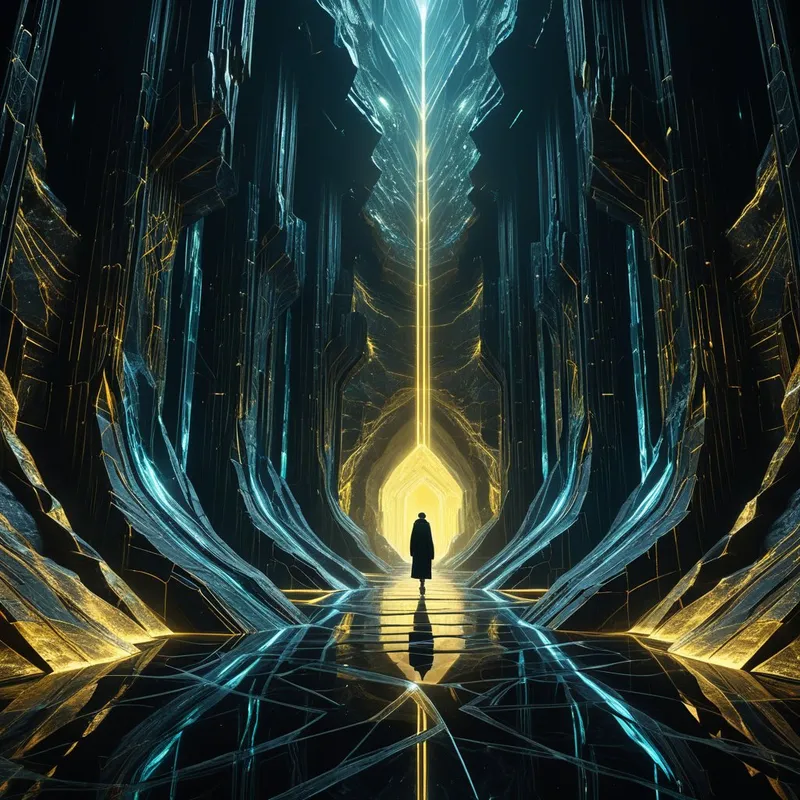
Spiritual Treasure: The Psyche's Forgotten Ledger
The Somatic Echo
It begins not as a thought, but as a pressure. A weight in the chest, not of burden, but of density—a gravitational pull from somewhere behind the sternum. The breath catches, not in fear, but in recognition of a proximity to something immense and dormant. There is a hum in the bones, a low-frequency resonance that feels ancient and personal, like a forgotten name vibrating on the tip of the tongue. This is the body’s pre-cognitive map, its somatic echo of a value system buried so deep it has become geological. It is the feeling of standing directly above a vault you built but cannot remember the combination to, a visceral certainty of wealth encased in amnesia. The mind will later conjure images of chests, keys, and glowing artifacts, but first, the nervous system registers the territory: you are in the presence of your own sequestered capital.
The Dreamer's Log
The dreamer finds themselves in a derelict server farm, its cooling systems silent. They are drawn to a single, dusty terminal humming with a faint, persistent light. Typing a command they do not consciously know, a complex data-mandala unfolds on the screen—a shimmering, rotating schema of connections and losses. At its center, a single file pulses, labeled not with text, but with a feeling of profound, aching familiarity.
This is the alchemical retrieval of a disowned self-part, a core program of identity exiled to the shadow archives during an early psychic crash.

The False Lead
This theme is not about literal windfalls, prophetic lottery numbers, or a cosmic promise of external reward. To interpret it as such is to remain a tourist in your own psyche, mistaking the map for the territory. The treasure is not a thing to be possessed, but a state to be integrated. It is not the end of a quest, but the activation of a dormant internal circuit. The grief you feel upon waking, the frustration of the treasure being just out of reach or lost upon waking, is not a sign of failure or bad luck. It is the precise measurement of the distance between your conscious identity and the wholeness you have sealed away. The treasure is never truly lost; it is only waiting for the correct psychic frequency—the right combination of courage and humility—to be tuned.
Psychological Architecture
To dream of spiritual treasure is to receive a dispatch from the deepest strata of the personal unconscious, where the psyche archives what it deemed too potent, too vulnerable, or too contradictory for the daylight self to hold. This is Shadow work of the most intimate order. The treasure often represents a cluster of innate capacities, core feelings, or ways of being that were sacrificed on the altar of adaptation—a child’s boundless creativity traded for parental approval, a natural sovereignty exchanged for belonging, a fierce passion buried under a landslide of practicality.
The individuation process here is one of reclamation. It demands a descent not into chaos, but into a highly organized, forgotten archive. You are not fighting a monster; you are auditing a ledger. Each gem, each key, each locked chest in the dreamscape corresponds to a psychic complex—a bundle of memory, emotion, and perception—that holds a piece of your native value hostage. The work is forensic and gentle: to approach these complexes not as enemies to be slain, but as exiled internal family members to be heard, understood, and invited back into the system. The treasure is the recovered wholeness that results when these disowned parts are repatriated.
Mythic Resonance
This theme hums with the frequency of the Grail Myth, not as a Christian relic, but as the ultimate symbol of the psyche’s lost center. The Wasteland in the story is not a physical place, but the inner state of the ruler—the conscious ego—grown sterile and impotent because it is cut off from the nourishing, feminine depths of the unconscious (the Grail). The healing question, “Whom does the Grail serve?”, is the pivotal moment of reorientation. It shifts the seeker from a mindset of conquest (“I must find the treasure”) to one of service and relationship (“How do I attend to the source of life?”). The treasure, like the Grail, serves the sovereign who serves something greater than their own isolated will.
Similarly, the story of Psyche and Eros maps the laborious process of reclaiming a lost love—a symbol for the connection to the animating, soulful principle (Eros). Psyche’s impossible tasks—sorting seeds, gathering golden wool, fetching water from the Styx—are metaphors for the meticulous, often tedious inner work of sorting psychic contents, gathering insights from dangerous territories, and drawing sustenance from the depths. The treasure she wins is not just reunion with Eros, but her own apotheosis into goddesshood: the transformation of a mortal psyche into a sovereign, divine whole.
Symbolic Nodes
- Hidden Rooms, Basements, Vaults: The personal unconscious, sealed compartments of the self.
- Keys, Codes, & Combinations: The specific insight, memory, or emotional state required for access.
- Jewels, Gold, Ancient Coins: Condensed psychic value, innate talents, core self-worth.
- Maps, Blueprints, Glowing Schematics: The psyche’s own guidance system for reintegration.
- Locked Chests, Sealed Jars: Complexes and protected wounds holding great potential energy.
- Forgotten Data, Corrupted Files: Memories or self-knowledge fragmented by trauma or time.
Archetypal Resonance
The energy of this theme resonates most powerfully with The Magician Archetype. The Magician’s domain is the hidden structure of reality, the leverage point where a small shift creates a profound transformation. Dreaming of spiritual treasure is an activation of the Magician’s core function: to know, to align, and to manifest from the unseen into the seen. The somatic echo—that hum of latent potential—is the Magician’s power source charging. The treasure itself is the prima materia, the raw, unrefined substance of the self that the Magician consciousness must learn to work with. However, this journey often begins in the territory of the Shadow Magician—the manipulator or illusionist who has used their insight for secrecy, self-protection, or to keep parts of the self hidden even from themselves. The alchemical work is to transmute this shadowy secrecy into conscious sovereignty, turning the act of hiding the treasure into the art of integrating it.
The Alchemical Process
The alchemical transmutation of spiritual treasure is called Solve et Coagula—to dissolve and to coagulate. The intense psychological heat is applied by the sustained, compassionate attention you bring to the very wounds that caused the treasure to be buried in the first place. You must dissolve the rigid identity structures—the “I am not creative,” “I am unworthy,” “I must be practical”—that act as the vault door. This dissolution feels like grief, like vulnerability, like the terror of the old persona crumbling.
The pressure is the conscious endurance of that dissolution without fleeing into distraction or old narratives. Within that liminal, liquid state, the particles of the treasure—the disowned creativity, the buried worth, the forbidden passion—are freed from their isolated clusters. Then, under the gentle, persistent pressure of your newfound awareness, they coagulate. They reform, not as isolated jewels in a box, but as a new, more resilient, and richer compound within your very being. The gold is no longer something you have; it becomes something you are. The sovereign is not the one who owns the treasure, but the one whose substance has been irrevocably alloyed with it.

The Integration Protocol
Question 1: In the dream, what was the primary emotion you felt upon discovering the treasure? Was it awe, fear, greed, confusion, or a profound sadness? This initial feeling is a direct reflection of your current relationship to your own hidden value.
Question 2: If the treasure you sought could speak, what one sentence would it whisper about why it was hidden? Listen not for a logical reason, but for the protective, childlike logic of the part of you that sealed it away.
Question 3: What current circumstance in your waking life feels like the "derelict server room"—a neglected, dormant, or abandoned space within your daily reality that might be the precise location for this integration to begin?
Action 1 (Somatic Cartography): For one week, spend five minutes each morning placing a hand over your sternum. Breathe into the pressure or sensation there. Without seeking images or stories, simply acknowledge the presence of the inner archive. Say internally, “I am here, in the territory.”
Action 2 (Unstructured Recoding): Take a large piece of paper. In the center, draw, scribble, or collage an abstract representation of the treasure’s “feeling.” Without planning, let lines, shapes, and words radiate out from it, connecting to other feelings, memories, or current life themes. This is not art; it is a psychic circuit diagram. Let it be messy and nonlinear.
Action 3 (Ritual of Acknowledgment): Find a small, ordinary object—a stone, a coin, a specific key. Let this object become a token for the treasure. Once a day, hold it and perform a simple, deliberate action: polish it, place it in sunlight, or simply turn it over in your hand three times. This ritual externalizes the commitment to consistent, mindful attention—the gentle heat of the alchemical vessel.
Final Validation
It is profoundly difficult to feel the weight of a wholeness you cannot yet access, to sense the blueprint of a palace while standing in the rubble of the anteroom. That frustration, that poignant ache, is not a sign that you are failing the dream. It is the dream succeeding in its mission: it has made you exquisitely aware of the distance, and in doing so, it has given you the coordinates. The treasure was never meant to be easy, for its value is calibrated to the depth of the journey required to claim it. You are not searching for a prize outside yourself; you are learning the language of your own inner sovereignty, syllable by hard-won syllable. The integration is the treasure. The seeker becomes the sanctum.