
Spiritual Mirroring: The Soul's Silent Dialogue
We spend our days looking outward, navigating a world of separate bodies and distinct minds. Then, in the dream, the fundamental architecture of that separation dissolves. You are no longer merely you, encountering an other. You stand before a reflection that knows you, a face that is yours and not yours, a landscape that pulses with the rhythm of your own hidden heart. This is the territory of Spiritual Mirroring—not a simple echo, but a profound somatic and psychic event where the boundary between self and world, self and other, becomes a permeable membrane. The dream becomes a hall of mirrors, each surface a question posed directly to the soul.
The Somatic Echo
Before the mind can parse the symbol, the body registers the truth. Spiritual Mirroring announces itself not as a thought, but as a felt sense. It is the uncanny chill that is not cold, the electric hum along the spine that is not fear, but recognition. There is a peculiar weightlessness, a sensation of being both solid and diffuse, as if your edges are blurring. The stomach may tighten not with anxiety, but with the profound gravity of an unseen truth approaching. The breath catches, not from shock, but from the somatic realization that you are breathing in rhythm with something vast and interior. It is the body’s ancient language saying: You are not alone in here. And what you meet is you.
The Dreamer's Log
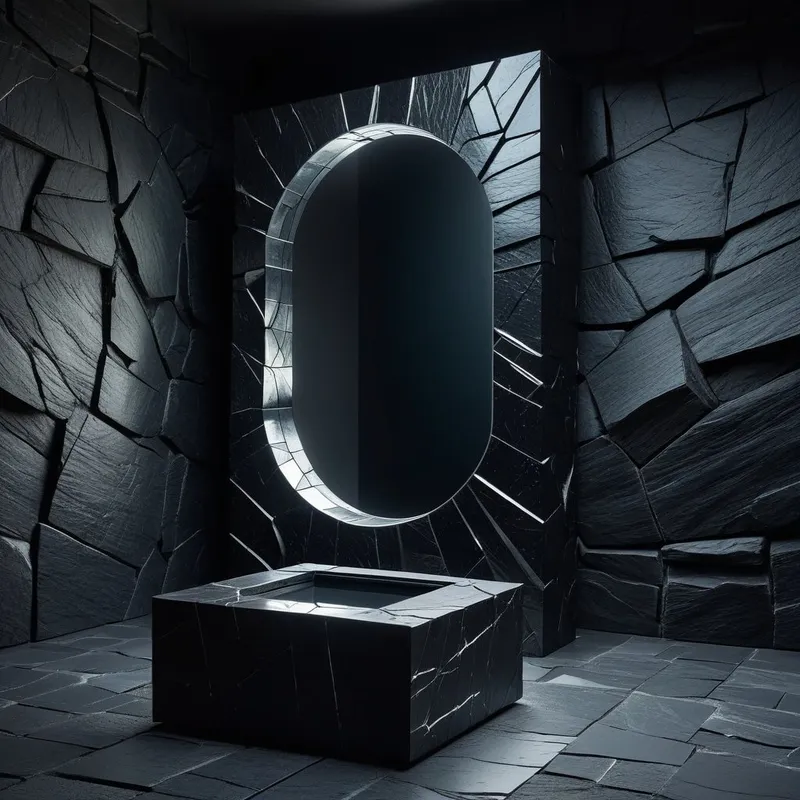
She found herself in a cavernous library where the books were bound in skin that felt familiar. At the center stood a mirror, but her reflection was delayed—it moved a heartbeat after she did, its eyes holding a grief her waking face had long forgotten. When she reached out, the glass became liquid mercury, swallowing her hand without a ripple.
This is not a dream about vanity or literal reflection, but about the latency of the soul—the parts of our emotional truth that live seconds behind our performed identity, waiting to be acknowledged and integrated.
The False Lead
This theme is not about narcissism or mere self-obsession. To mistake the mirrored other for a simple projection of ego is to bypass the depth of the encounter. Nor is it a sign of "losing yourself" in another person in a codependent sense. Spiritual Mirroring is the opposite of dissolution; it is a call to a more complex, textured integration. The terror is not of being absorbed, but of being confronted—of having to finally meet the exiled sorrow, the unexpressed rage, or the disowned brilliance that the mirror so faithfully holds.
Psychological Architecture
At its core, Spiritual Mirroring is the psyche’s method of introducing you to your internal family—the cast of characters that form your totality. Through the lens of Internal Family Systems, the mirrored figure is often an "exile": a part of you carrying burdened emotion, or a "firefighter" that arrives with intense, distracting behaviors. The dream mirror does not create this figure; it reveals its already-resident presence in the inner ecosystem.
The Shadow work here is deceptively simple and profoundly difficult: to stop turning away. Individuation demands we reclaim these reflections. When you dream of a menacing figure in the mirror, the path to wholeness lies not in shattering the glass, but in asking the figure what it needs. When you dream of a radiant, angelic version of yourself, the work is to humble yourself before its message, to digest the potential you have disowned. The mirror shows you the manager, the exile, the protector—not as enemies, but as estranged members of your own sovereignty, waiting for diplomatic recognition.
Mythic Resonance
We see this eternal dialogue in the myth of Narcissus, often reduced to a tale of vanity. But look deeper: he falls not for himself, but for an image—a flat, surface-level reflection that cannot speak, touch, or truly relate. He starves for connection with a phantom, which is the precise tragedy of failing to integrate a spiritual mirror. The reflection is not the problem; his inability to move beyond its two-dimensional surface is. Conversely, in the Japanese Shinto concept of Kagami (the sacred mirror), the mirror does not show the physical self, but the true, honest heart. It is the instrument of self-purification, revealing blemishes on the soul so they may be cleansed. The mirror is not a trap, but a tool for authenticity.
Symbolic Nodes
- Distorted/Melting Mirrors: The psyche's resistance to a clear view; truth feels fluid, unstable.
- Mirrors that Reflect a Different Scene or Era: Unintegrated memories or past selves seeking attention.
- A Mirror That Absorbs You (walking into/through it): The call to fully enter the inner world, to cross the threshold from observation to embodiment.
- Seeing a Specific Person's Face in Your Mirror: Not necessarily that person, but an aspect of your own character or emotional state that you associate with them.
- Shattered Glass that Still Holds a Coherent Reflection: Fragmentation of the ego, while the core Self remains intact and observable.
Archetypal Resonance
The energy of Spiritual Mirroring is most potently aligned with The Magician Archetype. The Magician’s realm is the liminal space between the seen and unseen, the conscious and unconscious. This archetype understands that to change the outer world, one must first master the inner symbols and reflections. The somatic echo of uncanny recognition is the Magician’s intuition flaring to life, sensing the hidden connections. The alchemical potential lies in the Magician’s core function: transmutation. The mirror presents the raw material—the shadow, the exile, the golden potential. The Magician within us holds the latent ability to not just see it, but to engage with it, dialogue with it, and ultimately transform its energy from a haunting image into an active, integrated part of our wholeness.
The Alchemical Process
The alchemy of the mirror requires the heat of sustained attention and the pressure of non-judgmental curiosity. The initial encounter is often leaden with terror, grief, or shame—the base metal of psychic pain. The transmutation begins when you, the dreamer awake, refuse to break the gaze. You apply the heat by revisiting the mirrored image in memory or journaling, feeling the somatic echo without fleeing. You apply the pressure by asking, "What part of me feels this? What does this figure protect? What truth does it hold that my waking life ignores?"
This process dissolves the brittle, reflective surface that kept the image separate. The silvered glass becomes a permeable membrane, then a fluid, then a vapor. The mirrored "other" ceases to be an externalized phantom and is invited inward, its essence digested and integrated. The sovereignty gained is not over the image, but through it—a sovereignty that comes from knowing the full constituency of your inner kingdom, no longer fearing the ambassadors from its forgotten provinces.

The Integration Protocol
Question 1: In the dream mirror, what was the primary emotion on the face of your reflection (or the figure you saw)? Does that emotion have a familiar texture in your waking life, a place where it lives just beneath the surface?
Question 2: If the mirrored figure could speak one sentence to your waking self, what would it be? Not what you fear it would say, but what your deepest intuition whispers it needs to communicate.
Question 3: How does the quality of the mirror itself (cracked, liquid, dusty, ancient) metaphorically describe your current relationship to this hidden part of yourself?
Action 1 (Somatic Anchoring): For one week, upon waking, place your hands on your heart and solar plexus. Recall the dream mirror. Breathe into the bodily sensation it evokes—the chill, the weight, the vibration. Do not analyze. Simply breathe with the feeling for three cycles, acknowledging its presence in your physical vessel.
Action 2 (Unstructured Dialogue): Set a timer for 10 minutes. Write a letter from the figure in the mirror to you. Let the words flow without censorship. Then, write your response. Do not craft; allow the dialogue to be raw and surprising.
Action 3 (Ritual of Permeability): Find a small mirror you can hold. Sit before it in low light. Look into your own eyes, not at your face. Soften your gaze until your features blur. As you breathe, visualize the solid glass becoming fluid, then a mist. Sense the boundary between the "you" here and the "you" in the reflection dissolving. Sit in that felt sense of permeability for a few moments before gently closing your eyes, carrying the integrated feeling inward.
Final Validation
To encounter the spiritual mirror is to be handed a map of your own uncharted interior. It is disorienting, often frightening, because it asks you to become a stranger to yourself in order to become more whole. The difficulty is real; it is the labor of the soul. But within that glass lies not a prison, but a portal. The reflection is not a verdict—it is an invitation. It is the silent, patient voice of your own completeness, showing you the very pieces you need to reclaim. Have the courage to meet the gaze. The sovereignty you seek is waiting on the other side of the glass, and it has always been your own face.