
The Unspoken Tongue: On the Dream Theme of Self-Expression
The Somatic Echo
It begins not as a thought, but as a pressure. A density in the chest, a humming in the jaw, a tightness in the throat that feels like a forgotten language trying to form words. This is the somatic echo of self-expression—a visceral, pre-verbal knowing that something within you is alive, coherent, and desperate for translation. It is the feeling of a completed circuit with nowhere to discharge, a song fully composed in a silent room. The body knows the truth long before the mind grants it permission: there is a version of you, vivid and whole, that exists only in potential. Its emergence is not a choice, but a biological imperative. To ignore this echo is to live with a constant, low-grade fever of the soul, a sense of being perpetually on the verge of a sneeze that never comes. The dream is the sneeze.
The Dreamer's Log
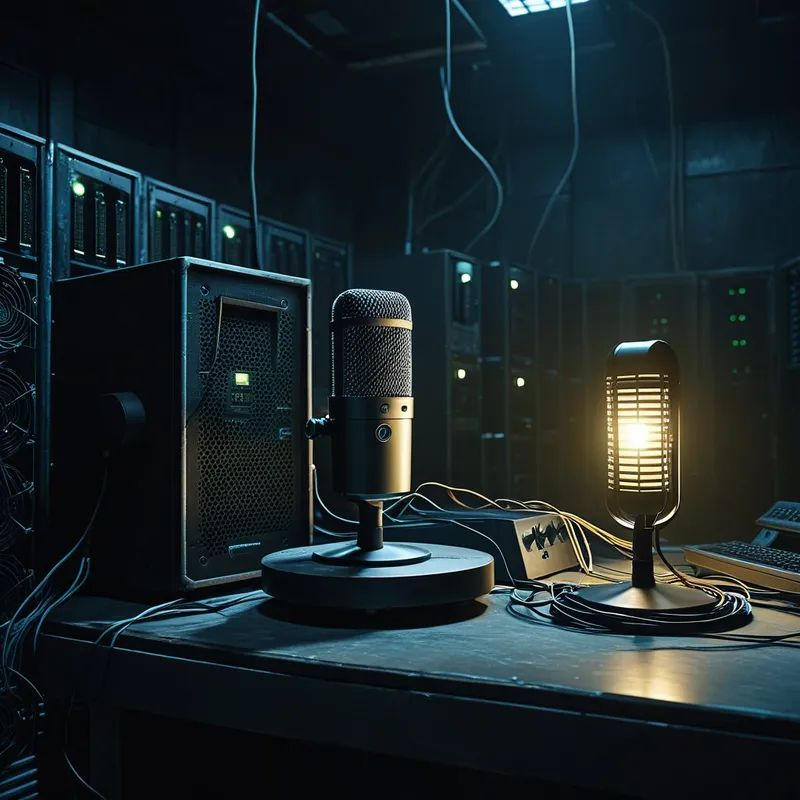
You are in a derelict control room, all dust and dead screens. In the center, on a console, sits an old-fashioned microphone. You try to speak into it, but your voice emerges as static—a crackling, formless noise. You look down and see the microphone’s cord has been cleanly severed, the copper wires inside glowing faintly, like embers in ash.
This dream is an alchemical image of the severed connection between internal truth and external transmission; the voice is present and potent, but its conduit to the world has been cut.
The False Lead
This theme is not about performance, talent, or external validation. It is not the ego’s desire to be seen as clever, artistic, or profound. That is the shadow of expression—the curated persona broadcasting on a secure, pre-approved frequency. True self-expression is the opposite of broadcasting. It is the act of translating your interiority, of making the private logic of your soul legible, first to yourself and then, perhaps, to others. A dream of screaming into a void is not about a lack of audience, but a fear of hearing your own authentic sound. A dream of singing perfectly to a crowd is not a sign of artistic destiny, but often a warning of expressing only what is expected, of being a flawless instrument playing a score written by someone else. The false lead is believing expression is about the outer reaction. It is, always, an inner event made visible.
Psychological Architecture
The architecture here is one of internal silos and forbidden corridors. Within the psyche’s structure, certain feelings, memories, and perceptions are deemed illegible—too raw, too strange, too vulnerable—and are sealed away. They become the exiled parts of your Internal Family System, the inner orphans whose voices were muted for causing trouble, for being "too much," or for not fitting the family or cultural blueprint. The work of self-expression is the shadow work of reintegration. It is the slow, courageous process of descending into those sealed chambers, not as a critic, but as a scribe. You sit with the exiled fragment—the childhood grief, the irrational anger, the peculiar joy—and you do not try to fix it. You listen. You learn its unique dialect. Individuation demands you become the ambassador for these forgotten territories, translating their raw, symbolic language into something that can cross the border into your conscious life. This is not a act of creation, but of diplomacy between the realms of your being.
Mythic Resonance
We see this in the myth of Echo and Narcissus. Echo, cursed by Hera to only repeat the last words spoken by others, embodies the agony of severed self-expression. She is pure reaction, a mirror of external sound, until she fades into nothing but a voice—a voice that can never originate, only reflect. Her fate is the nightmare of the unexpressed soul. In contrast, the alchemical journey is embodied by figures like Orpheus, whose expression—his music—was so authentic it could charm stones and bend the rules of Hades itself. His art was not entertainment; it was a fundamental, world-altering force. But the myth warns us: the power is in the authentic song, not in the glance backward toward validation. To look back is to sever the cord anew, to let the beloved truth slip back into the shadows.
Symbolic Nodes
Common images include: microphones, megaphones, or radios that are broken, muted, or receiving only noise; mouths sewn shut, filled with cloth, or speaking soundlessly; finding a hidden room filled with your own paintings, writings, or inventions; trying to shout a warning that no one hears; ink that turns to water, paint that vanishes, instruments with missing strings; and tunnels, pipes, or vocal cords depicted as architectural structures, often blocked or overgrown.
Archetypal Resonance
The energy of this theme resonates most deeply with The Creator Archetype.
The Creator’s core impulse is to bring the internal into external reality, to make the imagined tangible. This is the exact somatic pressure of the theme—the feeling of a formless something demanding form. Its shadow, the Self-Centered or Mad Scientist, manifests when expression becomes a closed loop, a performance for the self alone, or a manipulation of materials without soul, creating not to communicate but to control or prove superiority. The alchemical potential of the Creator lies in its courage to make the private public, to risk the vulnerability of giving your inner world an outer shape. It understands that in the act of expression—whether through word, gesture, image, or deed—you do not merely describe yourself; you complete a circuit of your own being. The Creator knows that to have a voice is not a gift, but a responsibility to the truth that chose you as its vessel.
The Alchemical Process
The transmutation here is from potential into presence. The raw prima materia is the chaotic, wordless, imagistic soup of your inner life—the grief, the vision, the love that has no name. The heat and pressure required are the twin forces of vulnerability and discipline. Vulnerability is the heat that melts the defensive walls around your authentic voice, allowing it to flow in its true, unpolished state. It is the terrifying willingness to be seen in your process, not just your product. Discipline is the pressure that gives that flow a shape; it is the commitment to sit with the chaos and wrestle it into a form—a sentence, a brushstroke, a gesture—that can hold the charge of your truth. The process is not peaceful. It feels like giving birth to a new organ of perception. You must hold the tension between the urge to scream everything raw and the fear of saying anything at all. In that crucible, the static finds its frequency. The severed cord begins, nerve by nerve, to regenerate.
The Integration Protocol
Question 1: Where in my body do I feel the pressure of the unsaid? Is it a knot, a buzz, a hollow? What is its texture and temperature?
Question 2: What is the oldest, most exiled part of my experience that still speaks to me in symbols, moods, or aches instead of words? What might its first, simple sentence be?
Question 3: If my authentic expression were a color, a sound, and a material, what would they be? How would they combine into an object?
Action 1 (Somatic Transcription): For five minutes, focus solely on the physical sensation in your body where you feel constriction or energy related to expression. Do not try to interpret it. Instead, let your hand move on a page, drawing abstract lines, shapes, and pressures that directly correspond to the sensation. Let the body "speak" graphically first.
Action 2 (Uncensored Page): Set a timer for ten minutes. Write, type, or voice-record without stopping, editing, or judging. The only rule is you must begin with the phrase: "What I am not saying is..." and continue. Do not read it back immediately. Let it be a pure, unedited data-dump of the interior.
Action 3 (Ritual of Emission): Take the product of your Uncensored Page (or a symbol representing it). Go to a boundary space—a threshold, a shore, a park's edge. Read it aloud to the elements (wind, water, trees) or burn it safely in a bowl, not to destroy it, but to transmute its energy from held potential into released frequency. Acknowledge the act of emission itself as the completion.
Final Validation
It is profoundly difficult. To translate the soul's native tongue into the crude, shared language of the world feels like a betrayal of its original music. It is messy, awkward, and frightening. You will feel exposed, foolish, and certain you have gotten it wrong. This is not a sign of failure, but of authenticity. The very resistance you feel is the measure of the truth you are approaching. Your dreams are not criticizing your silence; they are rehearsing your voice. They are showing you the severed cord not to shame you, but to illuminate the exact point where your sacred work of repair begins. The world does not need another polished performance. It is starving for your particular, unrepeatable, and desperately needed translation. Begin where you are. Speak to the dust. The static is a signal, waiting for you to recognize its name.