
The Dream Theme of Safety: Building the Internal Sanctuary
The Somatic Echo
Before the image of a locked door or a sheltering cave, the theme of Safety announces itself in the body as a deep, cellular sigh. It is the unclenching of a jaw you didn’t know was tight, the softening of a diaphragm held like a shield. It is the visceral memory of a weight lifted, a warmth spreading from the sternum outward, a quieting of the internal hum that scans for threat. Conversely, its absence is a cold, hollow ache behind the navel, a subtle tremor in the hands, a constant, low-grade tension in the shoulders—the somatic architecture of a system perpetually braced for impact. This is the ground from which the dream of safety grows: not an intellectual concept, but a felt sense of homecoming within one’s own skin.
The Dreamer's Log (Case Vignette)
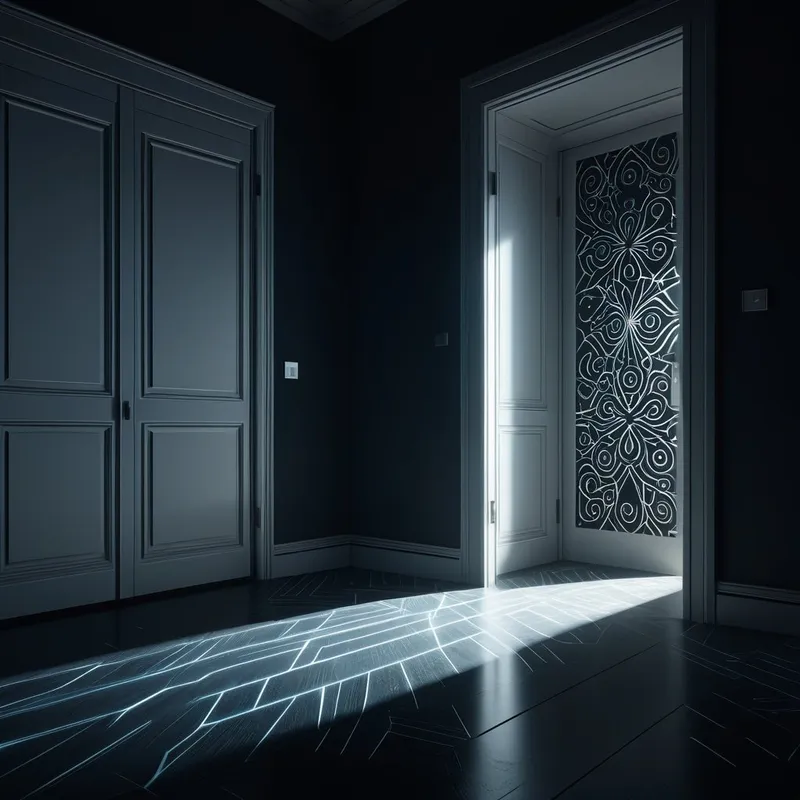
In the dream, I am in my apartment, but it feels cavernous and cold. I walk to the front door, a simple white door I know well, and find it unlocked, swinging slightly in a non-existent breeze. A profound dread fills me. I try to lock it, but the mechanism is smooth, featureless metal with no keyhole, no bolt. My fingers slide uselessly over its surface as the dread turns to a quiet, accepting grief.
This is not a dream about home security, but the psyche’s stark revelation of a missing internal mechanism—the grief of realizing one’s own boundaries have no functional lock, no sovereign “off” switch to the world’s demands.
The False Lead
A dream of compromised safety is not a premonition of literal danger, nor is it a sign of mere paranoia or weakness. To interpret it as such is to mistake the map for the territory. The dream is not warning you that your house is unsafe; it is showing you that your sense of being at home within yourself has been fractured. It points not to external threats, but to internal exiles—the exiled parts of the self that feel unprotected, unseen, and unwelcome in the conscious psyche. The locked door that won’t lock isn’t about the door; it’s about the dreamer’s relationship to their own right to say “no,” to close, to rest, to be separate.
Psychological Architecture
The work of Safety in dreams is the profound Shadow work of re-parenting the internal system. Through the lens of Internal Family Systems, we see these dreams as council meetings for the exiles: the terrified child, the overwhelmed adolescent, the betrayed idealist. They appear as the figure alone in the empty house, the one fleeing through unfamiliar streets, the voice that whispers they’re coming with no face to assign to “they.” The individuation process here is the slow, courageous act of turning toward these exiles not as threats, but as petitioners at the gates of your own awareness. It is building, from the inside out, a sanctuary where every part of you is allowed to exist without fear of annihilation, judgment, or abandonment. This is the architecture of the Self: not a fortress against the world, but a hearth within it.
Mythic Resonance
Consider the Greek myth of Hestia, goddess of the hearth. While others ventured out on epic quests, Hestia’s power resided in her unwavering presence at the center. The hearth-fire was not just for warmth and cooking; it was the sacred, immutable center of the home and the state, the symbol of internal continuity and safe return. A dream of safety calls on this Hestian energy—the need to tend the central fire of the self, which modern life so easily scatters to the winds. Conversely, the absence of safety echoes the fate of Philoctetes, wounded and abandoned on a desolate island, his pain making him both toxic and isolated. His healing—and his essential return to the community—only came when others dared to approach his wound with respect, not fear. Safety is found in tending the central fire or in the compassionate approach to the isolated wound.
Symbolic Nodes
- Doors, Windows, Gates: Their state (locked, open, broken, missing) reflects the condition of your psychic boundaries.
- Nests, Caves, Wombs, Fortresses: Images of containment and protection, speaking to the need for a conscious, chosen retreat.
- Blankets, Shields, Armor: The quality of these—threadbare or impenetrable, suffocating or comforting—reveals your current mode of self-protection.
- Familiar Rooms Turned Alien: Your own psyche feeling unrecognizable and inhospitable to you.
- Guides or Protective Animals: The emergence of internal resources or instinctual wisdom that knows how to navigate threat.
- A Persistent, Unseen Presence: The embodied feeling of being watched or followed, often representing an unintegrated fear or a past trauma held in the body.
Archetypal Resonance
The theme of Safety resonates most powerfully with The Caregiver Archetype. Its core energy is the nurturing, protective impulse to create and maintain sanctuary. The somatic echo of safety—the warmth, the sigh, the softening—is the direct experience of the Caregiver’s embrace turned inward. Its alchemical potential lies in its transmutation: from an outward-focused role of caring for others (which can shadow into the Martyr or Smotherer) into the sovereign capacity to care for the self. This is the ultimate act of the matured Caregiver: building an internal hearth so stable and warm that it can safely hold all one’s fragmented parts, thereby generating a resilience that needs no external validation. The dream of the broken lock is the Shadow Caregiver’s failure—the inability to protect the self.
The Alchemical Process
The alchemical transmutation of Safety is the Opus Contra Naturam—the work against nature—whereby the base lead of primal vulnerability is turned into the gold of unshakeable inner sanctuary. The required heat is the intense, often terrifying, pressure of consciously feeling the lack of safety. It is the courage to stay present with the hollow ache, the tremor, the dread, without fleeing into distraction or false narratives. The solve (dissolution) phase involves allowing the old, crumbling psychic structures—the walls built from others’ expectations, the locks that never worked—to fall apart. The coagula (coagulation) phase is the slow, deliberate reconstruction from the inside, using materials of your own choosing: self-compassion as mortar, discernment as the blueprint, and the steady flame of your own attention as the guiding light. The terror is not destroyed; it is invited to sit by the new hearth, listened to, and in that listening, transformed from a master of the house into an honored, integrated guest.

The Integration Protocol
Question 1: In the dream, where did you feel the most vulnerable? Locate that sensation in your waking body. What does it need right now—not a story, but a sensation (e.g., warmth, pressure, space)?
Question 2: If the unsafe space in the dream were a part of your own psyche, not the outside world, which exiled emotion or memory might be living there, and why does it feel it must hide?
Question 3: Imagine the perfect, felt sense of safety as a tangible object or environment in your mind. What is its most essential quality? (e.g., is it silence, warmth, solidity, boundless softness?)
Action 1 (Somatic Anchoring): For one minute, place a hand over your heart and another on your belly. Breathe slowly, directing the breath to the space between your hands. Do not try to change anything; simply be the witness to the territory of your own body, establishing a baseline of benevolent presence.
Action 2 (Creative Cartography): Draw, paint, or collage your "Internal Sanctuary." Do not think; let your hand move. Include its boundaries (are they walls, light, water?), its central feature (a hearth, a tree, a pool), and what it contains. This is not art; it is a blueprint of your psyche's desired state.
Action 3 (Ritual of the Threshold): Choose a real door in your home. Before passing through it, pause for three breaths. On the in-breath, gather your scattered energy; on the out-breath, release what does not serve your sanctuary. Consciously cross the threshold as an act of entering or leaving your sovereign space, reinforcing the integrity of your internal boundaries.
Final Validation
To dream of unsafety is to touch one of the most raw and human nerves. It is an acknowledgment, straight from the soul, that you have felt exposed, that your foundations have trembled. This is not a failure, but a profound honesty. Honor the grief of the unlocked door. Then, recognize that the very consciousness beholding that dream—the you that feels the dread and the grief—is also the architect, the Hestia, the caregiver with the power to rebuild. The sanctuary you seek is not a place you find, but a presence you become, one deliberate, compassionate brick at a time. You are both the wounded one on the shore and the courageous vessel sailing back to offer rescue. The dream is the map. You are the builder.