
The Dream of Rootedness: Finding Your Ground in a Fractured World
The Somatic Echo
Before the mind can articulate the concept, the body knows the ache of its absence. It is not a sharp pain, but a low-grade hum of disquiet. A feeling of being perpetually slightly off-balance, as if the floor beneath you is a millimeter softer than it should be. It’s the shallow breath of perpetual readiness, the shoulders held not in strength but in a subtle, defensive hunch against a wind that isn’t blowing. The stomach is a quiet, empty chamber echoing with every step. This is the somatic signature of un-rootedness: a life lived in the ankles and knees, never sinking into the hips, never trusting the spine to be the central pillar it was meant to be. The body becomes a visitor in its own posture, a temporary occupant in a space it cannot claim.
The Dreamer's Log
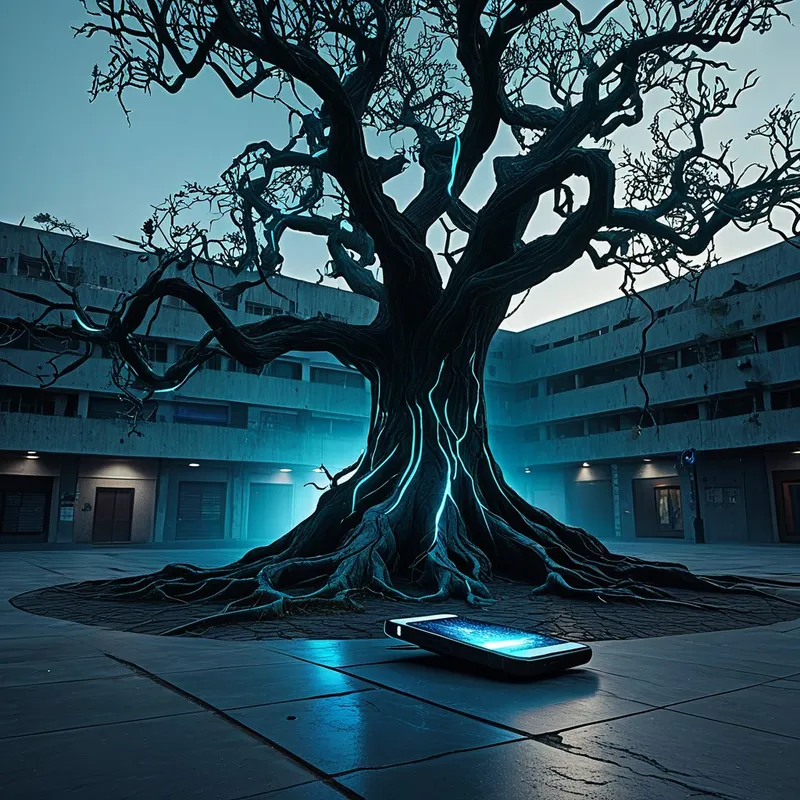
The dreamer stands in a vast, rain-slicked city plaza at the violet hour of dawn. The ground is seamless gray concrete. Suddenly, a web of cracks spiderwebs from their feet, and from the fissures, thick, luminous roots—the color of old gold and deep earth—erupt and coil upward. They do not seek the sky, but instead gently wrap around the dreamer’s own legs, holding them fast. In their hands, they find they are holding their smartphone, its screen a mosaic of hairline fractures, glowing with the same soft, root-like light.
Alchemical Interpretation: The psyche is forcing a confrontation between the fractured, surface-level identity (the phone) and the ancient, stabilizing Self (the roots), insisting that true connection must first be forged downward into the body and the unconscious, not outward into the digital ether.
The False Lead
Rootedness is not stagnation. It is not the refusal to move, grow, or change. That is rigidity, the petrification of the soul, which is the shadow of true stability. To mistake one for the other is a critical error. The dream of roots is not a command to plant yourself in toxic soil—a bad job, a draining relationship, a inherited narrative that no longer serves—and call it loyalty. That is the False Root, the anchor that drowns you. The terror in the dream of being held fast by roots is often the fear of this very conflation: the dread that to be grounded is to be trapped. The work is to discern the difference between the root that nourishes and the chain that binds.
Psychological Architecture
The architecture of rootedness is built in the shadowlands of the psyche, in the cellar of what we have disowned. To feel unrooted is to have exiled the parts of yourself that feel messy, needy, primitive, or slow. The Orphan who learned to survive by staying light on their feet, never settling where pain might find them. The Innocent who fears the dark, rich soil of shadow, preferring the sterile, sunlit surface. Individuation here is a process of re-membering—not as an intellectual exercise, but as a somatic reclamation. It is inviting the exiled internal family back to the hearth: the wounded child who needs holding, the ancestral grief that weighs like stone, the instinctual body that moves at the speed of seasons, not seconds. This is the Shadow work: to stop building your home on the porch of your personality and to descend, willingly, into the basement of your being, to make peace with the damp earth and the hidden foundations. Sovereignty is not built in the airy rooms of achievement, but in the reconciled darkness below.
Mythic Resonance
Consider the Norse world-tree, Yggdrasil. Its roots drill into three separate wells: one of primal wisdom (Mímisbrunnr), one of fate (Urðarbrunnr), and one seething with chaotic, serpentine energy (Hvergelmir). The tree’s stability is not in spite of these disparate, often turbulent sources, but because of its deep, differentiated connection to them. Its strength is its profound and varied anchorage. Similarly, the Greek Antaeus drew his invincible strength from direct contact with his mother, Gaia, the Earth. His was a rootedness of constant, physical renewal. Hercules only defeated him by lifting him away from his source, severing the connection. The myth warns us: our power is contingent on our contact. To be uprooted is to be defeated. Our modern tragedy is that we perform this Herculean feat on ourselves daily, lifting ourselves into the abstracted, digital stratosphere, wondering why we feel so weak.
Symbolic Nodes
- Trees, especially with visible or erupting root systems.
- Foundations, cellars, basements, and subterranean rooms.
- Feet, legs, and the spine.
- Mycelial networks, fungal growth, lichen.
- Anchors, deep-sea diving, heavy stones.
- Potting soil, clay, thick mud.
- Heritage objects: family Bibles, quilts, worn tools.
- Temples, pillars, and monolithic structures.
Archetypal Resonance
The Orphan Archetype is the primary architect of this theme. The Orphan’s core wound is the loss of belonging, the fundamental fracture that makes the ground feel untrustworthy. Its adaptive genius is realism and survival—learning to navigate a world without obvious support. In the quest for rootedness, the Orphan is not the problem to be solved, but the guide. Its somatic echo is that very feeling of hollow-bellied caution. Its alchemical potential lies in its profound, hard-won knowledge of the landscape of exile. By embracing and integrating the Orphan—not as a permanent identity, but as a wise and weathered part of the internal system—we transmute its survivalist scanning for danger into a deep, discerning knowledge of what constitutes true, nourishing ground. The integrated Orphan becomes the master builder of the hearth, because it remembers, more than any other, the cold of being without one.
The Alchemical Process
The alchemy of rootedness requires the heat of voluntary descent and the pressure of stillness. The prima materia is that floating, anxious energy—the desire to flee, to fix, to distract, to rise above. The process begins by consciously choosing to go against that impulse. You must apply the heat of your own awareness to the places in the body that feel empty or tense, and stay. This is the solve: the dissolution of the identity that lives only in the head, the melting of the barriers that separate you from your own physical and emotional ground. The pressure is the containment of that energy, refusing to let it leak out into old stories or future anxieties. In this vessel of mindful, embodied presence, the coagula occurs: a slow, gravitational settling. The grief of disconnection, the terror of the void, the fragmented memories—they are not eliminated. They descend. They find their weight. They become, particle by particle, the very substrate of your foundation. What was the terror of being nothing becomes the peace of being grounded. The sovereign Self is not the one who floats above it all, but the one who has metabolized the entirety of their experience into unshakable ground.

The Integration Protocol
Question 1: In your life right now, where do you feel you are "performing stability" on a surface level, while internally feeling like a temporary occupant? Name one specific room, relationship, or role.
Question 2: What exiled part of yourself—an emotion, a memory, a "unacceptable" need—feels like the damp, dark soil you are afraid to let yourself touch? What might it offer if welcomed?
Question 3: If your sense of self were a tree, what are its roots currently tangled in? Are they in nourishing earth, or wrapped around the rusted pipes of old obligations and inherited narratives?
Action 1 (Somatic Anchoring): For five minutes, stand barefoot. Feel the exact points of contact with the floor. Imagine roots, not of wood, but of your own attention, growing down from your feet, through the floor, into the ground. With each exhale, feel a subtle weight, a density, returning up those roots into your ankles, calves, and pelvis. Do not visualize vividly; just sense the shift in gravitational presence.
Action 2 (Creative Excavation): Take a large sheet of paper. In the center, draw a simple, abstract shape representing your body. Without planning, let your hand draw lines, shapes, and textures outward from the center that represent your current connections (to people, work, ideas, places). Then, draw lines, shapes, and textures inward toward the center that represent what feeds and sustains you. Use no words. Observe the difference between the outward web and the inward roots.
Action 3 (Ritual of Reclamation): Find a small, natural object—a stone, a handful of soil, a twig. Hold it and consciously project onto it one feeling, memory, or aspect of yourself from which you feel disconnected or ashamed. Go outside. Dig a small, deliberate hole. Place the object inside and cover it. State aloud: "I return this to the ground of my being. I do not abandon it. I make it part of my foundation." Walk away without looking back.
Final Validation
It is profoundly difficult to root in a world that prizes velocity over depth, curation over authenticity, and network over nexus. The feeling of being adrift is not your failure; it is a sane response to an uprooting culture. Honor the ache. It is the wisdom of your bones remembering their purpose: not just to move you, but to hold you. The journey downward, into your own darkened earth, is the most courageous voyage you will ever undertake. For in that silent, fertile darkness, you do not find an end, but the true beginning—the unshakable ground from which everything genuine must, and finally can, grow.