The Dream Alchemy of Resilience & Adaptation
The Somatic Echo
Before the mind can articulate the concept of resilience, the body knows its signature. It is not the rigid clench of defiance, but a deeper, more fluid sensation. It feels like a slow, tectonic settling in the bones, a quiet hum of potential energy in the marrow. The breath becomes a tide, learning to find its rhythm against a new, unexpected shoreline. There is a low-grade ache in the joints—not of injury, but of recalibration, as if the very architecture of your being is learning to bear weight differently. The stomach may hold a cold, metallic knot, the somatic residue of an impact already absorbed, now being metabolized. This is the echo of adaptation: the visceral, pre-verbal intelligence of a system learning to live inside a new pressure. It is the feeling of your internal family of selves—the protector, the child, the critic—pausing their usual arguments to listen, together, to the unfamiliar strain in the foundation.
The Dreamer's Log
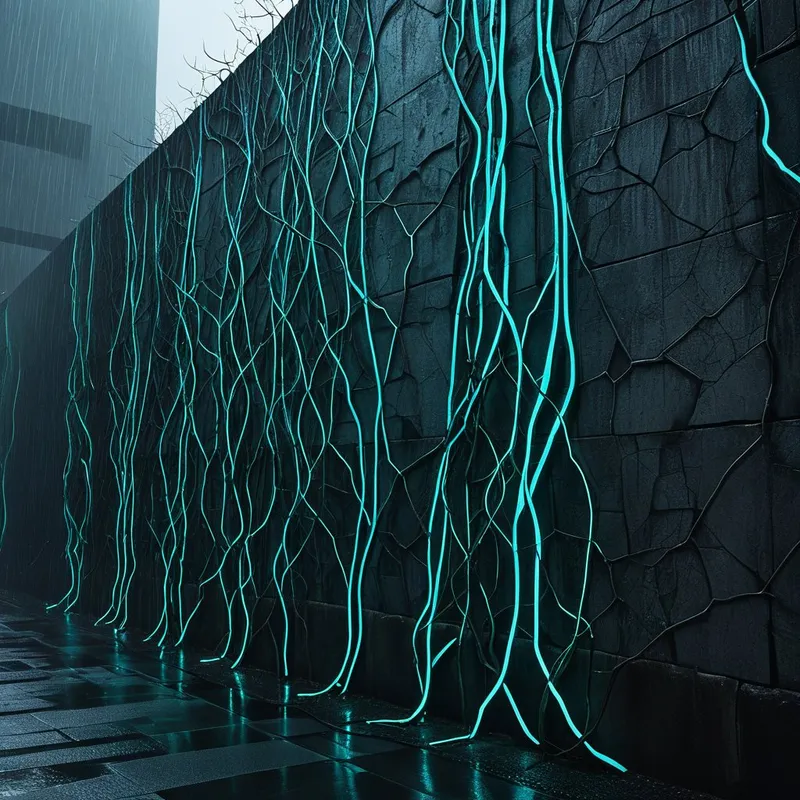
The dreamer finds themselves in a narrow alley between towering, windowless buildings of wet concrete. A monolithic wall blocks the path ahead, cracked from top to bottom. From within the deepest fissure, a thin, luminous vine emerges, not of leaves, but of intricate, bioluminescent circuitry. It grows not by breaking the wall apart, but by threading through its fractures, tracing the lines of weakness with a network of soft, persistent light.
This is the alchemy of the constrained seed: sovereignty is not found in the destruction of the obstacle, but in the ingenious, life-affirming use of its very structure.
The False Lead
Resilience in dreams is not a narrative of heroic triumph over clear-cut adversity. It is not the dream of winning the battle, slaying the dragon, or finally reaching the sunlit peak. To mistake it for such is to bypass its profound, shadowed work. This theme is also distinct from mere endurance, the numb, grinding persistence of the martyr. Adaptation is not passive survival; it is active, intelligent reconfiguration. The dream is not showing you how to "tough it out," but how to become something else entirely—something that can hold the contradiction, inhabit the rupture, and find a new form of coherence within the chaos. It is the difference between a stone weathering a storm and a river changing its course because of it.
Psychological Architecture
The deep work here is a fundamental negotiation with the psyche’s foundational blueprint. It is Shadow work of the highest order, for it demands we befriend the parts of ourselves we deemed "breakable," the vulnerabilities we labeled as failures. The process of individuation in this realm involves dissolving the ego's rigid identification with a single, stable form. You are asked to release the inner ruler who demands consistency and control, and instead listen to the exiled orphan who knows how to scavenge, and the hidden magician who knows how to transform.
This is an internal migration. Whole internal subsystems—beliefs, identities, coping mechanisms—must be deemed obsolete and gently decommissioned. The grief felt is for these dying selves, these old ways of being that once kept you safe. The terror is of the formless void that exists between the collapse of the old structure and the emergence of the new. Resilience is born in that liminal space, in the courage to not-know, to be undone, and to pay exquisite attention to what new pattern insists on forming from the debris.
Mythic Resonance
We see this firmware update in the myth of the Norse world tree, Yggdrasil. It is not a static monument but a living system constantly under assault: its roots gnawed by the dragon Níðhöggr, its branches shaking with the conflicts of the realms. Yet, it holds. It adapts. It is the resilient architecture of existence itself, integrating decay and conflict into its endless cycle of sustenance. Similarly, the Greek figure of Proteus, the old man of the sea, embodies pure adaptation. To hold him for answers is to hold change itself; he shifts into fire, water, beast, and tree. The lesson is not to pin him down, but to learn the stamina and flexibility to stay with the transformation until the essential truth is revealed. These are not stories of victory, but of intelligent, enduring response.
Symbolic Nodes
- Bridges that redesign themselves as you cross them.
- Buildings or bones that bend dramatically without snapping.
- Roots or mycelial networks spreading through inhospitable ground.
- Water in all its forms—especially finding new paths, wearing down stone, or persisting as vapor.
- Re-weaving spiders or re-building birds after a nest is destroyed.
- Chameleons, octopuses, or deep-sea creatures—masters of environmental interface.
- Kintsugi pottery—the explicit highlighting of repair.
- Modular or transforming structures in a landscape.
Archetypal Resonance
The Magician Archetype is the core energy of this theme. The Magician does not merely endure reality; they understand its underlying codes and, through will and imagination, seek to transform it. The somatic echo of recalibration is the Magician sensing the shift in the fundamental laws of their personal universe. Their alchemical potential lies precisely in this adaptive function: to take the raw, chaotic pressure (the prima materia of crisis) and, through the intense heat of conscious attention, transmute it into a new paradigm of operation. The Shadow Magician, the manipulator, fears true adaptation, opting instead for illusion and control—a brittle facade of resilience that eventually shatters. The true Magician archetype active here is the cyber-alchemist, who knows that to survive a system crash, you must learn its hidden language and rewrite the script from within.
The Alchemical Process
The transmutation here is from Fragility to Anti-Fragility. The base metal is the ego's brittle identity, which believes strength is found in rigidity and consistency. The heat and pressure are applied by the relentless, unexpected circumstances of life—the loss, the betrayal, the failure, the sudden change that cannot be reasoned with. This is the nigredo, the blackening, where all form seems to dissolve into chaos and despair.
The alchemical fire is the sustained, non-judgmental awareness you bring to this dissolution. It is the courage to feel the grief of the dying form without rushing to rebuild a replica. In the whitening (albedo), you begin to see not chaos, but components; not ruin, but raw material. The new pattern emerges not from a grand design, but from an intelligent, almost organic response to constraint—like the dream-vine using the crack. The gold (rubedo) is not an end to pressure, but a newfound sovereignty within it. You become a system that doesn't just resist shock, but incorporates it, using the disturbance to become more complex, more integrated, and more uniquely yourself. The psyche learns to thrive on volatility.
The Integration Protocol
Question 1: Where in my life right now am I trying to remain a solid, when the situation is asking me to become a liquid or a vapor?
Question 2: What old, internal rule or self-concept did I recently discover was breakable? Can I honor its service, even as I let its rigid form go?
Question 3: Looking back at a past rupture, what unexpected capacity or insight grew in the fissure that would not have existed without the break?
Action 1 (Somatic Recalibration): For five minutes, practice "shape-shifting" breaths. Inhale deeply, imagining your form as solid, rooted, and defined. On the exhale, imagine that form dissolving into water, then into mist, then into empty space. Hold the exhale in that formless state for a moment before inhaling a new, slightly different form back into being.
Action 2 (Creative Cartography): Draw or paint a map of a recent challenge. Do not draw literal events. Instead, map it as a landscape. Where were the rigid, impassable mountains? Where was the crumbling ground? Where did a hidden spring or a flexible bridge appear? Let the art show you the terrain of your own adaptation.
Action 3 (Ritual of the New Circuit): Find a small, broken object—a twig, a piece of outdated tech, a cracked dish. Spend time mending it not to hide the break, but to highlight it. Use gold ink, a bright thread, or a contrasting material. As you work, consciously dedicate this act to an internal "fracture" where you are currently building a new, more resilient connection.
Final Validation
The path of adaptation is not for the faint of heart. It asks you to consent to your own unmaking, to hold faith in the middle of the collapse, to trust a intelligence deeper than planning. This is profoundly difficult, and the weariness you feel is the honest cost of metamorphosis. Yet, within that very difficulty lies the forging of a sovereignty that cannot be granted or taken away. You are not just surviving the storm; you are learning the secret, silent language of the wind and the rock, becoming an integral part of the landscape's enduring, flexible dance. The dream is your psyche's proof: you are already doing it. You are the wall, the crack, and the luminous, growing vine.