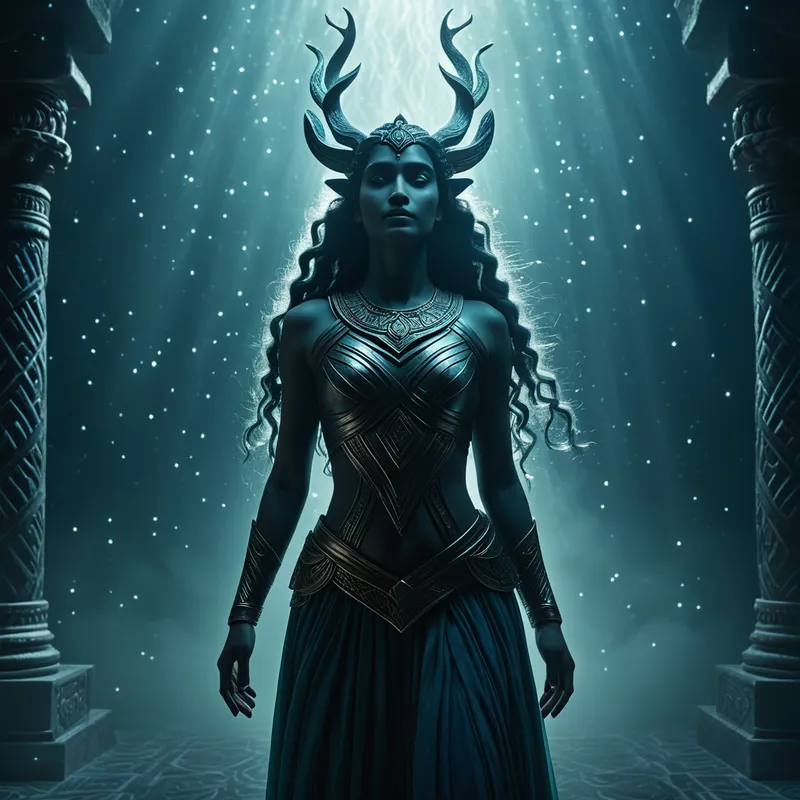
The Sacred Architecture: Dreams of Religion and the Psyche’s Search for Meaning
The Somatic Echo
It begins not as a thought, but as a pressure. A weight in the chest, dense and ancient, like a cornerstone laid by hands you never knew. It is the somatic echo of religion in dreams: a profound gravity, a pull toward something vast and structured that exists both within and beyond you. You might feel it as a tightness in the throat—the unsung hymn, the unspoken prayer. Or as a hollow ache in the solar plexus, the altar where you were taught to place offerings that never quite sated the hunger. This is the body remembering its catechism of belonging and exile, of awe and terror, long before the mind conjures the image of a church, a mantra, or a god. It is the architecture of the soul feeling its own walls, testing its own foundations for cracks of light or fault lines of doubt.
The Dreamer’s Log
I stood before a colossal, locked door in a silent cathedral. In my hand was a single, ornate key that felt both alien and intimately mine. I knew it would fit, but a deep, somatic dread held my arm frozen at my side—the fear wasn’t of what was behind the door, but of the irrevocable act of turning the key myself.
Here, the dream presents the alchemical moment where received faith must become personal revelation; the key of sovereign choice is offered, and the terror of using it is the final idol to be dissolved.

The False Lead
A dream of religion is rarely a simple message to adopt or abandon a creed. It is not a divine endorsement of your current path, nor is it a supernatural warning of apostasy. To interpret it as such is to remain within the very system of external authority the dream often seeks to interrogate. The anxiety you feel is not about theological error, but about the terrifying responsibility of your own inner authority. The dream is not concerned with the content of belief, but with the structure of your believing—the internal cathedral you have inherited, and the parts of your own spirit you have entombed within it to keep the peace.
Psychological Architecture
This is the deepest shadow work: the excavation of your personal myth from the collective bedrock. We are born into psychic structures—familial, cultural, religious—that provide meaning, order, and container. Individuation in this realm is a perilous deconstruction. It requires you to enter the inner sanctum not as a supplicant, but as a sober architect. You must meet the internalized high priest who demands obedience, the exiled heretic who holds your forbidden questions, and the innocent child who just wants to feel held by something bigger than itself. This is Internal Family Systems played out on a cosmic scale. The goal is not to destroy the temple, but to reclaim its blueprints, to see which walls are load-bearing soul and which are mere theater, erected to manage a fear of the infinite void. The grief here is for the lost simplicity of handed-down answers. The terror is the vertigo of an open sky where a ceiling used to be.
Mythic Resonance
Consider the story of Theseus in the Labyrinth. He enters a constructed, ritualized space of terror (the imposed religious structure) not to worship the Minotaur at its center, but to confront and slay it. He does so only by holding the thread given to him by Ariadne—a symbol of connection to a wisdom that is intuitive and relational, not dogmatic. The labyrinth is not evil; it is a complex system. The work is to navigate it with a new kind of guidance, to face the monstrous shadow at its heart (the devouring, unquestioned aspect of the dogma), and to re-emerge, forever changed, into the world. Similarly, the Buddha under the Bodhi tree embodies this theme. He sits within the structure of ascetic practice, faces the armies of Mara (personifications of doubt, desire, and fear), and does not call upon an external god for deliverance. He touches the earth itself, claiming his own embodied experience as his witness and authority, and in that moment, achieves enlightenment. The external framework of seeking dissolves into the internal fact of knowing.
Symbolic Nodes
- Churches, Temples, Mosques, Zendos: The architecture of containment and collective belief.
- Altars, Prayer Mats, Ritual Objects: Sites of transaction with the divine, representing your personal practice of meaning-making.
- Scriptures, Holy Books, Illuminated Text: Codified knowledge; the letter of the law versus the spirit.
- Clergy, Gurus, Priests, Prophets: Personifications of spiritual authority, intermediary figures between you and the numinous.
- Empty Religious Spaces: The feeling of structure without presence, dogma without spirit.
- Heretical Acts or Blasphemy: The rebellious Self breaking taboo to reclaim direct experience.
- Natural Sites as Cathedrals (Forests, Mountains, Caves): The bypassing of man-made structure for direct, animistic revelation.
Archetypal Resonance
The Magician Archetype is the prime mover in dreams of religion. The Magician’s core desire is to understand the fundamental principles of the universe and to enact transformation according to that will. This is the essence of the religious impulse: to comprehend the sacred order and to align with it. The somatic echo—that pressure of profound meaning—is the Magician sensing the latent power in the unseen structure. The alchemical potential lies in the transition from the Shadow Magician—the manipulator who uses ritual, dogma, or guilt as spells to control oneself or others—to the integrated Magician. The integrated Magician performs the ultimate act of sorcery: transmuting inherited, external doctrine into a lived, internalized philosophy. They no longer recite the incantation; they become the source of the word. The locked door in the dreamer’s log is the Magician’s final test: to use the key (will) and claim the sanctum as their own conscious creation.
The Alchemical Process
The transmutation here is from Doctrine to Gnosis. The prima materia is the heavy, leaden weight of internalized dogma—the “shoulds” and “musts” of belief. The alchemical fire is applied through the intense, sustained heat of sovereign questioning. This is not cynical doubt, but a sacred curiosity that holds each inherited belief in the crucible of personal experience and asks: “Does this ring true in the deepest chamber of my soul? Does this structure enlarge my spirit or imprison it?”
The pressure is the unbearable tension of living in the liminal space—no longer a faithful child of the old system, not yet a confident citizen of a new, self-authored one. This is the nigredo, the dark night of the soul, where all former certainties blacken and dissolve. The albedo appears when you begin to distinguish the pure, white essence of your own authentic longing for the sacred from the colored pigments of cultural conditioning. The final rubedo, the red gold of gnosis, is not a new set of answers. It is the embodied, fiery confidence in your own capacity to seek, to question, and to find meaning directly—to have a personal relationship with the mystery, however you conceive it. The structure becomes a conscious choice, not an unconscious inheritance.

The Integration Protocol
Question 1: When have I felt the most profound sense of sacred connection or awe in my waking life? Was it within a traditional religious structure, or outside of it? What were the conditions that allowed that feeling to arise?
Question 2: What is one "article of faith" I inherited (about divinity, sin, prayer, my own nature) that I have never genuinely, from my core, questioned? What fear holds that question at bay?
Question 3: If my psyche is a sacred space, what part of me feels like the high priest guarding the rituals? What part feels like the exiled heretic? What would a conversation between them sound like?
Action 1 (Somatic Grounding): When you feel the "weight" of this theme, place a hand on your heart and a hand on your belly. Breathe deeply into that pressure. Instead of trying to think your way out of it, silently ask: "What does this weight most need from me right now?" Listen not for words, but for shifts in sensation—a release of tension, a warmth, a sigh. The body's intelligence often speaks first.
Action 2 (Creative Unbuilding): Take a large sheet of paper. Draw the outline of a building that represents your internal "house of belief." It can be a church, a library, a labyrinth, anything. Now, with a different colored pen, mark the rooms. Label them: "Room of Forbidden Questions," "Chamber of Comforting Rituals," "Dungeon of Exiled Doubts," "Tower of Personal Revelation." This is not analysis; it is cartography of your inner sacred architecture.
Action 3 (Ritual of Re-consecration): Choose a small, daily action that you typically do on autopilot (making tea, walking to your door, opening a window). For one week, perform this action as a conscious ritual. Before you begin, pause. Set a simple, silent intention: "I perform this act to remind myself that meaning is made, not given." Feel the shift from passive habit to active, mindful creation. You are practicing being the Magician of your own mundane sacrament.
Final Validation
It is a terrifying and lonely work, to dismantle the only lighthouse you have ever known, even as you stand in the dark. Honor that fear; it is the proof of the structure's once-necessary shelter. But know this: the dream does not show you religion to chain you back to an altar. It shows you religion to remind you that you contain the sacred. The cathedral you dream of is not out there. Its foundations are in the marrow of your bones, its spire in the reach of your consciousness. The key has always been in your hand. The integration is the slow, courageous turn of the wrist, the groan of the hinge, and the step you take across the threshold into the vast and holy space of your own authority.