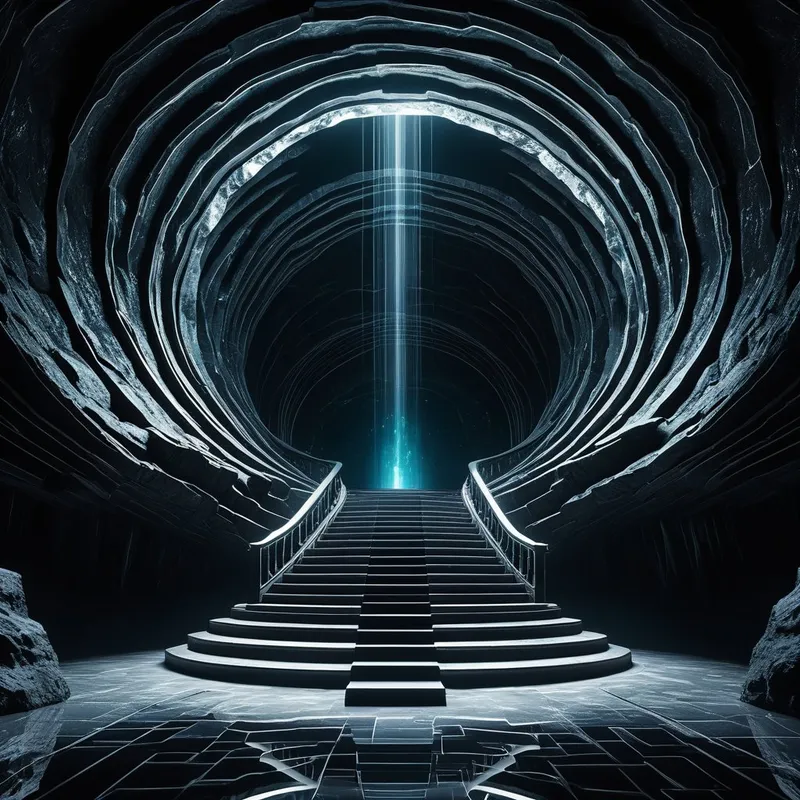
The Alchemy of Regression: When the Dream Calls You Back
The Somatic Echo
It begins not as a thought, but as a gravity. A slow, dense pull in the solar plexus, a familiar ache in the jaw you thought you’d unclenched years ago. The body remembers the old architecture before the mind can name it. There is a taste of copper, a scent of damp earth and old paper—not a memory, but a present-moment echo. The shoulders may round forward, not in defeat, but in recognition, as if bracing to enter a familiar, low-ceilinged passage. This is the somatic signature of Regression/Return: the visceral, often unwelcome, recollection of a self you believed was archived. It is the feeling of the foundation shifting beneath the floor you just finished polishing, revealing not a flaw, but a deeper, older layer waiting to be integrated.
The Dreamer's Log
The dreamer stands in a vast, derelict data-center, the air thick with the hum of forgotten machines. Rows of obsolete server racks stretch into darkness, coated in grey dust. On a single, flickering terminal screen, a command prompt blinks, awaiting an input they no longer remember. In their hand, they find a small, cold, silver key.
Alchemical Interpretation: The psyche is signaling that a crucial piece of personal code—an old way of knowing, a dormant capacity—has been left running in a deprecated system, and sovereignty requires its conscious retrieval and integration.

The False Lead
This is not failure. To mistake the dream of return for a sign of personal bankruptcy is the first and most painful error. It is not evidence that your progress was an illusion, nor is it a cosmic sentence to relive your past. The theme of Regression/Return is distinct from mere nostalgia or traumatic flashback; it is not a passive rerun but an active, purposeful retrieval mission. The psyche does not send you back to be punished, but to reclaim. It is a structural recalibration, not a collapse.
Psychological Architecture
Beneath the surface terror of "going backwards" lies the profound Shadow work of Individuation. We are not unitary beings, but internal families, constellations of sub-personalities formed in response to the world. To survive, we often exile members: the too-vulnerable child, the fiercely angry protector, the wildly creative spirit deemed impractical. We build a life atop this burial ground. The dream of return is the exiled part pounding on the floorboards of consciousness. It is the Self, the central organizing principle, initiating a depth-psychological operation to reclaim these disowned fragments. The journey back is not a retreat of the ego, but an advance of the whole being. You are being called to descend not into your past, but into your foundations, to meet the ghosts not as hauntings, but as constituents.
Mythic Resonance
This is the universal firmware of descent and retrieval. In the Mesopotamian epic, the goddess Inanna must pass through seven gates to the underworld, stripped of every emblem of her queenly power, to meet her shadow sister, Ereshkigal. She goes not to conquer, but to witness a funeral—a profound regression to a state of raw, hung flesh. Her return, facilitated by allies, is not a restoration of her old self, but a resurrection that now includes the knowledge of the depths. Similarly, the alchemical Nigredo, the blackening, is not an end but the essential first stage where the prima materia dissolves into chaotic, primal unity, without which no transmutation is possible. The myth is not about the fall; it is about the necessary un-becoming that precedes a more complete becoming.
Symbolic Nodes
- Childhood homes, especially basements, attics, or specific, charged rooms.
- Old schools, lockers, desks, or facing a forgotten test.
- Obsolete technology: rotary phones, cassette tapes, flickering CRT monitors.
- Recurring landscapes from an earlier life, now empty or subtly distorted.
- Encountering a younger version of oneself, often silent or asking a simple question.
- Lost objects—keys, rings, specific books—resurfacing in mundane places.
Archetypal Resonance
The Orphan Archetype is the primary conductor of this theme’s energy. Not its shadow aspect of Victim, but its core essence as the Realist and the Survivor. The Orphan knows the terrain of exile intimately. Its somatic echo is that deep, gravitational pull toward the abandoned place, the honest ache of separation. It does not sugarcoat the journey. Its alchemical potential lies in its profound, unflinching truth: to become whole, you must acknowledge what was left behind. The Orphan’s return is not a cry for pity, but a gathering of evidence—the scattered, authentic pieces of a self that adapted to survive. It is this archetype that provides the courage to turn and face the forgotten server room, not as a failure, but as the holder of essential data.
The Alchemical Process
The transmutation here is one of Reclamation and Re-membrance (literally, putting the members back together). The intense heat and pressure—the solve et coagula—is applied by the sheer tension between your current, sophisticated identity and the raw, archaic material that surfaces. The grief is for the time lived in exile. The terror is of disintegration. The alchemical fire is the conscious, compassionate attention you must bring to these returning fragments. You must hold the space as the old, brittle structures of "who I am now" dissolve in contact with "who I was then." The pressure is to resist the ego’s frantic urge to re-bury the material and instead, to listen. The sovereign gold forged in this process is Authentic Foundation: a self built not on the graves of its exiles, but with their reclaimed strengths integrated into its structure. You do not go back to live there; you return to bring its resources forward.

The Integration Protocol
Question 1: What specific quality—a vulnerability, a passion, a wildness, a simplicity—did I learn to exile or deprioritize at the time the dream landscape references?
Question 2: How is that exiled quality secretly trying to serve or protect me now, even through the uncomfortable symptom of its return?
Question 3: If this returning fragment were a member of my internal family, what would it need from me now to feel heard, safe, and valued?
Action 1 (Somatic Anchoring): When the somatic echo of regression arises, place a hand on the area of sensation. Breathe into it, not to change it, but to acknowledge its presence. Silently state: "You are here. I am here with you." This grounds the psychic pull in present-moment awareness.
Action 2 (Unstructured Reclamation Writing): Set a timer for 10 minutes. Write from the perspective of the lost object, the younger self, or the empty room in your dream. Do not craft a narrative. Let it speak in fragments, demands, memories, or pure sensation. The goal is expression, not analysis.
Action 3 (Ritual of Forward Integration): Find a small, physical token that symbolically connects to the dream’s regression (a stone, an old key, a specific leaf). Carry it with you consciously for a day. At day’s end, place it somewhere in your current living space where you will see it regularly, formally welcoming its energy into your present life.
Final Validation
The path of return is the most counter-intuitive courage. It feels like a defeat precisely because it is the ego’s project that is being humbled. Honor the difficulty. The disorientation is a sign that deep work is underway, not that you are failing. You are being asked to trust a intelligence deeper than linear progress—the psyche’s own compass, pointing unerringly toward the missing pieces of your wholeness. This regression is, in its truest sense, the only way forward.