
The Alchemy of the Mended Vessel: Dreams of Recovery & Healing
The Somatic Echo
Before the mind can articulate the concept of healing, the body broadcasts its necessity in a language of sensation. It is not the sharp cry of fresh injury, but the deep, resonant ache of a structure that has borne weight for too long. It feels like a hollow space within the ribcage that echoes with every heartbeat, a phantom limb of a lost vitality. It is the specific fatigue that sleep does not touch—a weariness in the marrow, not the muscle. The somatic echo of recovery is a profound, cellular homesickness for a state of integrity you have perhaps never known, but which your entire being recognizes as its birthright. It is the quiet, persistent hum of a system running a self-diagnostic, finding fractures in the foundation and whispering, This must change.
The Dreamer's Log
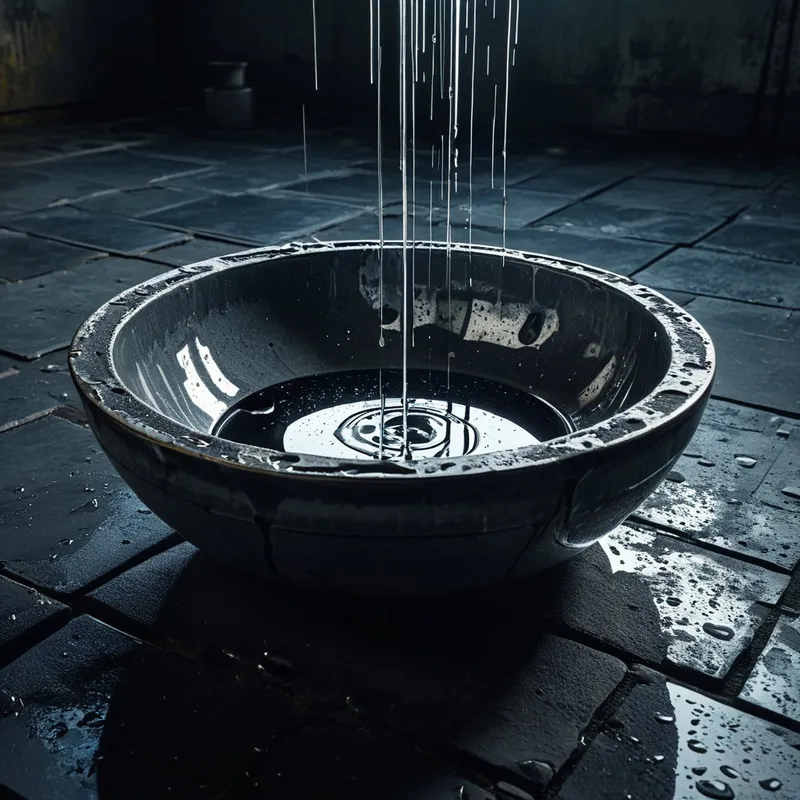
The dream is always the same: I am in a vast, derelict factory, all rust and echoing drip. In the center of a concrete floor, slick with condensation, sits a simple ceramic bowl, cracked clean through. From a broken pipe high in the shadows, a single, heavy drop of liquid silver falls, timeless and precise, landing in the bowl’s center. It does not overflow. It does not repair the crack. It simply fills, drop by infinite drop, the vessel that is already broken.
Alchemical Interpretation: The psyche is not seeking to erase the fracture, but to learn how to hold a new, more potent substance within the truth of its brokenness.
The False Lead
Recovery in dreams is not the fantasy of a painless return to a previous, unscarred state—that is the siren song of the Shadow Innocent, promising a denial that only deepens the wound. It is not a linear progression of "bad days" giving way to "good days" on a predictable chart. To mistake this process for mere symptom management or a stroke of fortunate "feeling better" is to confuse the rebuilding of a cathedral with the application of a fresh coat of paint. True healing is a structural renovation, often invisible from the street, occurring in the load-bearing walls of the soul. The dream is not reporting on convalescence; it is conducting the blueprint for metamorphosis.
Psychological Architecture
This is the slow, deliberate work of the internal mason. From the perspective of depth psychology and Internal Family Systems, the psyche is not a monolithic self but a constellation of parts. The part that was wounded—the Exile—holds the raw memory, the grief, the terror. Around it, other parts have formed like scar tissue: Managers who strive for perfect control to prevent re-injury, and Firefighters who numb or distract with intensity when pain flares.
Dreams of recovery signal the Self—the core, compassionate consciousness—beginning to approach this inner citadel of pain not as a problem to be solved, but as a child to be welcomed home. It is the agonizing, tender process of differentiation: learning that you are not the wound, you are not the frantic manager, you are not the numb firefighter. You are the space in which all these parts exist. Healing is the act of extending sovereignty back over these disowned territories, not by force, but by presence. It is the reintegration of the exile, which transforms the protectors from desperate jailers into honored members of the inner council.
Mythic Resonance
This architecture is etched into our collective firmware. Consider the myth of the Wounded Healer, epitomized by Chiron the centaur. Struck by a poisoned arrow, Chiron suffers an incurable wound. His greatness does not come from having the wound magically removed, but from the profound, empathetic wisdom his eternal suffering grants him, making him the greatest teacher of healers and heroes. His wound is not a flaw to be hidden; it is the very source of his authority. Similarly, the Phoenix does not simply heal its burns; it must be wholly consumed by the transformative fire, its old form utterly annihilated, before it can rise renewed from the ashes. Both myths reject mere mending in favor of alchemical rebirth—the wound or the fire is the necessary catalyst for becoming something entirely new.
Symbolic Nodes
- Mending Objects: Knitting, weaving, glue, solder, sutures.
- Slow Processes: Tides filling a bay, roots cracking stone, moss growing over ruins, sap sealing a tree's wound.
- Contained Vessels: Bowls, cups, basins, crucibles (holding the transformative substance).
- Sanctuaries: Greenhouses, quiet libraries, warm kitchens, sheltered grottos.
- Guides: Often non-human—a patient animal, a steadfast tree, a guiding light, a deep well.
Archetypal Resonance
The energy most active in the theme of profound recovery is The Creator Archetype.
This may seem counterintuitive; we often relegate healing to the Caregiver. But the Caregiver tends to the existing form. The Creator is summoned when the existing form is insufficient and must be re-imagined from the ground up. Its core energy is not comfort, but genesis. The somatic echo of hollow ache is the Creator’s blank canvas, the void from which new order must be born. Its alchemical potential lies in its ability to use the raw materials of fracture, grief, and memory not as waste, but as the essential pigments and textures for a new self-portrait. The Shadow Creator—the Mad Scientist or Self-Centered Artist—lurks here too, threatening a sterile, isolated reconstruction divorced from humanity, or an endless, narcissistic rehashing of the wound as the sole subject. The true Creator integrates the wound into the masterpiece, making it meaningful, not central.
The Alchemical Process
The transmutation here is from Scattered Fragment to Integrated Vessel. The prima materia, the leaden base substance, is the identity of "the wounded one"—a self-concept built around fracture, defined by what was done to it. The required heat and pressure is the unbearable tension of holding two contradictory truths simultaneously: I am hurt and I am whole. This is the psychological crucible.
One must fully feel the grief, the rage, the terror of the exile (the solve—the dissolving) without becoming it. This is the heat. Then, one must consciously, patiently, begin to relate to those feelings from the seat of the Self, the observing, compassionate awareness (the coagula—the coagulating). This is the pressure. The transformation occurs not when the pain vanishes, but when its energy is repurposed. Grief becomes depth of compassion. Rage becomes boundaries of steel. Terror becomes a heightened sensitivity to beauty. The shattered pieces are not discarded; they are painstakingly reassembled into a mosaic, with the cracks filled with gold—the Japanese art of kintsugi. The vessel becomes more valuable, more complex, and more uniquely itself for having been broken.

The Integration Protocol
Question 1: In the landscape of your body, where do you feel the most persistent "hollowness" or ache? If that space had a texture, a temperature, and a quiet message for you, what would they be?
Question 2: What is one old story about yourself ("I am fragile," "I must always be in control") that your recent pains or struggles have completely shattered? Can you feel the empty space where that story used to live?
Question 3: If your current process of healing had to be governed by one natural law (like erosion, photosynthesis, or tidal pull) rather than a human goal, which law would it be and why?
Action 1 (Somatic Cartography): For one week, carry a small notebook. Three times a day, pause and scan your body. Do not analyze, just feel. Note the single most prominent sensation (e.g., "tightness behind sternum," "hollowness in belly," "warmth in palms"). Write only the sensation and the time. Do not interpret. This builds a non-judgmental relationship with your somatic echo.
Action 2 (Vessel Creation): Find or make a physical vessel—a bowl, a cup, a small box. Over the course of a month, place inside it small objects, notes, or images that represent not your pain, but the qualities emerging from your pain (e.g., a smooth stone for newfound resilience, a feather for unexpected lightness, a scrap of velvet for self-tenderness). Let the vessel become a temple to your transformation, not a shrine to your wound.
Action 3 (Kintsugi Narrative): Write a short story or parable. The protagonist is not a person, but an object that has been broken (a vase, a bridge, a key). Describe its breaking not as a tragedy, but as the necessary event that allowed it to be reassembled into a new form with a new, more profound purpose. How does its function change? What new substance (your "gold") holds it together now?
Final Validation
This work is not for the faint of heart. To choose to heal is to choose to feel the full weight of what was previously too heavy to hold. It is to become the architect of your own ruins and the gardener of your own scorched earth. There will be days when the hollow ache feels like the only truth, and the mending seems a cruel, distant fiction. Honor those days. The depth of that feeling is the measure of the sovereignty you are reclaiming. You are not fixing something that is broken. You are conducting a silent, cellular revolution. You are learning the most radical act: to be a sanctuary for every part of yourself, especially the ones that believe they are beyond repair. The dream is your co-conspirator in this quiet coup, handing you the blueprint, drop by silver drop. All you must do is agree to hold the vessel.