
The Alchemy of Proximity and Distance
The Somatic Echo
Before the mind can articulate a story of nearness or farness, the body knows the map. It is a geography of tension. Proximity hums in the chest as a magnetic pull, a warmth that gathers behind the sternum, a leaning-in of the entire organism. It can feel like gravity, an undeniable orbital force drawing you closer to a center—a person, a memory, a version of yourself left behind.
Distance, its twin, registers as a hollowing. A cold draft through the ribs. A phantom limb sensation where connection once was. It is the ache of a stretched tendon, the subtle tremor in the hands that once held something solid. This is not mere loneliness; it is the somatic signature of a psychic architecture rearranging itself. The space between here and there becomes electrically charged, a field where longing and autonomy crackle against one another. To dream of this theme is to feel the psyche measuring its own dimensions, testing the tensile strength of its bonds and the vastness of its inner wilderness.
The Dreamer's Log
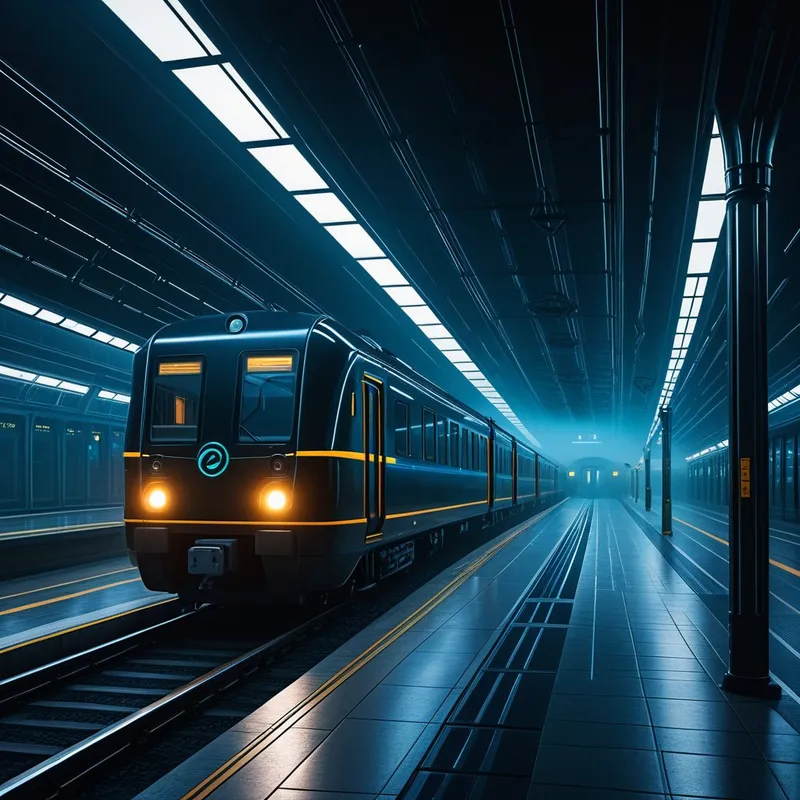
I am standing on an endless platform. A train of dark, polished obsidian is idling, its doors open, pouring out a warm, honeyed light. I know I must board it to reach someone vital, but my feet are fused to the concrete. With each attempt to will myself forward, the platform elongates, stretching the distance to the carriage into a impossible, fog-choked corridor. The train does not leave; it waits, a silent, glowing promise just beyond reach.
This dream is an alchemical vessel where the raw ore of yearning meets the immutable law of internal resistance, heating both into a conscious dilemma.
The False Lead
This theme is not about circumstantial loneliness or the simple logistics of geography. It is not a diagnosis of a "fear of intimacy" or a "commitment issue" as pop psychology might lazily declare. To misinterpret it as such is to mistake the symphony for a single note. The dynamic of proximity and distance in dreams speaks to a fundamental structural relationship within the psyche itself. It is about the negotiation between parts of the self that crave merger and parts that demand sovereignty. The terror is not of another person, but of the dissolution of a familiar self-boundary. The grief is not for an external other, but for an internal connection that has been lost or must be consciously severed for growth to occur.
Psychological Architecture
Beneath the dream narrative lies the silent, strenuous work of Shadow and Individuation. Consider the psyche as an internal family system. There exists an exiled part—perhaps the Orphan, the vulnerable child—that clamors for proximity, for the safety of enclosure within another. Its opposite is a vigilant protector, a Rebel or a Shadow Ruler, that enforces a rigid distance, equating closeness with engulfment and annihilation. The dreamscape becomes the negotiating table.
The alchemical process here is one of recognition without fusion. It is the arduous task of bringing the lonely exile and the rigid sentinel into the same room of awareness, allowing each to voice its terror. The individuating Self must learn to hold proximity internally—to be a sanctuary for its own orphaned fragments—while simultaneously maintaining a conscious, chosen distance from patterns, identities, and external pulls that threaten its nascent sovereignty. The architecture shifts from one of exile and defense to one of conscious, fluid boundaries. You are not building a higher wall or tearing one down; you are learning to be the gatekeeper who knows when to open, when to close, and when to simply sit at the threshold and witness the landscape.
Mythic Resonance
This tension echoes in the very firmware of our stories. Recall the myth of Orpheus and Eurydice. His journey to the underworld is the ultimate quest for proximity, to bridge the ultimate distance of death itself. The gods grant his plea, but with a condition that encodes the paradox: he can lead her back, but he must not look. He must hold her in faith, not in sight. The glance over his shoulder is not doubt of her, but a failure to hold the tension of a nearness that cannot be confirmed, a proximity that must be felt in the soul rather than grasped by the senses. He enforces a fatal distance by demanding a concrete proof of proximity. The myth does not judge him; it maps the exquisite, tragic impossibility of the human heart, which longs to collapse distance even when the soul’s evolution requires its respectful observance.
Symbolic Nodes
Dreams speak in the poetry of the senses. Common images for this theme include: Elongating hallways or stretching roads; Vehicles that will not start, or depart without you; Transparent barriers—glass walls, thin membranes, force fields; Figures seen across vast, empty plazas or through windows; Telephones with dead air or distorted voices; Magnets that alternately attract and repel; Tides receding just as you reach the water’s edge. Each is a glyph of the fundamental push-pull, a symbol of the charged field between self and other, between the current self and the self it is becoming.
Archetypal Resonance
The energy of this theme resonates most deeply with The Lover Archetype. The Lover’s core drive is for connection, communion, and the ecstatic blurring of boundaries in passion, beauty, and intimacy. In its shadow aspect, this drive distorts into obsession, promiscuity (emotional or physical), or a clinging fusion that fears any separation as death.
The somatic echo of this theme—the magnetic pull and the hollow ache—is the pure language of the Lover. The alchemical potential lies in the Lover’s capacity to value connection so profoundly that it learns to distinguish between true intimacy and possessive merging. The heat of this process forces the Lover to transform its yearning from a demand for external union into a capacity for internal wholeness, which then allows for a mature, chosen closeness that honors the sacred distance inherent in the other’s sovereignty. The dream’s tension is the Lover’s soul-craft, learning to hold the beloved—whether person, project, or self-part—in a space of reverence that includes both nearness and separateness.
The Alchemical Process
The transmutation here is from Dependency/Aversion to Conscious Relating. The prima materia, the base matter, is the raw, reflexive swing between clinging and fleeing. The alchemical fire is applied through the sustained, uncomfortable awareness of this pendulum swing within yourself. It is the heat of noticing the clutch of anxiety when someone is too far, and the claustrophobic revolt when they are too near.
The pressure is the conscious refusal to act on either impulse immediately. You must hold the tension. In this pressurized container, a separation occurs: the pure gold of your genuine desire for connection rises, distinct from the leaden fear of abandonment. Simultaneously, the clear crystal of your need for autonomy clarifies, separate from the brittle fear of engulfment. The solve et coagula—dissolve and recombine—manifests as you learning to offer your connected presence from a place of internal fullness (the redeemed Lover), while maintaining your own form with compassionate firmness. The sovereignty gained is not isolation, but the power to choose how to connect, and from what ground of being.
The Integration Protocol
Question 1: In the dream, what quality of energy did the "distant" object or person hold? Was it alluring, threatening, neutral, or mournful? What does that feeling reflect about a part of yourself or a life dynamic you perceive as currently "out of reach"?
Question 2: Where in your body do you feel the sensation of "needing to get closer"? Where do you feel the sensation of "needing to get away"? Can you allow both sensations to exist simultaneously without choosing one?
Question 3: If the distance in the dream were a form of protection, what is it protecting? If the proximity were a form of nourishment, what part of you is being fed?
Action 1 (Somatic Cartography): For one week, carry a small notebook. Moment-to-moment, note when you feel a subtle pull toward someone or something (a person, your phone, work) and when you feel a subtle push away. Do not analyze, just log the impulse. This maps your unconscious proximity-distance rhythms.
Action 2 (Unstructured Bridge): Set a timer for 15 minutes. With a large sheet of paper and two contrasting colors, let your hand express "proximity" with one color and "distance" with the other. Do not draw objects; allow lines, shapes, blotches, and textures to emerge from the somatic echo. Let them interact on the page. This externalizes the internal negotiation without words.
Action 3 (Threshold Ritual): Choose a doorway in your home. Stand at the threshold. Feel the distinct spaces on either side. Step fully into one, then the other, noting the shift. Then, stand in the doorway itself, belonging to neither space entirely, yet connecting both. Practice holding this "in-between" state for a few breaths, embodying the conscious gatekeeper.
Final Validation
This work is not for the faint of heart. To consciously engage with the dynamics of proximity and distance is to consent to feel the primal ache of separation and the terrifying bliss of connection in their full, undiluted force. It is to stand in the electric field between your own heartbeats. Yet, within this charged space lies your profound agency. You are not a passive passenger on the train or a helpless statue on the platform. You are the architect of the station, the scheduler of the routes, and the one who chooses—moment by moment, relationship by relationship, breath by breath—when to step across the gap, when to honor it, and when to simply rest in the knowledge that true closeness begins with the sovereignty to hold your own ground. The map of your longing is also the blueprint for your wholeness.