
The Dream of Primal Toolmaking
The Somatic Echo
It begins not as a thought, but as a pressure in the bones. A deep, tectonic ache in the wrists, the forearms, the jaw. It is the somatic memory of a weight not yet lifted, of a lever not yet placed. You wake with a phantom grip, fingers curled around an absence that feels more substantial than the air. This is the body’s intelligence speaking in the language of density and resistance. It is the echo of a fundamental impulse: to meet the raw, unyielding substance of your life—your grief, your rage, your potential—and to shape it. To make of the immovable object, a point of purchase. The mind will later conjure images of flint and forge, of handles and edges, but first, the body knows the truth. You are in the pre-verbal workshop of the self, and the material is your own unprocessed experience.
The Dreamer's Log
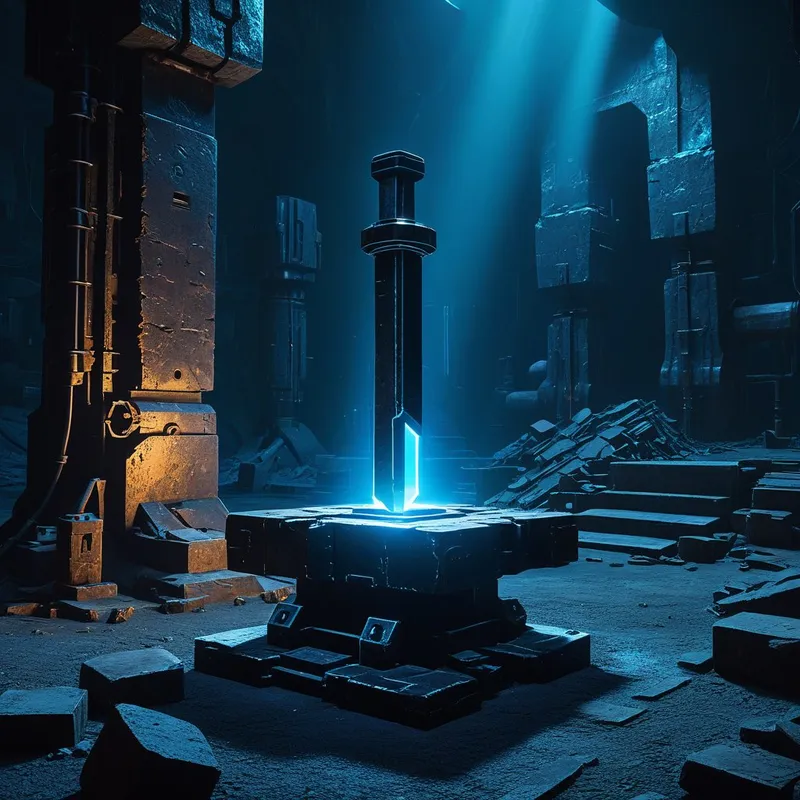
The dream is always the same: a cavern, lit only by the dull red glow of a stone I am holding. My other hand searches the damp floor, finding not a proper hammer, but a heavy, rusted gear from some long-dead machine. I begin to strike the stone against a larger, flat rock. The sound is not a clang, but a deep, resonant thud that vibrates up my arms. With each impact, flakes of obsidian fall away, revealing not a spearhead or an arrow, but a crude, asymmetrical blade—a tool with no clear name, for a task I do not yet know.
This is the alchemy of necessity: the psyche, confronted with a problem of its own ancient making, scavenges the ruins of outdated identities to forge a new, essential function.
The False Lead
This is not a dream of simple problem-solving or acquiring external skills. To interpret it as a call to take a woodworking class or to “get better tools” for your job is to mistake the profound for the practical. It is not about adding something to your repertoire from the outside. This is the opposite of consumerism. It is about the terrifying, glorious realization that the existing tools—the coping mechanisms, the inherited beliefs, the polished personas—have shattered against the bedrock of a new reality. The dream is not about the tool, but about the making. The grief you feel is not for the broken hammer, but for the death of the hand that believed it knew how to hold one.
Psychological Architecture
Here, in the shadowed workshop, the work of Individuation becomes visceral. You are not assembling a pre-fabricated self from a kit. You are reducing yourself to constituent parts—to the flint of your core trauma, the ore of your neglected passion, the scrap metal of your abandoned projects. The Shadow here is not a monster to be slain, but the pile of discarded, “useless” material. The bitterness you refuse to feel? That is the carbon that will harden the steel. The childish fantasy you’re ashamed of? That is the unique shape of the handle. Primal toolmaking is the psyche’s declaration of sovereignty over its own raw material. It is the slow, painful process of ceasing to look for the right answer in the world, and beginning to forge the right question from the substance of your own being. You become both the ore and the smith, the problem and the uniquely fitted implement that can address it.
Mythic Resonance
We see this firmware update in the tale of Prometheus, but not in his theft of fire. We see it in his punishment: chained to the rock, his liver devoured daily, only to regenerate each night. The eternal, agonizing cycle is the ultimate primal toolmaking. His body itself becomes the tool—the anvil, the ore, and the regenerative process—through which consciousness (the fire he gave) is continually, painfully integrated. It is not a gift given once, but a process endured forever. Similarly, in the Norse myths, the dwarven smiths forge world-altering tools—Thor’s hammer, Odin’s spear—from materials that are themselves mysteries: the sound of a cat’s footfall, the breath of a fish. The instruction is clear: the components of your most powerful implements are not the obvious, heavy things, but the intangible, overlooked frequencies of your own experience—the quiet grief, the suppressed joy.
Symbolic Nodes
- Finding a Rusted/Outdated Tool: An old identity or coping mechanism that must be repurposed, not used as-is.
- Striking Stone on Stone: The friction between two rigid, unconscious aspects of the self, creating a spark of awareness.
- An Asymmetrical/Unnamed Blade: A new psychological function, born of necessity, that does not yet have a category in the conscious mind.
- A Makeshift Anvil (a flat rock, a piece of industrial scrap): The stable, often painful, point of impact where transformation is forced to occur.
- Raw, Unprocessed Materials (flint, ore, rough wood): Core emotional truths and innate potentials before they are socialized or shaped by others.
Archetypal Resonance
The Creator Archetype is the active force in this dream theme, but it is the Creator in its most fundamental, even brutal, incarnation. This is not the artist awaiting inspiration, but the architect in the rubble after the collapse, forced to use the debris to build a new shelter before nightfall. Its somatic echo is the ache of bringing form from chaos, a deep muscular commitment. Its alchemical potential lies in its utter self-containment; it draws nothing from the outside, relying solely on the integrity of its own vision and the stubbornness of its material. The shadow of the Creator—the Mad Scientist or Self-Centered Artificer—lurks here too, in the temptation to create a tool for domination or to become so enamored with the forging process that you forget the tool must eventually be used in the world. The true Creator of the primal forge understands: the tool’ beauty is its absolute fitness for a purpose born of your own necessity.
The Alchemical Process
The transmutation here is from Passive Endurance to Active Agency. The prima materia is the weight of your own history, the accumulated “rock” of circumstance and conditioning. The heat and pressure are applied by the relentless, unavoidable confrontation with a reality that your old tools cannot shape. This is the nigredo, the blackening: the despair of realizing you are unequipped. The striking of stone on stone is the separatio, violently dividing what is essential (the sharp edge) from what is excess (the flakes that fall away). The forming of the crude tool is the coagulatio—the spirit taking on a usable, though rough, form. The fire is not in a furnace, but in the friction of the work itself, in the heat generated by your own sustained effort against inertia. You do not escape the weight of the material; you learn to wield it as a hammer. The terror of being tool-less becomes the profound sovereignty of being self-made.

The Integration Protocol
Question 1: In my waking life, what is the "flat rock" or "makeshift anvil"—the stable, often uncomfortable, reality against which I am currently being forced to shape myself?
Question 2: What "rusted gear" from my past—an old identity, a discarded skill, a forgotten passion—am I being called to pick up again, not to use as it was, but to repurpose as a hammer for a new kind of work?
Question 3: If the tool I am forging has no known name, what is the first, most basic function it must perform? Is it to cut a tie, to dig a foundation, or to simply create the first mark on a blank surface?
Action 1 (Somatic Mapping): For one week, pay attention to the physical sensations in your hands and forearms when you feel frustrated or creatively blocked. Do not try to change it. Simply note the sensation as the body's memory of "gripping" a tool that isn't there.
Action 2 (Unstructured Material Study): Gather three raw, natural, or discarded objects (a stone, a piece of rough wood, a bent piece of metal). Without a goal, spend 20 minutes simply arranging, stacking, and feeling their weight and texture in your hands. Let your mind wander, but keep your attention on the physical dialogue between your hands and the materials.
Action 3 (Ritual of First Strike): Light a candle in a dark room. Hold two small stones. Speak aloud one rigid belief or old pain that feels like an "unworkable material." Then, deliberately strike the stones together once. Blow out the candle. Sit in the darkness and the echo of the sound. The act is complete; you have initiated the process.
Final Validation
The ache in your hands upon waking is real. The frustration of fumbling with materials that refuse to conform is valid. This is not a dream of easy mastery, but of hard-won competence earned at the most fundamental level. It confirms the difficulty of your becoming. Yet, within that validation lies your empowerment: you are not waiting for a savior to bring you a key. You are in the dark, learning the weight of the rock that will become your keystone. You are not tool-less. You are in the profound, sacred, and messy process of becoming your own forge. The first tool you make will be clumsy. It will be yours. And it will be enough to begin the real work.