
The Dream of Practical Application: From Blueprint to Bone
The Somatic Echo
It begins not as a thought, but as a weight. A density in the palms, a low-grade hum in the marrow of the forearms. It is the somatic memory of a tool not yet lifted, a tension in the shoulders that anticipates a load they are not yet bearing. This is the echo of potential force, a kinetic energy trapped in stasis. You feel it as a peculiar restlessness in the solar plexus—not the flutter of anxiety, but the deep, rhythmic thrum of an engine idling. The body knows a truth the mind has yet to articulate: you possess a blueprint. You have absorbed the theory, glimpsed the vision, felt the insight resonate in your chest like a struck bell. But now, the bell’s pure tone has decayed into a silence that demands to be filled with action. The echo is the ghost of the next step, haunting the muscles before they move. It is the ache of a bridge not yet built between the island of understanding and the mainland of your daily life.
The Dreamer's Log
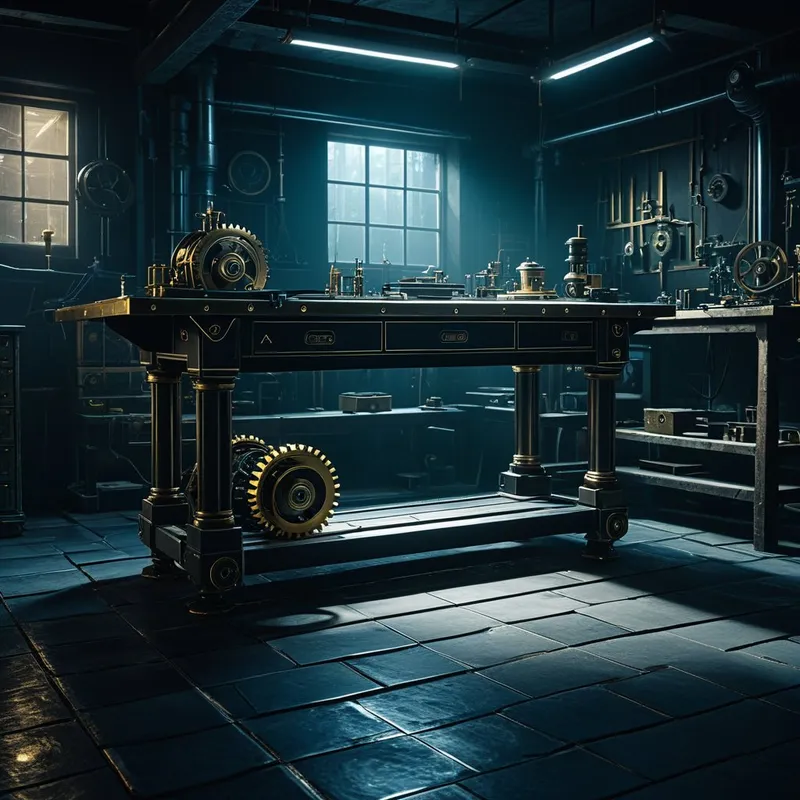
The workshop is always dim, lit only by the cold glow of a single fixture above a vast steel table. On it lies a device of breathtaking complexity—interlocking gears of blackened brass, filaments of copper woven into impossible circuits, a core of smooth obsidian. I know its function with absolute certainty; it is meant to harmonize a dissonance I feel in the world. My hands move with instinctual knowledge, yet every component I pick up feels both familiar and alien. I am on the cusp of the final connection, the act that will bring it to life, when I realize a crucial, tiny piece—a crystalline resonator—is missing from the organized trays beside me. The dream ends in the silent search through drawers of shadow.
The alchemical interpretation: The dream reveals the final stage of synthesis, where embodied knowledge confronts the one missing piece of self-trust required to activate the whole.
The False Lead
This theme is not a mere to-do list from the subconscious, nor is it a punishment for procrastination. To mistake it for simple "productivity anxiety" is to confuse the architect’s profound frustration with the laborer’s fear of the clock. The terror here is not of work, but of wrong work—of applying a sacred, hard-won insight in a way that betrays its essence, that reduces a soul-alchemy to a petty transaction. It is the fear that the translation from inner truth to outer form will inevitably corrupt it. The dream is not nagging you to "use" your gifts for external validation; it is initiating you into the responsibility of incarnation. The false lead is believing the blockage is a lack of skill or resource, when it is almost always a protective part of the psyche—a loyal inner guardian—fearing the seismic changes that true application will unleash upon your carefully ordered world.
Psychological Architecture
Beneath the dream of the unfinished device lies a deep structural shift in the internal family system. The "Exiles"—those wounded, creative, or visionary parts of you that hold the raw insight—have been heard. The "Managers"—the parts that run your daily life with efficiency and caution—have, reluctantly, cleared a space on the workbench. Now, the "Firefighters," the parts that rush in to douse any spark that threatens the status quo with chaos, are whispering that the missing piece is a flaw in you, not a step in the process. This is the Shadow work: to witness this internal council not as a failure, but as a delicate negotiation of sovereignty. Individuation here is the act of becoming the conscious foreman of this inner workshop. It is claiming the authority to say to the fearful protector, "I see your concern for our safety. Stand watch, but do not withhold the tools." It is the slow, deliberate integration where the visionary (the one who sees the device) and the artisan (the one whose hands must build it) recognize they are, and always have been, the same being. The psyche is restructuring from a kingdom of disparate specialists into a unified, self-governing republic.
Mythic Resonance
We see this eternal drama in the figure of Hephaestus, the Olympian smith. Cast out from Olympus for his imperfection, he does not merely languish; he descends to his volcanic forge. There, in the heat and isolation, he transforms his exile into application. His lameness is not overcome; it becomes the grounding stability from which he works. He does not dream of beautiful armor; he makes it, imbuing each piece with function and mythic purpose. His story is not one of triumphant return to the party on the hill, but of becoming indispensable through the silent, practical magic of manifestation. The myth whispers: the application is the belonging. Similarly, the Golem myth of Jewish mysticism speaks to this theme—the profound responsibility and terror that comes when theoretical wisdom (the written shem) is practically applied to animate clay into life. The lesson is not in the creation, but in the integration of that creation into the fragile world.
Symbolic Nodes
- Unfinished Crafts or Devices: Half-built engines, incomplete sculptures, puzzles with one missing piece.
- Tools in Disarray or Misapplied: A chisel used to stir soup, a surgical scalpel lying in garden soil.
- Blueprints & Schematics: Maps to nowhere, instructions in a fading ink, diagrams that fold in on themselves.
- Empty Foundations or Frames: The skeleton of a house with no walls, an empty pedestal, a loom with no thread.
- Barren Laboratories or Workshops: Immaculate, sterile spaces devoid of any experiment or project.
Archetypal Resonance
The energy here is most purely that of The Creator Archetype. This is not the Creator in its initial, ecstatic inspiration phase, but in its most mature, grounded, and demanding expression. The somatic echo—the weight in the hands—is the Creator moving from vision to vessel. The psychological architecture is the Creator’s workshop, where chaos of idea meets the order of form. The alchemical potential lies in the brutal, beautiful friction of that process. The Shadow Creator, as the self-centered perfectionist or the "mad scientist," manifests in the dream as the endless preparation, the obsessive search for the one perfect missing component, which is ultimately a fear of releasing the creation into an imperfect world. The active Creator archetype resolves this by embracing the sacred compromise: that true creation is an act of love, not control, and its application is a dialogue with reality, not a imposition of fantasy.
The Alchemical Process
The transmutation here is Coagulation—the alchemical stage where the dissolved, spiritualized matter begins to solidify into a new, permanent form. The "heat and pressure" is the sustained, often frustrating, engagement with mundane reality. It is the heat of friction when your beautiful, boundless insight scrapes against the hard edges of time, resources, and human limitation. The grief is for the pure, perfect idea that must now be clothed in imperfect action. The terror is that in the doing, you will be revealed as a fraud, that your hands are not worthy of your heart’s vision. The alchemical fire is lit by committing to the next, small, physical step despite that terror. It is writing the first paragraph of the book you feel unworthy to write. It is planting the seed in the poor soil. It is making the clumsy, initial connection on the device. In that action, you are not just building an external thing; you are coagulating your own psyche. You are teaching your inner world that spirit can indeed take root in matter, that you are a reliable conduit for this magic. The leaden fear of failure is transmuted into the golden sovereignty of the proven maker.
The Integration Protocol
Question 1: Where in my waking life do I feel that exact somatic echo—the weight of unused knowledge in my body? What specific, small action does that part of my body subtly lean toward doing?
Question 2: If the unfinished device or project in my dream were a metaphor for a current inner knowing, what is the one "missing piece" I am searching for? Is it truly missing, or am I refusing to see a simpler, more accessible component already at hand?
Question 3: What protective part of me fears the consequences of successfully applying this insight? What change does it legitimately seek to guard me from, and how can I honor its concern while gently assuming command of the workshop?
Action 1 (Somatic Blueprint): For five minutes, stand with your eyes closed and physically mime the act of using the tool or completing the task from your dream. Do not think. Let your muscles guide the motion. Notice where the movement feels fluid and where it stutters. The stutter is a clue.
Action 2 (Manifestation Sketch): Using only paper and pen (no erasers), quickly and messily draw the device, blueprint, or structure from your dream. Then, on the same page, draw the simplest, most primitive version of it that could still function. This bridges the ideal and the achievable.
Action 3 (Ritual of the First Connection): In your physical environment, perform a literal, tiny act of assembly or repair. Fix a loose knob. Re-pot a plant. Assemble a shelf. As you perform this mundane coagulation, hold the intention that you are simultaneously making the first, real connection for your inner project, teaching your psyche that application is safe and sacred.
Final Validation
It is profoundly difficult to hold a star in your hands and be asked to build a lamp. The gap between the luminous truth you carry and the earthly means of its expression can feel like a betrayal, a comedown, a silencing of the sublime. Honor that grief. It is the sign of a soul that takes its visions seriously. And then, from that place of honor, feel the counterweight: the ancient, sturdy satisfaction waiting in the well-used tool, in the smudge of earth on the blueprint, in the first, rough sound of the engine turning over. Sovereignty is not born in the realm of ideas. It is forged, piece by practical piece, here at the workbench of the real, where you finally prove to yourself that you are not just a dreamer of forms, but the capable, enduring maker of your own life.