The Dream of Poetry: Your Psyche’s Primal Syntax
The Somatic Echo
Before the image of a page, before the sound of a meter, it arrives as a pressure. A rhythmic thrum in the chest, a syncopated pulse behind the eyes. It is a feeling of too-muchness—a swell of emotion, memory, and perception that has not yet found its channel. The body becomes a vessel holding a solution about to precipitate. There is a tension between the chaotic, fluid interior and a longing for a form that can hold it without breaking it. You feel it as a gathering storm in the diaphragm, a tightness in the throat that is not obstruction but potential—the birthplace of a cry, a song, a truth waiting for its shape. This is the somatic ground from which the dream of poetry grows: the visceral ache of meaning seeking its own anatomy.
The Dreamer’s Log (Case Vignette)
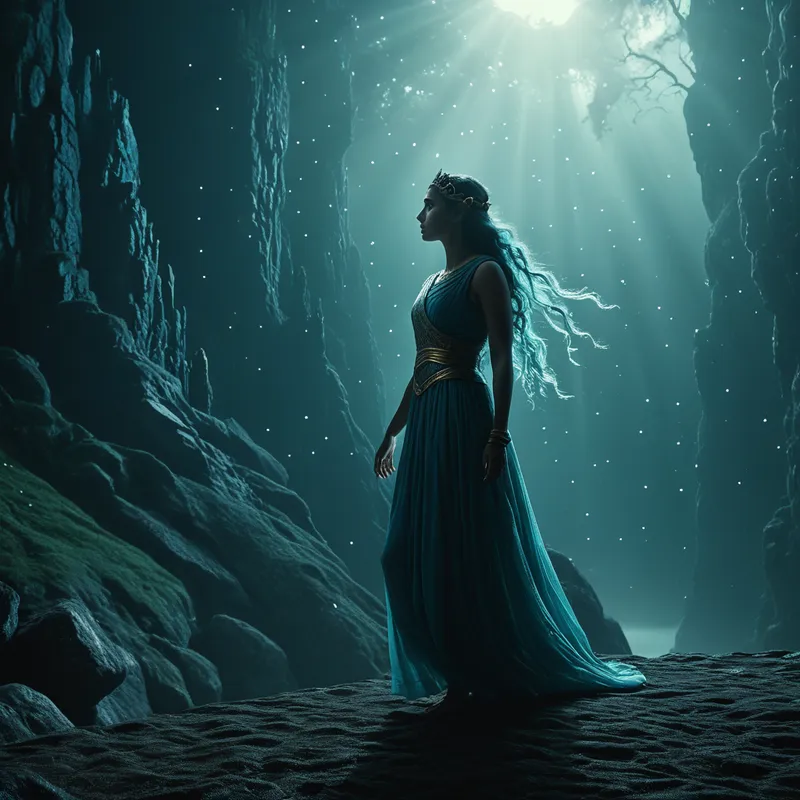
I stood before a towering, obsidian tablet, its surface smooth and cold. My fingers traced cracks that pulsed with a faint, bioluminescent light. I had no chisel, no tool, but I knew I had to inscribe something. As I pressed my palm against the stone, the light flowed up my arm, and words I did not recognize formed in my mind—not in my language, but in a syntax of feeling. I awoke with the rhythm of those unknown verses beating in time with my heart.
The alchemical interpretation: The dreamer’s unspoken emotional truth, solid and imposing as obsidian, is cracking under the pressure of its own latent energy, seeking the precise inscription that will liberate its light.

The False Lead
This is not a dream about becoming a published poet or receiving a message from the beyond. To interpret it as a literal call to creative writing is to mistake the map for the territory. The poetry here is not an aesthetic product but a psychic function. It is not about talent, but about translation. The false lead is to externalize the process—to look for the poem "out there" or to believe the dream is about artistic validation. In truth, it points inward, to the raw, unedited data-stream of your experience that is demanding to be organized into a personal, meaningful code. It is the opposite of chaos; it is chaos yearning for its own inherent order.
Psychological Architecture
When poetry appears in a dream, the psyche is engaged in a profound act of shadow integration and individuation. Think of your conscious mind as a well-ordered city, with straight streets and clear signage. The poetry emerges from the wild, unmapped wetlands at its edge—the place where feeling and image live in primordial soup. The work here is liminal; it occurs at the threshold between the formless swamp of the unconscious and the structured land of the ego.
This is shadow work of the most intimate kind. Each unformed feeling, each repressed memory, each exiled fragment of your inner family is a phoneme of this hidden language. The dream of poetry signals that these fragments are gathering, not in rebellion, but in a bid for communication. They seek to form a coalition, to find a shared syntax so they can finally tell you their story. The individuation process is this: you are not just hearing the story, you are learning to speak their tongue. You are building a bridge made of rhythm and metaphor, a structure strong enough to carry the weight of your whole self across.
Mythic Resonance
We see this in the myth of Orpheus, the poet whose music could charm beasts, stones, and even the lords of the underworld. His power was not in the notes themselves, but in his ability to translate the raw, howling grief of loss (his Eurydice) into an ordered, resonant pattern that could interface with reality itself—to negotiate with death. His failure, ultimately, was a failure of integration; he could not hold the tension between the poetic truth of the underworld and the literal demands of the upper world. The poetry dream is your Orphean moment: your deep self is composing the song that might retrieve what you have lost to your own personal underworld.
Likewise, consider the Hindu concept of Vāc, the goddess of speech, who exists in four forms. The deepest is Para Vāc—transcendent, unmanifest sound, the vibrational source of all reality. The poetry dream is an encounter with Madhyamā Vāc, the intermediate, mental word, the stage where the unmanifest feeling begins to clot into the possibility of meaning. It is the sacred, often terrifying, process of the formless seeking form.
Symbolic Nodes
- Unreadable Text: Glowing script, water-warped pages, fading ink. The knowledge is present but not yet decipherable by the waking mind.
- The Empty Page/Pristine Surface: A tablet, a blank scroll, a still pool. Potential and pressure in equal measure.
- Voice Without Source: Hearing a recitation, a chant, or a rhythm from nowhere. The message is disembodied, belonging to the psyche itself.
- Writing with Unusual Tools: Inscribing with light, blood, water, or breath. The medium signifies the raw, somatic nature of the content.
- A Fragmented or Ruined Library: Books with missing pages, toppled shelves. The internal archive is damaged or disorganized, requiring a new system of cataloging—poetry as the new indexing logic.
Archetypal Resonance
The Creator Archetype is the primary force awakened here, not in its shadow form of the mad scientist forcing creation, but in its essential, archetypal core. The Creator’s energy is the drive to bring the internal, invisible world into external, tangible reality—to give soul a shape. The somatic echo of pressure and potential is the Creator feeling the stir of a new reality within. The alchemical potential lies in the Creator’s ability to hold the tension between inspiration (the chaotic, glowing light from the cracks) and discipline (the act of inscribing it onto the tablet). This dream is the Creator’s sacred mandate: to stop the world from your psyche long enough to build a vessel that can carry its essence into the realm of lived experience.
The Alchemical Process
The alchemical transmutation here is from prima materia (the raw, emotional mass) to lapis philosophorum (the philosopher's stone of personal truth). The intense heat and pressure—the nigredo—is felt as that somatic overwhelm, the "too-muchness." It is the agony of bearing meaning that has no outlet.
The process requires a descent into that chaos without drowning. You must allow the fragmented images, the contradictory feelings, the half-remembered sensations to swirl in the vessel of your awareness. The fire is your unwavering attention. The pressure is your refusal to let this material be dismissed as nonsense or mere dream residue. As you attend to it, a strange ordering begins—not imposed by the logical mind, but arising from the material's own nature. Rhythms emerge. Metaphors suggest themselves. A line forms. This is the albedo, the whitening: the moment the chaotic mass reveals its own intrinsic, elegant structure. The poem is not made; it is extracted, like a latent image from a photographic plate. The sovereignty gained is not over the material, but through it. You become sovereign because you have learned the native language of your own soul.

The Integration Protocol
Question 1: Where in my waking life do I feel that same somatic pressure—the rhythmic thrum, the tightness of unsaid truth? What situation or relationship feels like an "empty page" I am afraid to mark?
Question 2: If the dream-poem were a translation of an exiled part of my inner family, who is speaking? What long-ignored feeling or memory is trying to find its voice?
Question 3: What single, central word or image from the dream holds the most potent, electric charge for me? If that word were a key, what door in me might it unlock?
Action 1 (Somatic Transcription): For one minute, place a hand on the part of your body where you felt the dream's echo most strongly. Breathe into that space. Then, without lifting your hand, speak or whisper whatever sounds, words, or fragments arise. Record it. Do not edit. This is the raw phonetics of your somatic truth.
Action 2 (Found Poem Ritual): Take a text that feels unrelated to your emotion—a technical manual, an old newspaper, a discarded letter. With a pen, circle words and phrases that viscerally jump out, guided by the dream's mood. Arrange these found fragments into a new sequence on a fresh page. You are not writing; you are excavating the poem that already exists in the debris of your world.
Action 3 (Vessel Creation): Craft or designate a physical vessel—a small box, a jar, a carved stone. This is your poesis vessel. Over the next week, each time a potent, poetic fragment of thought or feeling arises (a dream image, a sudden metaphor, a line of inner dialogue), write it on a slip of paper and place it inside. Do not read them. After a week, empty the vessel and arrange the slips before you. Witness the poem your psyche has composed in secret.
Final Validation
This work is not decorative. It is not a hobby for quiet afternoons. To dream of poetry is to be drafted into the most urgent and delicate labor of your life: the construction of a self from the inside out. It is difficult because it asks you to trust the intelligence of your own chaos, to believe that your deepest wounds have a grammar that can become a gift. The terror is real—the fear of the blank stone, the unknown language. But the rhythm you felt in your chest is the proof. It is the pulse of a reality waiting to be born. Your attention is the midwife. Your courage to inscribe, however clumsily, is the act of sovereignty. The poem is already written in your bones. The dream has come to teach you how to read it.