
The Stage of the Self: Dreaming of Performance and Illusion
The Somatic Echo
Before the mind can name it, the body knows the dream of performance. It is a tightness in the solar plexus, a subtle clenching that is not quite fear but a held breath. It is the ghost-sensation of a mask adhered to the skin, a phantom weight on the shoulders that feels like a costume made of lead. There is a humming in the ears, the white noise of an unseen audience, and a dryness in the throat that anticipates a line you have not yet been given. This is the visceral landscape of the performer-self, a system on high alert, calibrated for observation and appraisal. The body is not lying; it is reporting the truth of a life lived in projection, where the boundary between the authentic gesture and the rehearsed one has grown thin as a scrim.
The Dreamer's Log (Case Vignette)
I am backstage in a colossal, decaying theater. My costume, an elaborate gown of mirrors and wires, is fused to my skin. The curtain is about to rise, but I have forgotten my part, my name, even the play itself. I hear the restless murmur of the crowd, a sound like distant thunder. All I know is that I must go on.
This dream is an alchemical crisis: the persona has become a prison, and the Self, the true actor, has been exiled from its own script.
The False Lead
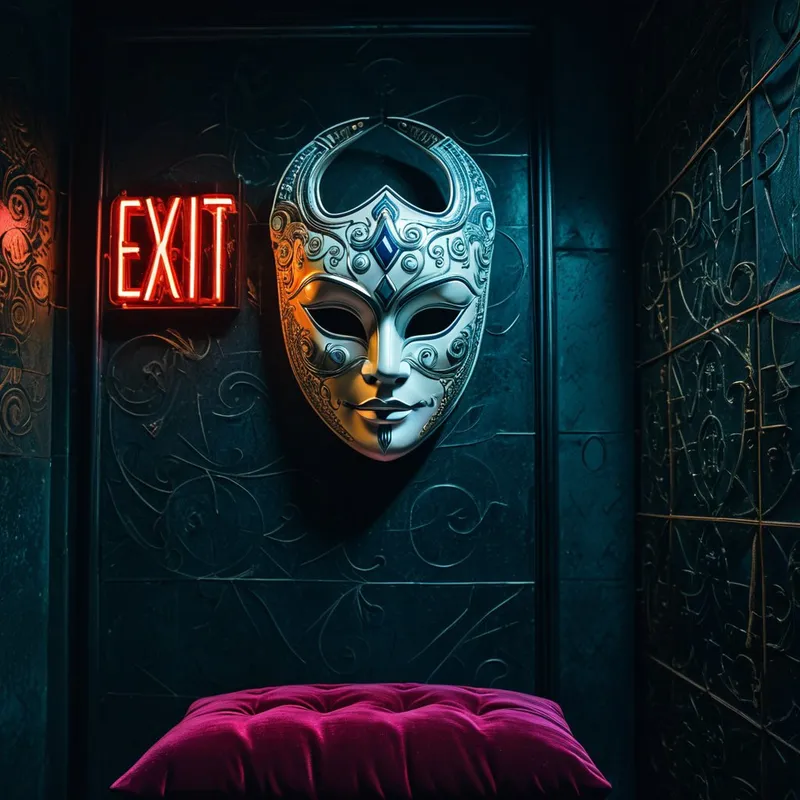
This theme is not about social anxiety or a simple fear of public speaking, though it may wear that disguise. It is not a prophecy of impending embarrassment or a warning of mere exposure. To interpret it as such is to mistake the symphony for a single sour note. The terror here is not of a failed performance, but of a performance that succeeds too well—one that permanently eclipses the performer. It is the grief of realizing you have been applauded for a role that has slowly consumed you, leaving the authentic voice backstage, whispering lines no one is meant to hear.
Psychological Architecture
The architecture here is one of concentric stages. At the outermost ring is the Persona, the necessary mask we wear to navigate the social world. It is a useful tool, a social interface. But in the dream of performance, this tool has become the master. It has recruited internal parts—the Pleasing Child, the Achieving Hero, the Wise Sage—and forced them into a perpetual dress rehearsal. The Shadow work is to descend backstage, into the wings and dressing rooms of the psyche, and meet the exiled parts: the Terrified Child who doesn’t know the lines, the Furious Rebel who wants to tear the script, the Grieving Orphan who feels unseen behind the glittering facade.
Individuation in this realm is the slow, deliberate process of turning the spotlight away from the persona and sweeping it across the entire, shadowed theater of the self. It is the realization that you are not just the actor on the proscenium, but also the playwright, the director, the stagehand, and the silent, watching audience. Sovereignty is born when you reclaim the right to rewrite the play, to step out of the spotlight, or to finally speak your own, unscripted truth into the expectant silence.
Mythic Resonance
We see this eternal drama in the myth of Narcissus. His fatal error was not self-love, but a profound misidentification. He fell in love with a reflection—a flawless, surface illusion—and, in doing so, starved the complex, breathing being that cast it. He performed the role of the lover for an image, and the true self wasted away. Similarly, the tale of the Emperor’s New Clothes is not merely about vanity, but about the collective conspiracy of performance. The entire kingdom performs the illusion of seeing the magnificent garment, until the innocent voice of a child—the un-integrated, authentic part—shatters the shared fantasy and exposes the vulnerable reality beneath.
Symbolic Nodes
- Being on stage with no script or forgotten lines.
- Masks that cannot be removed or that change expression on their own.
- Mirrors that reflect a distorted or unfamiliar face.
- Costumes that are too tight, too heavy, or fused to the skin.
- A critical or faceless audience.
- Malfunctioning props or sets that collapse.
- Being an imposter or fraud who is about to be discovered.
- Searching for an exit behind a stage with no doors.
Archetypal Resonance
The energy here pulses with the frequency of The Shadow Magician. The Magician archetype in its essence is the visionary, the alchemist who transforms reality through will and insight. Its shadow, the Illusionist, wields that same power not for true transformation, but for deception—both of others and, most crucially, of the self. This shadow archetype is the master director of the internal theater, creating dazzling special effects and convincing narratives that maintain the performance. The somatic echo of a held breath and a clenched gut is the body’s rebellion against the Illusionist’s spell. The alchemical potential lies in forcing a confrontation: to turn the Magician’s power inward, to use its insight to see through its own illusions, thereby initiating the true transmutation from manipulator of images to sovereign of substance.
The Alchemical Process
The alchemy of Performance/Illusion is Sublimation: the direct transformation of a solid (the rigid, frozen persona) into a vapor (dispersed awareness), bypassing the liquid state of chaotic meltdown. The heat required is the unbearable warmth of exposure—not public humiliation, but the private, searing honesty of seeing your own mechanisms. The pressure is the weight of conscious choice, the decision to stop performing even when the audience (internal and external) expects the show.
This process is not gentle. It feels like the disintegration of a known world. The glittering mask must tarnish and crack under the heat of self-inquiry. The familiar script must burn away, leaving ash and silence. In that void, where the performance has ceased, the grief for the lost role arises. This grief is the prima materia, the raw substance. From it, through the patient work of re-membering the exiled parts, a new integration is forged. The sovereignty gained is not a louder performance, but a profound quiet. It is the authority that comes from no longer needing an audience to confirm your existence.

The Integration Protocol
Question 1: Where in your waking life do you feel the subtle, somatic clench of "performing"? Is it in a specific relationship, a role at work, or even in your private thoughts?
Question 2: If the mask you wear most often could speak its true purpose—beyond "fitting in" or "being liked"—what would it say? What is it truly protecting?
Question 3: Imagine your life as a stage. Who, or what part of you, is standing in the wings, waiting in the shadows, never allowed to step into the light?
Action 1 (The Unrehearsed Moment): For one hour, engage in a simple, daily activity (making tea, walking, washing dishes) with the explicit intention of not performing it for anyone, not even for your own internal critic. Notice the sensations, the meandering thoughts, without crafting them into a story.
Action 2 (Mask-Mapping): Create a simple, expressive drawing. Draw a central figure (abstract or representative) and around it, sketch the various "masks" or "roles" you wear. Use color, texture, or words to label them. Then, with a different color, draw lines or shapes connecting them to the center. What do you see?
Action 3 (Ritual of Dissolution): Write a single, short sentence that represents a core line from your "performance script" (e.g., "I must be helpful," "I cannot show uncertainty"). Speak it aloud to yourself in a mirror. Then, physically dissolve the paper—tear it, burn it safely, or let it soak in water. As you do, state quietly: "This is a role. I am more than this part."
Final Validation
It is profoundly difficult to feel the mask fuse to your skin, to hear the applause for a self that is not quite yours. That disorientation is real, and its grief is valid. But within that very fracture lies your liberation. The stage was never your cage; it was your training ground. The spotlight that felt like an interrogation is revealing itself as a beacon, calling not the performer, but the sovereign—the one who can finally step off the scripted mark and inhabit the boundless, authentic space of your own becoming. The performance ends where the life begins.