
The Veiled Self: On the Dream Theme of Mystique
The Somatic Echo
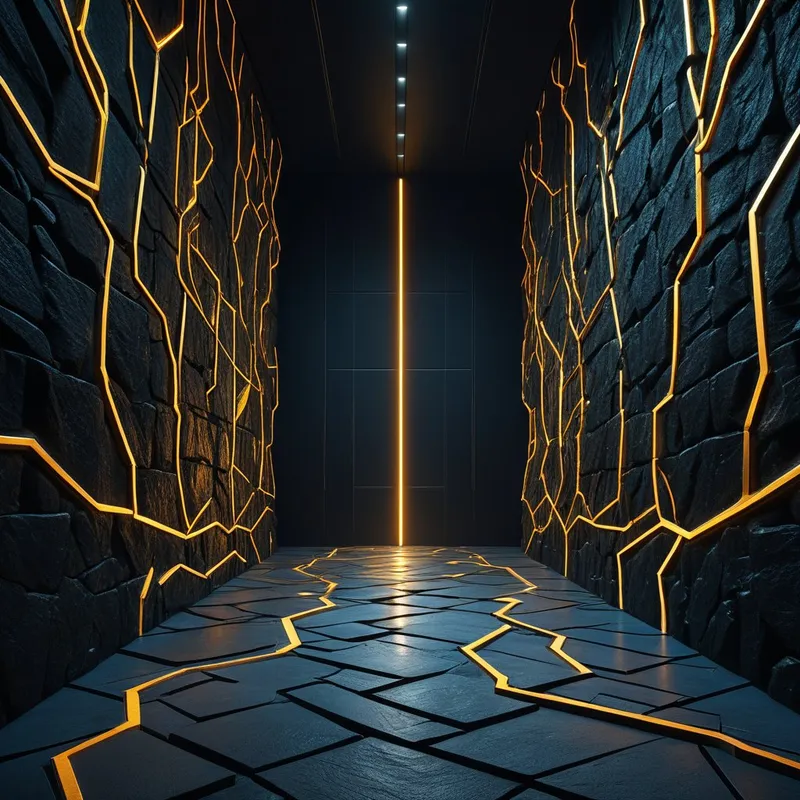
It begins not as a thought, but as a sensation in the solar plexus—a cool, magnetic pull, like the gravity of a dark star. The breath catches, not in fear, but in a suspended ah. The skin prickles with a static awareness, a sense of being watched by something that is, paradoxically, a part of you that has been watching from the shadows for a lifetime. This is the somatic signature of Mystique: a profound, bodily recognition of the presence of an absence. It is the chill of ancient stone in a sunless place, the electric hum before a storm that changes everything. The mind scrambles to label it—dread, awe, anticipation—but the body knows it first as pure, unmediated potential. It is the feeling of standing before a door you did not build, holding a key you did not forge, knowing the act of turning the lock will irrevocably alter the architecture of your inner world.
The Dreamer's Log
I am in a library of impossible scale. The shelves are carved from black basalt and stretch into a gloom pierced by occasional beams of dusty light. I know I am searching for a specific volume, but its title is only a feeling on my tongue. On a central plinth, under a single shaft of light, lies a single key made of polished obsidian. As I reach for it, the air thickens with a scent of ozone and old roses, and I see my reflection in the key’s surface—but it is not my face. It is a constellation of silver light in the shape of my silhouette.
Alchemical Interpretation: The dreamer’s psyche presents the obsidian key—a perfect symbol of the conscious ego’s desire for a tool to “unlock” the mystery—only to reveal that the key itself is a mirror, reflecting the dreamer’s own luminous, unmapped interior as the true treasure.

The False Lead
Mystique is not mere secrecy. It is not about information withheld by others, nor is it the glamour of being an enigma to the outside world. That is its shadow, its cheap imitation—the persona of the cryptic individual who uses ambiguity as a shield or a weapon. True Mystique in dreams is not a wall you erect, but a depth you discover. It is not a game of hide-and-seek with the world; it is the terrifying, beautiful process of the self seeking the parts of itself that have been sequestered, not out of shame, but out of a primal, protective instinct. To mistake this call for a call to cultivate obscurity is to polish the lock while ignoring the vast chamber it secures.
Psychological Architecture
The architecture here is one of sacred partitions. Within the internal family system of the psyche, certain sub-selves—often those bearing immense creative potency, archaic wisdom, or raw, untamed emotion—are placed in quarantine. They are not exiled to the dungeon of the Shadow, where we banish our perceived flaws. Instead, they are held in a sanctum, a velvet-lined vault within the Shadow. They are the “protected mysteries.” We intuit that to engage with them directly, with our current, fragile ego-structure, would be overwhelming. Their energy is too potent, their truth too foundational. So, the psyche wraps them in layers of symbolism—the veiled figure, the locked room, the untranslatable text, the object of impossible beauty. Dreaming of Mystique is the sign that the ego has grown strong enough, or desperate enough, to approach the sanctum. It is the beginning of a negotiation between the part of you that manages daily reality and the part of you that is reality’s underlying, poetic code.
Mythic Resonance
Consider the myth of Psyche and Eros. Psyche is wedded to a god she is forbidden to see. Her reality is one of ultimate intimacy shrouded in ultimate mystery—she knows her lover’s touch, his voice, his presence, but not his form. Her nights are filled with sensual certainty, her days with agonizing uncertainty. The mystique is the condition of her relationship. Her eventual lighting of the lamp is not a betrayal of trust, but an inevitable stage in her individuation; she must see to know, and only by knowing (and nearly losing) the divine can she herself become divine. The mystique was the necessary container for her transformation. Similarly, in the Arthurian cycle, the Grail Castle appears and disappears, visible only to the pure of quest. It is never possessed, only glimpsed. Its power lies in its elusive nature, forcing the knight into a state of perpetual, humble seeking, reshaping his character not through acquisition, but through the sustained encounter with the mysterious itself.
Symbolic Nodes
- Veils, curtains, or shimmering barriers of light or water.
- Locked boxes, cabinets, or rooms with intricate, keyless locks.
- Objects of deep black or brilliant iridescence (obsidian, oil-slick, mother-of-pearl).
- Unreadable texts, maps of unfamiliar territories, or blueprints of impossible machines.
- Masks that are blank or reflect the viewer’s own face.
- Enclosed gardens, private libraries, or personal sanctums discovered within a familiar place.
- A guide or figure whose face is obscured or constantly shifting.
Archetypal Resonance
The energy of Mystique resonates most powerfully with The Magician Archetype, specifically in its latent, unintegrated state. The Magician’s core power is the understanding of hidden principles and the transformation of reality through will and knowledge. The Mystique dream, however, presents the pre-Magician stage—where the archetype is not an active force but a dormant potential, a set of blueprints sealed in a vault. The somatic echo is the Magician’s power felt as a static charge in the atmosphere, not yet channeled. The locked rooms and veiled objects are the archetype’s tools and knowledge, awaiting the rightful claim of an ego strong enough to wield them without corruption. The alchemical potential lies in moving from being haunted by mystery to becoming the sovereign of the secret, transforming awe into agency.
The Alchemical Process
The alchemy of Mystique is Transmutation Through Sustained Attention. The base material is the anxiety of the unknown, the grief for a wholeness you sense but cannot grasp. The heat is applied not in a sudden, violent revelation, but in the slow, patient pressure of leaning into the not-knowing. It is the heat of holding your gaze on the veil without tearing it, of sitting in the locked room without picking the lock. This intense psychological process requires tolerating the profound discomfort of ambiguity, resisting the ego’s desperate urge to label, define, and thus neutralize the mystery. As you do this, a slow change occurs. The terror of the hidden thing metabolizes into respect for its power. The grief of separation becomes a yearning for communion. The “secret” ceases to be a noun—a thing to be uncovered—and becomes a verb: the sacred, ongoing process of your own depth revealing itself to you, on its own terms. The leaden weight of obsessive curiosity is transmuted into the gold of participatory awe.
The Integration Protocol
Question 1: Where in my waking life do I feel that same magnetic, cool pull in my body—the pull toward a person, a creative idea, or a topic that feels simultaneously fascinating and slightly forbidden?
Question 2: What part of myself might I be keeping in a “sanctum,” not because I hate it, but because I am in awe of its power or afraid of its demands?
Question 3: If the mysterious object or figure in my dream could speak one sentence to me, not to explain itself, but to describe the quality of its existence, what would it say?
Action 1 (Somatic Cartography): For one week, carry a small, smooth stone (or a token) in your pocket. Whenever you feel that “mystique” sensation—the catch in the breath, the static prickle—place your hand on the stone. Don’t analyze the feeling; just let the stone be an anchor, a physical witness to the moment of encounter with your inner unknown.
Action 2 (Vessel of the Veiled): Take a blank notebook or a sheet of paper. Without planning, using any medium you like (ink, charcoal, watercolor), let your hand create a visual representation of the barrier itself—the veil, the door, the mist. Do not draw what is behind it. Focus entirely on the texture, quality, and feeling of the boundary. This honors the mystery without violating it.
Action 3 (Ritual of the Keyless Lock): Find a box with a lid or a drawer you rarely use. Place inside it a single object that symbolizes a question you have for yourself, not an answer (e.g., a feather for “What wants to be free?”, a seed for “What is waiting to germinate?”). Once a week, open the box, hold the object, and sit with the question. Then close it again. This ritualizes a respectful relationship with the unresolved.
Final Validation
It is arduous work, to court the parts of yourself that you have, with innate wisdom, kept at a respectful distance. The longing they evoke is a form of homesickness for a home you have never fully inhabited. Honor the fatigue that comes from holding space for such potent ambiguity. This is not a failure of understanding, but the necessary labor of building a container strong enough to hold your own magnificence. The mystique does not dissolve into banality upon integration; it deepens. You do not solve the mystery—you become worthy of it. And in that becoming, you find that the key was never meant to open a door, but to recognize that you, yourself, are the sanctum you have been seeking.