
The Symphony of the Psyche: Dreaming in Musical Thinking
The Somatic Echo
Before the melody arrives, there is a hum. It is not a sound you hear with your ears, but a vibration you feel in the marrow of your bones—a low-grade resonance that makes your teeth ache and your fingertips tingle. It is the somatic prelude to a dream of musical thinking. The body becomes an instrument, its tensions the strings, its rhythms the percussion of blood and breath. You may wake with a sense of being tuned, or horrifically out of tune; a dissonance so visceral it feels like a physical illness, a harmony so profound it feels like a cure. This is the intelligence of the body preparing the mind for a new form of cognition, where thought is not a linear argument but a polyphonic composition, where feeling is not a distraction but the essential bassline of truth.
The Dreamer's Log (Case Vignette)
I am holding my phone, but the screen is a shattered lake of black glass. Instead of apps, I see musical staves. A single, pulsing note of cobalt blue leaks from a crack, and when I try to catch it, it dissolves into a cloud of static that smells like ozone and old paper. The silence that follows is heavier than any sound.
Alchemical Interpretation: The shattered interface of daily logic releases a primal, coded intelligence (the blue note), which the conscious mind cannot yet capture, forcing a confrontation with the fertile, terrifying silence of potential.

The False Lead
This is not a dream about being gifted or cursed with perfect pitch, nor is it a simple metaphor for "harmony" in your life. To interpret it as a sign to take up the piano or join a choir is to mistake the symphony for the instrument. Musical thinking in dreams is not about external performance; it is about an internal, structural revolution. The dissonance you feel is not "bad luck" or "stress"—it is the friction of old, rigid cognitive patterns grinding against a new, fluid intelligence trying to be born. The terror is not of a wrong note, but of the entire composition of your known self being rewritten.
Psychological Architecture
Beneath the melody lies the architecture of the Shadow. Each isolated part of you—the inner critic, the hidden child, the ambitious driver, the silent sufferer—has been speaking its own monologue, often at cross-purposes. Musical thinking emerges when these disparate voices are forced into relationship. The process is one of deep Shadow work and Individuation: the cacophony of your internal family system must first be heard in all its discord before it can be conducted into a chorus. The grief is for the loss of the singular, dominant narrative. The terror is of the chaotic, democratic process of the psyche where every exiled part demands its measure. To dream this is to stand at the mixing board of your own soul, learning that harmony is not the absence of conflict, but the artful arrangement of it.
Mythic Resonance
We see this firmware update in the myth of Orpheus, who did not argue with the underworld or fight it, but re-composed it. His lyre did not overpower the cries of the lost; it wove them into a new arrangement so compelling it suspended the laws of death itself. His failure was not a musical one, but a failure of this new thinking—he glanced back, reverting to a visual, linear logic of doubt, and the symphony collapsed. Similarly, the Norse myth of the god Kvasir, born from the spit of all the gods, embodies a consciousness distilled from collective contribution. He became the wisest being, not through solitary genius, but by being a living vessel of blended intelligences, until he was murdered and his blood—his essence—was mixed with honey to create the mead of poetry, the intoxicating drink of inspired thought.
Symbolic Nodes
- Shattered instruments that still produce perfect sound.
- Hearing a symphony in the sound of rain or traffic.
- Trying to read sheet music where the notes are alive and crawling.
- A silent room that feels unbearably loud.
- A familiar song played in a wrong, yet more "correct" key.
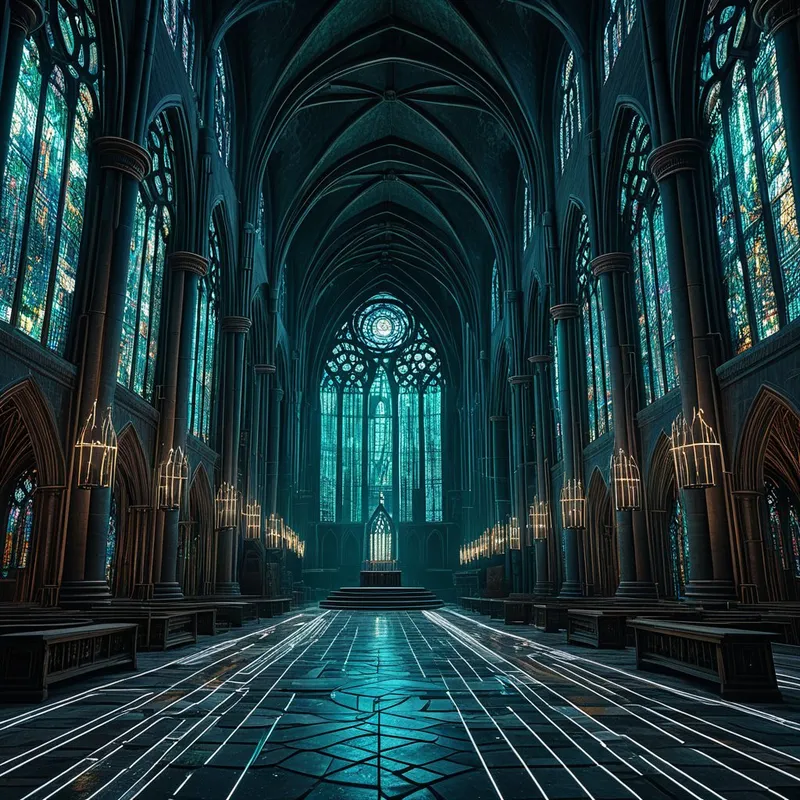
- Architectural spaces—halls, tunnels, hearts of trees—that have a distinct, audible resonance.
Archetypal Resonance
The core energy of Musical Thinking resonates most powerfully with The Magician Archetype. This is not the stage illusionist, but the deep alchemist who understands the hidden structures of reality and knows how to transform them. The somatic echo of tuning and resonance is the Magician sensing the latent energy in the elements of the self. The alchemical potential lies in the Magician’s fundamental power: to perceive the underlying pattern—the score—beneath the apparent chaos of thoughts and feelings, and to conduct them toward a willed transformation. The shadow here is the Manipulator, who uses this perception of psychic patterns not to harmonize, but to control and deceive the self, creating addictive internal loops instead of liberating symphonies.
The Alchemical Process
The transmutation here is from fragmented noise into coherent signal. The prima materia is the raw, often painful data of your lived experience—every memory, every trauma, every joy, each a distinct tone or rhythm. The alchemical heat is applied by the conscious act of listening without judgment. This is the intense pressure: to hear the shriek of your inner orphan’s fear alongside the pompous march of your inner ruler’s demands, and not to silence either. The vessel is your attentive awareness. As you hold these dissonant parts in simultaneous awareness, a strange integration begins. They start to relate, to answer one another, to find intervals and rhythms. The grief of their isolation and the terror of their chaos are not eliminated; they become the minor keys and complex time signatures that give the composition its depth, its truth, and ultimately, its strange, sovereign beauty. You are no longer a listener to a fixed track; you become the composer of a living process.
The Integration Protocol
Question 1: In your waking life, where do you experience the most visceral "dissonance"—a situation or relationship that just feels wrong in your body, like an off-key note?
Question 2: If your current mindset had a theme song, what would its rhythm, key, and volume be? If a part of you wanted to change the song, what would it change first?
Question 3: What one "note"—a single emotion, memory, or truth—have you been trying to silence because it doesn't fit the melody you think you should be playing?
Action 1 (Somatic Tuning): For one minute, sit in silence and place your hands on your chest and belly. Do not try to calm or change your breath. Simply feel its rhythm. Is it staccato or legato? Is there a pause, a rest? Acknowledge the rhythm as your body's first, most honest composition.
Action 2 (Unstructured Score): Take a large piece of paper. Let your hand move freely, not to draw a picture, but to create a visual "score." Use lines, shapes, scribbles, and colors to represent the different "voices" or feelings you carry inside—let the critic be a sharp, angular red, the hopeful part a flowing gold. Don't interpret, just let them coexist on the page.
Action 3 (Resonance Ritual): Go to a space with distinct natural or urban sound—a park, a busy cafe, under a bridge. Close your eyes for five minutes. Don't listen to the sounds, but listen for the spaces between them. Find the silent rhythm that holds the noise. This practices the art of finding the container for your internal symphony.
Final Validation
This process is not about achieving a state of constant, blissful harmony. That is the fantasy of the Shadow Innocent. The real work, the real music, is far more demanding and more beautiful. It asks you to become comfortable in the orchestra pit of your own soul, amid the tuning and the missed cues and the moments of sublime unison. It is difficult because it requires you to honor every part, even the ones that play out of tune. But in that difficult, conscious composition lies your profound sovereignty: you are no longer a single, brittle note, but the entire, resilient, and ever-evolving song.