
The Architecture of the Forgotten Self: Dreaming of Memory & Recall
The Somatic Echo
It begins not as a thought, but as a pressure. A density in the chest, a weight behind the eyes. It is the feeling of a word on the tip of a tongue that has forgotten its own shape, a name that dissolves into static before it can be spoken. This is the somatic echo of memory—not the memory itself, but the ghost of its absence. The body remembers what the mind has filed away in inaccessible archives: the tremor of an old grief, the blueprint of a childhood fear, the unspent energy of a joy too sharp to hold. Before the dream-images arrive, you feel the architecture of your own interior, humming with sealed rooms and corridors you swore you sealed shut. The echo is a low-grade magnetic pull, a psychic gravity drawing you toward the parts of yourself you agreed to forget.
The Dreamer's Log (Case Vignette)
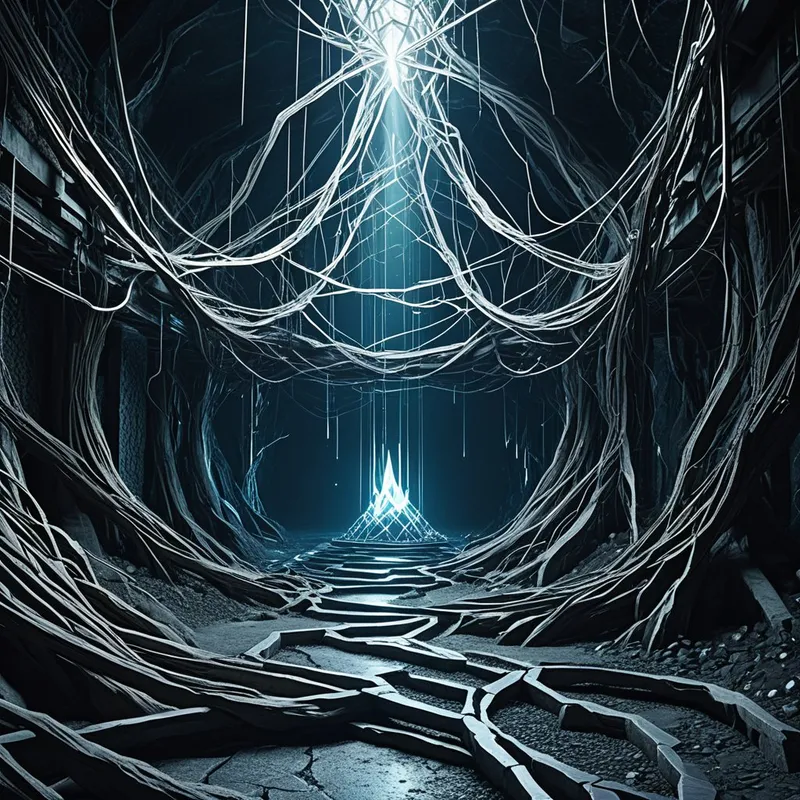
I am in a cavernous, abandoned server farm. Rows of monolithic black towers hum with a cold, blue light. I know I am here to retrieve a specific file—a single memory. I have the access code, a string of numbers that feels like a birthdate. I input it at a terminal, but the screen fractures into a kaleidoscope of static. From the distortion, a single, clear image emerges: my own childhood hand, holding a porcelain doll with a hairline crack across its cheek. The doll’s eyes are vacant, but I feel it watching me. The hum of the servers rises to a deafening whine.
Alchemical Interpretation: The dream reveals a core, fractured memory of early vulnerability (the doll) being held by the self, now accessed through the cold, logical framework (server farm) adulthood has built to contain it.

The False Lead
This theme is not a simple replay of the past, nor is it a diagnostic tool for factual accuracy. To interpret a memory dream as merely a sign of “nostalgia” or “unresolved issues” is to mistake the map for the territory. The dream is not interested in historical fact-checking. Its concern is psychic truth—the emotional and structural reality that a memory holds within your current system. A dream of a forgotten house is not necessarily about the house; it is about the foundational blueprint of the self that was drafted there. The terror is not in the recalled event itself, but in the re-inhabitation of the emotional body that experienced it. The false lead is to chase the content; the work is to commune with the container.
Psychological Architecture
When memory surfaces in dreams, it signals a shift in the internal family system. Exiled parts—the shamed child, the furious adolescent, the betrayed lover—are petitioning for reintegration. They knock on the door of consciousness not with words, but with the sensory artifacts of their exile: a scent, a texture, a tone of voice. The Shadow work here is profound. It requires you to stop being the curator of your own museum and become the archaeologist of your own ruins. You must descend, not to dig up bones to display, but to listen to the story the soil itself tells. Individuation in this realm is the re-membering of the self. It is the conscious act of gathering the scattered, forgotten, or disowned fragments of your being and weaving them back into the tapestry of your sovereignty. The memory is the key, but the lock is in the present moment.
Mythic Resonance
We see this eternal process in the myth of Orpheus and Eurydice. Orpheus is granted the chance to retrieve his lost love from the underworld on one condition: he must not look back at her until they reach the surface. He fails, turning to recall her visage, and she vanishes. This is not merely a lesson about doubt. It is a precise allegory for the psyche’s retrieval process. The underworld is the unconscious, teeming with lost loves (parts of ourselves). The condition is the alchemical rule: you cannot integrate a lost part by staring directly at its old form (the literal, static memory). You must lead it forward into the new light of your current consciousness, allowing it to transform in the journey. To look back is to fix it in its dead state, ensuring its loss. The myth also lives in the story of Theseus and the Minotaur, where Ariadne’s thread is not just a tool for escape, but a literal line of recall—a memory-tether woven through the labyrinth of the forgotten self to find the way back to wholeness.
Symbolic Nodes
- Forgotten Rooms/Secret Passages: Undiscovered aspects of the self, sealed psychic chambers.
- Old Photographs/Film Reels: Memories frozen in time, demanding re-animation with present understanding.
- Data Storage (Tapes, Drives, Libraries): The mind's logical systems for archiving experience.
- Dust, Cobwebs, Archive Boxes: Neglected or repressed emotional material.
- A Specific, Unplaceable Scent: The most primal trigger of emotional memory, bypassing cognitive gates.
- A Message You Can't Read (Fading Ink, Unknown Language): Knowledge from the unconscious not yet translatable to the conscious mind.
- Meeting a Younger Version of Yourself: Direct encounter with an exiled internal part.
Archetypal Resonance
The energy of Memory & Recall resonates most deeply with The Magician Archetype. The Magician’s domain is the hidden structure of reality, the secret laws that govern transformation. In the landscape of memory, the Magician does not merely recollect; they re-call—summoning energy from the past into the present to alter the future. The somatic echo of a forgotten memory is the Magician sensing a disturbance in the field, a pocket of untapped power or unresolved pattern. The alchemical potential here is the Magician’s greatest work: transmuting the leaden weight of traumatic recall or nostalgic haze into the gold of integrated wisdom. However, this theme often activates in its Shadow aspect, as The Shadow Magician—the Manipulator or Illusionist. This shadow appears when we use memory to deceive ourselves, constructing curated narratives that trap us in victimhood or false innocence, manipulating our own history to avoid the heat of transformation.
The Alchemical Process
The alchemy of Memory & Recall is Distillation. The prima materia is the chaotic, sensory-rich mass of lived experience—the undifferentiated soup of joys, traumas, and mundane moments. The intense psychological heat is applied when a dream forces a specific memory to the surface. This heat is the friction between the memory’s raw, emotional truth and the conscious mind’s narrative about it. The pressure is the discomfort of holding both simultaneously without dismissing either. In the vessel of attentive awareness, the process begins. The fixed story (the caput mortuum, or dead head) is separated from the volatile essence—the core feeling, the unmet need, the frozen insight. This essence, distilled through the tears of grief or the fire of re-felt anger, rises. It is no longer “that thing that happened years ago.” It becomes a pure, potent tincture: a clarified understanding of your own resilience, a recognized pattern, a reclaimed power. The terror of the memory is not erased; its energy is purified and repurposed, becoming a component of your inner elixir.
The Integration Protocol
Question 1: When the memory-feeling arises in the dream, where in your body do you first sense it? Don't name the emotion; describe the physical sensation as if to a sensor without a feeling-lexicon.
Question 2: If the memory or forgotten object in the dream were a lost part of your own character—a strand of your courage, a shard of your voice, a fossil of your joy—which part would it be?
Question 3: What current situation in your waking life feels like the same architectural space as the dream-memory? (Not the same event, but the same emotional structure—e.g., the same sense of confinement, the same quality of longing, the same pattern of obscured truth).
Action 1 (Somatic Anchoring): Upon waking with a memory-dream, immediately place a hand on the part of your body that holds the strongest sensation. Breathe into that space for one minute. Do not analyze, simply acknowledge the sensation as a real, present-moment event in your physical being.
Action 2 (Unstructured Re-Creation): Using any medium—mud, charcoal, torn paper, digital scribbles—visually represent the texture of the memory, not its image. Was it jagged? Smudged? Metallic and cold? Fibrous? Let your hand express what the memory felt like before your mind labels it.
Action 3 (Ritual of Re-contextualization): Find a small, physical object that symbolically relates to the dream memory (a stone for something solid/heavy, a feather for something fleeting, a key for something locked). Carry it with you for a day. At sunset, place it somewhere new in your home—a shelf, a windowsill—and silently state: "I place this knowing here, in my present."
Final Validation
This work is not for the faint of heart. To re-enter the sealed rooms of the self is to willingly feel the old weather that still storms there. It is to acknowledge that time is not linear in the psyche, and that a grief from decades ago can be as electrically alive as today's news. This validation is necessary. And from within that acknowledgment arises the true empowerment: you are not being haunted. You are being petitioned. The memories returning are not ghosts seeking to drag you back, but lost citizens of your inner kingdom seeking amnesty and integration. They come bearing the very pieces you need to become whole. Your ability to recall them in the dreamscape is not a malfunction; it is the deepest intelligence of your soul, performing its own archaeology, lighting lanterns in the dark so that you may finally, compassionately, reclaim your entire territory.