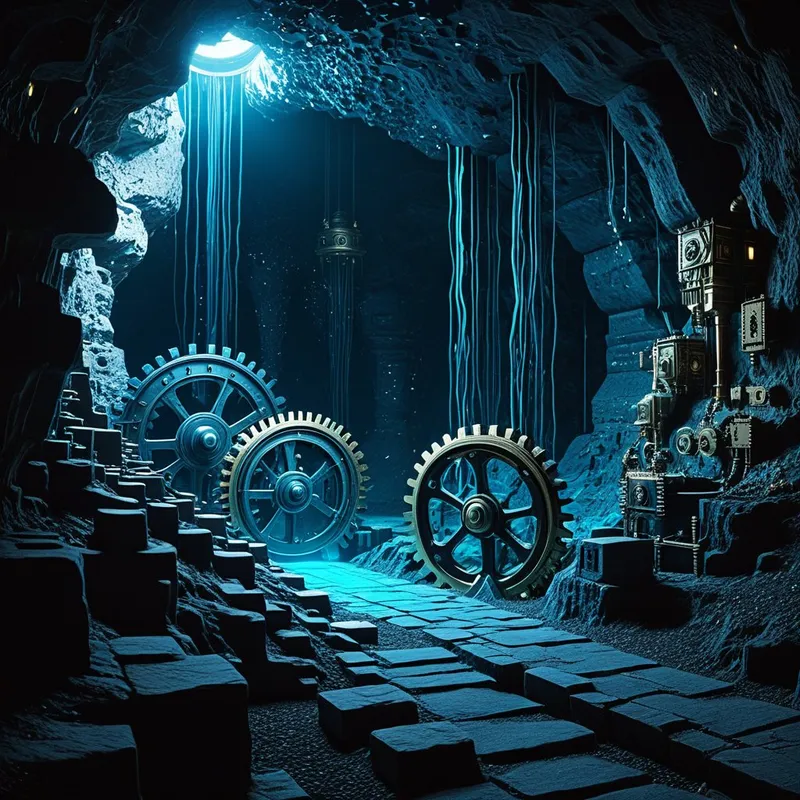
The Somatic Echo
Before the image forms, the body knows. It is a sensation of being a vessel for a deep, tectonic shift—not a violent earthquake, but the slow, grinding movement of continental plates beneath the skin. You may wake with a jaw clenched like a locked gear, a stiffness in the spine that feels structural, not muscular, or a humming in the bones akin to a dormant engine idling in a vast, internal garage. There is a pressure, a density, that speaks of immense forces held in perfect, precarious balance. This is the somatic whisper of a psyche engaged in profound recalibration. It is the feeling of being both the architect and the construction site, the blueprint and the raw material, aware that something fundamental is being reassembled in the dark.
The Dreamer's Log
The bathroom sink is cracked, a hairline fracture running from the drain to the rim. When I turn the faucet, no water comes. Instead, a stream of tiny, intricate clockwork components—tiny silver gears, minuscule springs, pins like slivers of light—spills into the porcelain basin, piling up silently. I try to gather them, but they slip through my fingers, cold and precise.
This dream is not about a broken sink, but about the alchemical moment when the familiar vessel of a coping mechanism fractures, revealing the intricate, forgotten machinery of feeling it was designed to contain and control.

The False Lead
This theme is not about external systems failing you—a car breaking down, a computer crashing. To interpret it as mere "bad luck" or logistical anxiety is to mistake the symphony for a single out-of-tune instrument. Nor is it a cold, robotic directive to "optimize" your life. The dream is not a productivity app. The mechanism is not a tool for efficiency, but a living metaphor for your psychic infrastructure. It points not to what you do, but to the often-unconscious how and why you do it—the silent agreements, the emotional plumbing, the defensive architectures you’ve built to navigate the world. A dream of a stalled engine is not about your career; it’s about the fuel you’ve stopped allowing yourself to feel.
Psychological Architecture
To dream of mechanisms is to be granted temporary clearance to the psyche’s backstage. Here, in the shadowed wings, you witness the pulleys and levers of personality, the hydraulic systems that lift your mask into place, the intricate clockwork of trauma responses timed to perfection. This is the domain of Internal Family Systems made manifest: not as abstract "parts," but as literal, functional components. The critical inner voice becomes a relentless piston. The numbing behavior is a cooling vent for an overheated core. The people-pleaser is a complex gear train designed to mesh seamlessly with any external demand.
The individuation process here is one of conscious engineering. It begins with witnessing these subsystems without judgment, seeing the genius in their original, protective design. The grief comes when you realize the machine you built for a childhood battlefield is now operating in a peacetime garden, its functions obsolete, its noise a disturbance. The shadow work is to lovingly decommission the parts that no longer serve, not with the wrench of repression, but with the reverence of an archivist preserving a blueprint. You are not destroying the machine; you are becoming its conscious operator, its compassionate mechanic, understanding that every gear of anxiety was once a vital component of a survival strategy now ready to be transmuted.
Mythic Resonance
We see this eternal process in the myth of Hephaestus, the lame god of the forge. Cast out from Olympus, he does not languish. In his sunless, volcanic workshop, he transmutes his isolation and pain into objects of breathtaking function and beauty—the palaces of the gods, their weapons, their automata. His lameness is not a weakness but the very ground of his creative power; his mechanism is the forge itself, the alchemical container where raw ore (suffering, limitation) is subjected to intense heat and pressure to be shaped into purposeful form. He represents the soul’s capacity to take the very stuff of its brokenness and architect from it a new, integral structure.
Similarly, the Minotaur’s Labyrinth is not just a prison, but a mechanism of containment. Its function is to hide a shameful truth in an impossibly complex structure. The dream of being lost in a labyrinth speaks to the psyche’s creation of intricate, internal defenses so convoluted that even the self gets lost within them. The hero’s thread is not a trick, but the first conscious circuit—a simple, functional line of awareness woven back through the self-constructed maze.
Symbolic Nodes
- Gears, Cogs, Clockwork: Interdependency, timing, synchronicity, or feeling "locked in" to a pattern.
- Engines, Motors: Drive, libido, vital energy, ambition, or what "motivates" you on a primal level.
- Pipes, Conduits, Wires: Channels of emotion, communication, or life force; where energy flows or is blocked.
- Switches, Levers, Control Panels: Points of agency, decision, or the illusion of control.
- Broken or Malfunctioning Machinery: A coping strategy or internal system that has reached its limit and is failing.
- Blueprints, Schematics, Code: The underlying, often hidden, plan or belief system structuring your reality.
- Empty Factories or Power Plants: Latent potential, a core function lying dormant or abandoned.
Archetypal Resonance
The Creator Archetype is the prime mover in this theme. Its energy is not merely about artistic expression, but about the fundamental impulse to give structure to chaos, to impose a meaningful, functional form upon the raw materials of experience. The somatic echo of grinding gears is the Creator at work in the depths, drafting new blueprints in the dark. Its shadow—the Mad Scientist or Self-Centered Creator—emerges when this architectural drive becomes dissociated from the whole self, building labyrinthine defenses or cold, logical systems that operate without heart. The alchemical potential lies in reclaiming this archetype consciously: to move from being an unconscious artifact of your own past constructions to becoming the sovereign architect of your present inner world, forging systems of being that are both resilient and humane.
The Alchemical Process
The transmutation here is from automatic function to conscious authorship. The base metal is the unconscious, repetitive cycle—the knee-jerk reaction, the ingrained story, the emotional reflex that runs like a flawless, soulless program. The nigredo, the blackening, is the heat of noticing this automation with brutal clarity. It is the grief of seeing your own hands building your cage, the pressure of realizing your beautiful, complex machinery is running on outdated software.
The albedo, the whitening, is the meticulous, patient work of reverse-engineering. It is sitting with the blueprint of a trauma response and understanding, with compassion, its original, brilliant design for survival. The rubedo, the reddening, is the integration. It is not discarding the old mechanism, but rewiring it with the gold of consciousness. The anxious piston becomes a drumbeat of passionate alertness. The cooling vent becomes a channel for compassionate boundaries. The old gear train is repurposed into a bridge that connects, rather than conforms. The intense heat required is the unwavering attention you must bring to your own internal operations, a attention that refuses to look away from the moving parts of your own soul.

The Integration Protocol
Question 1: Where in my waking life do I feel like a component in someone else’s machine, and where am I the conscious operator of my own?
Question 2: What is one repetitive, internal "program" (a thought loop, a defensive reaction) that I can recognize as a once-necessary mechanism? What was it originally designed to protect?
Question 3: If my current sense of self were a machine, what would be its primary function? What fuel does it run on, and what is its intended output?
Action 1 (Somatic Blueprint): For one week, when you feel the "clench" of an automatic response—anger, anxiety, withdrawal—pause. Place a hand on the part of your body where you feel it most. Breathe into that space and silently ask: "What function are you trying to perform?" Do not seek an answer in words; listen for the somatic echo.
Action 2 (Unstructured Schematic): Take a large piece of paper and draw, not what you look like, but what your inner "system" looks like. Use no representational images. Use only lines, shapes, textures, and colors. Let your hand map the pressure points, the blocked conduits, the energy sources, the silent chambers. This is not art; it is a cartography of your functional psyche.
Action 3 (Ritual Recalibration): Find a small, broken mechanical object—a watch, a lock, a simple tool. Sit with it. As you examine its parts, tell the story of one internal mechanism of yours that feels similarly "broken" or stuck. Then, deliberately and respectfully, dispose of the object (bury it, recycle its metal). This is a physical ritual to signify your readiness to decommission an unconscious function and reclaim its raw materials for a new creation.
Final Validation
It is a profound and often lonely courage to look upon the machinery of your own soul—to witness the rusted parts alongside the gleaming, mysterious engines. To feel the grind of recalibration is not a sign of breaking, but of profound becoming. The dream is your intimate schematic, a love letter from the depths showing you the magnificent, complex architecture you already inhabit. You are not fixing a broken machine. You are learning, at last, to read the sacred blueprints of your own existence, and in that reading, you claim the ultimate authority: the power to consciously participate in your own divine design.