The Architecture of the Self: Dreaming of Meaning Construction
It begins not as a thought, but as a pressure. A tectonic shift deep in the marrow of your being. You feel it first in the body: a low hum in the bones, a subtle vertigo behind the eyes as if the ground of your known world has developed a slight, persistent tilt. The stomach tightens, not with fear, but with the weight of an unformed potential—the somatic echo of a psyche preparing to lay down new foundations. It is the visceral sensation of the internal architect waking, surveying the raw materials of memory, trauma, and desire, and finding the old blueprints insufficient. Before a single dream image forms, the body knows: a restructuring is imminent.
The Dreamer's Log
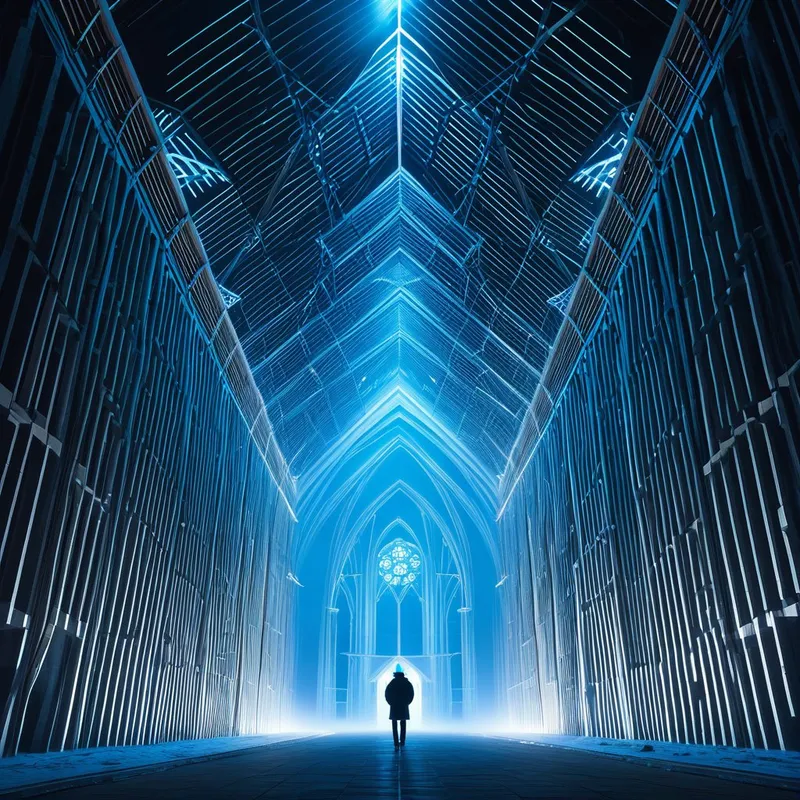
I am in a vast, silent library at night, one I have never seen but know intimately. I am not searching for a book; I am compelled to write one. The pages are blank, but my hands move, etching symbols that are not letters but living, shifting geometries. With each mark, a corresponding shelf in the darkness groans and reorganizes itself, whole sections dissolving and re-crystallizing into new, unknown categories. The library is rewriting its own catalog through my hand.
Alchemical Interpretation: The dreamer is not consuming meaning from external authority (the library) but is actively, somatically authoring the very logic by which their inner world is organized and understood.

The False Lead
This is not a dream of simple problem-solving or planning a project. To mistake the profound psychic restructuring of Meaning Construction for mundane anxiety about "figuring things out" is to confuse an earthquake with a shaky table. The terror—and the glory—of these dreams is not in finding a pre-existing answer on a shelf, but in the horrifying, liberating realization that you must invent the shelf, the cataloging system, and the language of the text itself. It is the difference between following a map and realizing you are the cartographer of a territory that forms only as you walk.
Psychological Architecture
Here, Shadow work is not about confronting a monster in a dark corner; it is about confronting the architect of the labyrinth you find yourself in. The process of Individuation, in this theme, is the slow, often excruciating, act of taking responsibility for the design of your own reality-tunnel. You encounter the parts of you that built walls for safety that became prisons, that crafted stories of identity that hardened into limiting scripts. The work is a dismantling—not with wrecking balls, but with the precise, patient tools of awareness. You feel the grief of the orphaned self who believed meaning was something given, and the terror of the sovereign self who must now generate it. This is the architecture of becoming: you are both the site, the material, and the builder.
Mythic Resonance
We see this eternal process in the figure of Weaver deities, like the Norns of Norse myth or Spider Grandmother in many Indigenous traditions. They do not merely observe fate; they spin it, thread by thread, at the loom of existence. Their power is not in domination, but in continuous, conscious creation. Similarly, the alchemical myth of the Philosopher's Stone is not about finding a magical object, but about undergoing the opus—the great work—of transforming base perception (the prima materia of unexamined experience) into the gold of conscious, self-authored meaning. The stone is not found; it is constructed within the vessel of the self.
Symbolic Nodes
- Building sites, scaffolds, half-finished structures.
- Writing or coding in unknown languages or symbols.
- Assembling machines, puzzles, or complex models.
- Libraries, archives, or servers being reorganized.
- Weaving, knitting, or circuit-boarding.
- Empty rooms or blank canvases that demand filling.
- Foundational elements: cornerstones, keystones, source code.
Archetypal Resonance
The energy at the core of Meaning Construction is that of The Creator Archetype. This is not the shadow creator, obsessed with a fixed, perfect product, but the essential Creator who understands that the act of bringing form from chaos is the fundamental divine impulse. The somatic echo of pressure and potential is the Creator feeling the urge of the unborn idea. The alchemical potential lies in its willingness to engage with the raw, often messy, process of iteration—to build, tear down, and rebuild the internal structures of belief and identity. This archetype knows that meaning is not mined, but made; its sovereignty comes from embracing this terrifying and glorious responsibility as the artist of one's own soul.
The Alchemical Process
The transmutation here is from consumer to author. The prima materia is the passive, inherited, or trauma-forged narrative of your life—the meaning you were given. The heat and pressure are applied by the conscious, often disorienting, act of questioning every assumption: Who built this wall in my heart? Who wrote this rule in my mind? Do I choose to keep it? This is the nigredo, the blackening, where old structures lose their solidity and dissolve into chaotic potential. The albedo, the whitening, is the emergence of a new, self-reflective awareness—the "I" that can observe the construction process itself. The final rubedo, the reddening, is not a finished product, but the achieved capacity to live in conscious, fluid creation of your world's meaning, holding the tools of your perception with steady hands.
The Integration Protocol
Question 1: In my waking life, where do I feel like a passive tenant in the architecture of my reality, and where do I feel like the active architect?
Question 2: What is one foundational "story" or belief about myself or the world that I have never consciously chosen, but have simply inherited or absorbed? What would its opposite be?
Question 3: If my current sense of self were a building, what room feels most authentically "mine," and what room feels like it was designed by someone else's blueprint?
Action 1 (Somatic Blueprint): For five minutes, sit in silence and place your hands on your sternum. Feel the physical structure of your body—the rib cage, the spine. Imagine your breath is not just air, but a luminous substance flowing through you, and with each exhale, it solidifies into the most basic, essential structure that you would choose to live within. Don't visualize a house; feel the quality of the space.
Action 2 (Unstructured Codex): Take a blank notebook or document. Set a timer for 10 minutes. Begin writing, drawing, or diagramming with the sole instruction: "I am writing the first rule of my own constitution." Let it be messy, paradoxical, and raw. This is not a manifesto for others; it is the first mark on your own blank page.
Action 3 (Ritual Re-cataloging): Choose one small, physical area of your home—a bookshelf, a drawer, a digital folder. Empty it completely. Then, reorganize its contents not by conventional categories (alphabet, date, type), but by a personal, felt sense of connection, resonance, or a new logic you invent in the moment. Observe the slight shift in authority this act requires.
Final Validation
To dream of building meaning is to be assigned the most daunting and sacred of tasks. It is far easier, and often less lonely, to live in a pre-fabricated world. Honor the disorientation, the grief for the simpler world of given answers, and the sheer fatigue of such psychic labor. Then, feel for the quiet, unshakeable hum beneath it all—the hum of your own creative sovereignty. You are not lost in a library someone else built. You are the library, the book, and the hand that writes. The meaning you seek is not hidden in the text. You are the meaning, under construction.