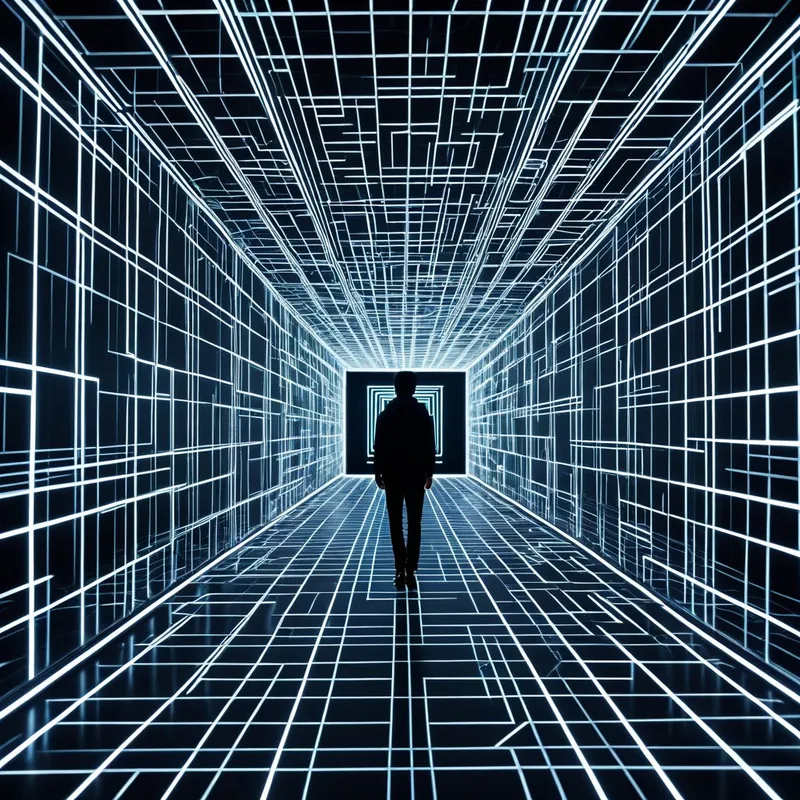
The Hidden Strings: On the Dream Theme of Manipulation
The Somatic Echo
Before the mind forms the image of the puppet master, the body knows. It is a specific, chilling inertia. Not the paralysis of terror, but the leaden weight of compelled motion. Your limbs feel like someone else’s property. Your breath hitches, not from fear, but from the violation of a rhythm forced out of sync. There is a nausea in the gut—not from disgust, but from the ingestion of a will that is not your own. The jaw may clench against a command not yet spoken; the shoulders hunch, preparing for a burden placed there by invisible hands. This is the somatic signature of manipulation: the deep, cellular recognition that your agency has been hijacked. Your nervous system is not your own. It is a occupied territory, broadcasting on a frequency you did not choose.
The Dreamer's Log
The dream is always the same. I am in a vast, silent server room, cold and humming. I sit at a terminal, my fingers flying across a keyboard, coding something urgent and vital. But then I look down. My hands are not moving of their own accord. Thin, luminous strings are attached to each finger, rising up into the darkness of the ceiling. Someone, something, is playing me like an instrument. I am typing the will of another.
Alchemical Interpretation: The dream reveals the psyche’s confrontation with an internalized program—a foreign “will” operating through the dreamer’s own skilled hands, mistaking compliance for creation.

The False Lead
This is not a dream about mere external coercion or “bad luck.” To interpret it as a simple warning about a manipulative person in your waking life is to miss the deeper, more unsettling truth. The external figure, if one appears, is often a projection—a mask worn by a part of your own psyche that has mastered the art of controlling you. This theme is not about the villain “out there.” It is about the internal governance that has turned tyrannical, the sub-routines of protection that have become prison guards. It is the shadow of autonomy itself.
Psychological Architecture
The architecture of manipulation in the psyche is built from borrowed blueprints. In childhood, we internalize scripts for safety: “If I am perfect, I will be loved.” “If I anticipate every need, I will not be abandoned.” “If I make no waves, I will be safe.” These are survival mechanisms, the inner Caregiver or Orphan learning to manipulate the environment—and later, the self—to secure belonging. But in adulthood, these mechanisms fossilize. The inner Magician, whose gift is transformation, twists into its shadow. It stops weaving reality from authentic desire and starts constructing elaborate illusions of control. It manipulates your emotions (“Don’t feel that, it’s dangerous”), your choices (“This path is safer”), your very perception of reality.
The individuation process here is a brutal, necessary demolition. It requires you to feel the strings. Not to cut them in a blind rage—that is the Shadow Rebel’s game—but to trace each one back to its source within you. Which exiled part of you is holding the other end? Is it the frightened child pulling strings to keep the parent-pleaser performing? Is it the cynical protector manipulating you into isolation to avoid the risk of hurt? This is shadow work of the highest order: re-integrating the puppet-master by listening to its terrified reasons for existing. Sovereignty is not born from destroying the controller, but from understanding its fears so profoundly that its services are no longer required.
Mythic Resonance
We see this eternal drama in the myth of Theseus and the Minotaur. The labyrinth is not just a physical trap; it is a psychological construct, a system of confusion built by a ruler (King Minos) to contain a monstrous, shameful secret (the Minotaur). To navigate it, Theseus does not merely use brute force. He must use a thread—a connection to his authentic self (Ariadne’s gift)—to avoid being lost in the manipulative maze. The victory is not just slaying the beast, but retracing his steps out of the system, reclaiming his path from the architecture designed to consume him. The modern labyrinth is internal: the twisting corridors of “shoulds,” the dead ends of inherited beliefs, the minotaur of our own repressed rage, fed by our compliance.
Symbolic Nodes
- Puppets, Marionettes, Dolls: The classic image of animated passivity.
- Remote Controls, Consoles, Keyboards: Interfaces for control at a distance.
- Strings, Wires, Cords, Leashes: The tangible connections of influence.
- Ventriloquist Dummies: Voice and agency sourced from elsewhere.
- Being a Passenger in a Vehicle You Cannot Steer: Movement without direction.
- Scripts, Teleprompters, Pre-Written Notes: Language that is not your own.
- Mirrors that Reflect a Different Face: A distorted or foreign self-image imposed.
Archetypal Resonance
The core energy of this theme resonates most powerfully with The Shadow Magician.
The Magician’s gift is the understanding of hidden forces and the fundamental principles of reality to manifest change. Its shadow, the Manipulator or Illusionist, perverts this gift. It uses its knowledge of psychological systems—your fears, your desires, your vulnerabilities—not to liberate, but to control. It creates convincing illusions of choice where none exist, weaving spells of guilt, obligation, or false necessity. The somatic echo of leaden inertia is the body under the Manipulator’s spell, its natural rhythms overridden by a foreign code. The alchemical potential lies in forcing this Shadow Magician to turn its gaze inward, to use its profound understanding of systems not to manage the prison, but to architect the key. It must transmute from illusionist to authentic alchemist, transforming the base metal of compelled behavior into the gold of conscious, self-authored will.
The Alchemical Process
The transmutation of manipulation is the Reclamation of the Instrument. The heat required is the unbearable friction between who you are pretending to be and the silent, screaming shape of your authentic will. This is not a gentle warming. It is the pressure of saying “no” when every internal string vibrates with the terror of “yes.” It is the heat of allowing a relationship to fracture, a role to be abandoned, a script to go unread—not from rebellion, but from the slow, solidifying truth of “I am not that.”
The process begins in the nigredo, the blackening: the despair of realizing you have been both puppet and puppet-master in your own life. The grief for time lost to performed emotions and borrowed ambitions. Then, the albedo, the whitening: the cleansing clarity of tracing one string, just one, to its source. “I do this because a part of me believes I must to survive.” This insight is the solvent. Finally, the rubedo, the reddening: the integration. You do not cut the frightened part off; you take its hand. You thank its shadow Magician for its desperate, misguided protection. And in that integration, the string dissolves. What remains is not a void, but a nerve. A direct line to your own authority. The instrument is no longer played by another; it learns to sing with its own voice.

The Integration Protocol
Question 1: In the dream, what was being manipulated? Your voice? Your movement? Your choices? Trace this back: in your waking life, where do you feel that same specific quality of agency being muted, directed, or overridden?
Question 2: If the manipulating force in the dream could speak, what would its primary argument be? What is it trying to prevent or achieve by controlling you? Listen for the fear beneath the control.
Question 3: Imagine the dream scenario, but this time, you become aware of the strings and stop resisting them. You simply feel their pull, acknowledge their source, and then, with infinite slowness, begin to move your limb in a slightly different direction than the pull. What new possibility emerges?
Action 1 (Micro-Sovereignty): For one day, commit to a tiny, inconsequential rebellion of authenticity. Wear the mismatched sock. Order the drink you truly want, not the one you think is “appropriate.” Do not explain or justify it. Simply act from the un-manipulated core. Feel the internal tremor of a string going slack.
Action 2 (Mapping the Labyrinth): Take a large piece of paper. In the center, draw a simple symbol of yourself. Now, without overthinking, draw lines outward like branches or corridors. Label each with a “should,” an obligation, or a role that feels compulsory (“The Good Employee,” “The Reliable Friend,” “The Person Who Never Gets Angry”). This is your labyrinth. Now, lightly draw your Ariadne’s thread—a single, colored line—winding through it, connecting back to your center. Where does the thread want to go that the labyrinth’s walls do not allow?
Action 3 (The Un-scripting Ritual): Write a monologue—the script you feel you’ve been performing in a key area of life. Then, burn it safely. As it burns, speak aloud (even in a whisper) one sentence that contradicts the script, that comes from a place before the strings were attached. It can be as simple as “I am tired,” or “I want something else.” Let the ash be the compost for an unscripted word to grow.
Final Validation
To dream of manipulation is to touch one of the deepest wounds of the soul: the alienation from one’s own will. It is terrifying, humiliating, and profoundly disorienting. Honor that. You are not weak for having these dreams; you are courageous for meeting this shadow material at the threshold of awareness. This dream is not a sentence; it is an invitation to the most sacred of reclaimations. The strings you feel are not your destiny. They are the final, fragile tethers to a governance you are ready to outgrow. Your sovereignty awaits not in the severing of a thousand threads, but in the quiet, undeniable act of feeling your own pulse beneath them, and choosing, stitch by internal stitch, to weave a tapestry of your own design.