The Lost Paradise: An Alchemy of Exile and Return
The Somatic Echo
It begins not as a thought, but as a hollow ache behind the sternum—a phantom limb for a world you swear you once inhabited. It’s the taste of a fruit you cannot name on a tongue that remembers sweetness. It’s a gravity in the bones, a subtle pull toward a magnetic north your compass no longer acknowledges. This is the somatic echo of the Lost Paradise. It is the body’s memory of integration, of a time before the internal civil war, before certain parts of you were deemed unacceptable and sent into exile. The mind may rush to label it “nostalgia” or “regret,” but those are mere translations of a deeper, wordless truth: something whole has been fractured, and the blueprint for that wholeness is still etched into your cellular architecture.
The Dreamer's Log
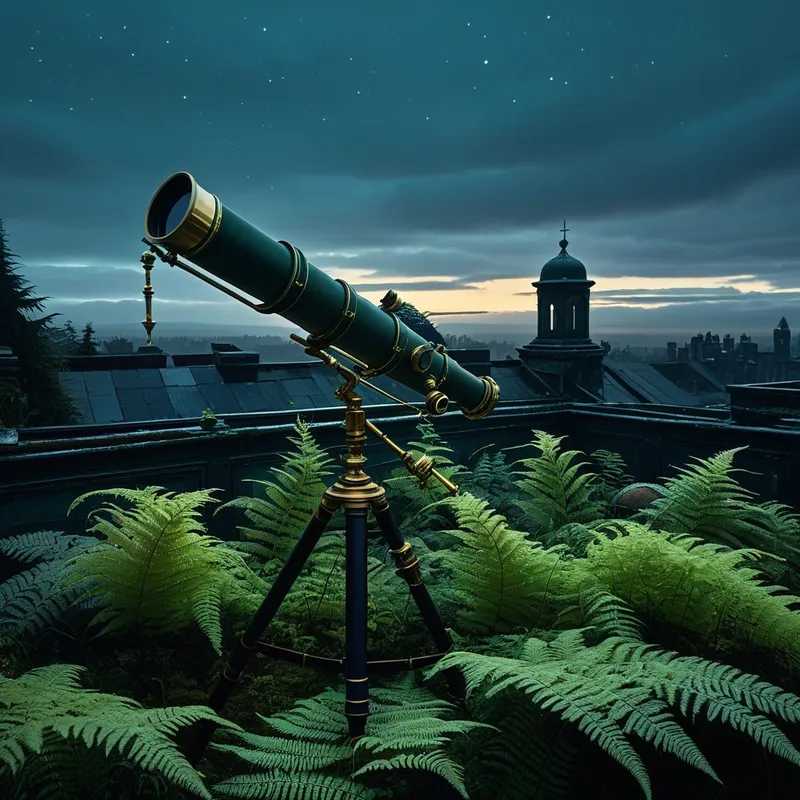
You stand on the rooftop of a derelict skyscraper, a forgotten garden overgrown with luminous, data-moss-covered ferns. In the center, an ornate brass telescope points not at the stars, but at a faint, shimmering crack in the darkening sky. You know, with a certainty that chills you, that this crack is the last remaining gateway to a city of impossible light you built in a dream you’ve since forgotten. The telescope’s lens is clouded with an internal frost you cannot wipe away.
This dream is not about a lost place, but a lost state of being—the visionary architect within you, now dormant, whose tools have grown cold from disuse. The alchemical task is not to find the city, but to thaw the lens of your own perception.
The False Lead
This theme is not about mere misfortune, a streak of bad luck, or simple longing for a happier past. To mistake it for nostalgia is to remain a tourist in your own psyche, snapping photos of a ruin without understanding why it fell. The Lost Paradise is not behind you in linear time. It is a dimension of your own consciousness that has been walled off, a room in your internal mansion whose door has been sealed and labeled “dangerous” or “impossible.” The grief you feel is not for a past event, but for a disowned potential—the Creator who was told to be practical, the Lover who was told to be cautious, the Rebel who was told to conform. The paradise is lost because you, in your complexity, have been partitioned.
Psychological Architecture
The work here is the archaeology of the self. You are not digging for buried treasure, but for exiled citizens of your own psyche. In the language of internal family systems, these exiles are the parts of you that carried too much intensity, too much beauty, too much raw truth for the survival system that developed around you. Perhaps your boundless joy (the Innocent) was met with dismissal, so it retreated, taking with it the capacity for unguarded wonder. Maybe your fierce integrity (the Rebel) caused conflict, so it was locked away, and with it went the courage to set boundaries.
The Shadow work is to descend, without a map, into this internal hinterland. It is to sit in the silence with these exiled ones and listen to their grief. This is not an act of recovery, but of re-membering—literally putting the members of your inner world back into communication. The paradise is the state of internal diplomacy, where exiles are heard, protectors can stand down, and the Self can lead. Individuation demands you become the sovereign of this entire, often war-torn, realm.
Mythic Resonance
We see this not as a one-time event, but as the fundamental human condition in the story of the Fall from Eden. Eden is not a geographical location but a state of unconscious wholeness. The eating from the Tree of Knowledge is the inevitable fracture—the birth of duality, of self-awareness, and with it, shame and exile. The angel with the flaming sword guarding the gate does not bar re-entry to a place, but to a state of naive unity. You cannot unknow what you know. The paradise to be regained is not that ignorant garden, but a conscious, hard-won integration built with the full knowledge of both light and shadow.
Similarly, the Greek myth of Eros and Psyche whispers of this process. Psyche’s paradise is the nocturnal, blissful union with Eros, lost the moment she brings a light to see him—to know him. Her subsequent trials—sorting seeds, gathering golden wool, fetching water from the Styx—are not punishments, but the exact, brutal alchemical operations required to rebuild a relationship with the divine (her own soul’s depth) on conscious terms, not unconscious projection. The lost paradise of perfect, unseen union must die for the conscious, sacred marriage to be born.
Symbolic Nodes
- A Sealed or Overgrown Gateway/Path: The blocked access to a part of the self.
- A Forgotten or Overgrown Garden: The neglected inner world of potential and soul.
- A Beautiful, Empty City: The structure of a life built without the soul’s inhabitants.
- A Faded or Broken Map: The outdated strategies and beliefs that no longer lead to wholeness.
- A Melting Ice or Thawing Landscape: The beginning of an emotional and psychic thaw, where frozen exiles begin to stir.
- A Key That Doesn’t Fit, or a Door That Won’t Stay Open: The frustration of old methods failing to access new depths.
Archetypal Resonance
The core energy of the Lost Paradise is most potently held by The Orphan Archetype. Not its shadow expression of Victim, but its essential, profound aspect: the Realist and the Survivor. The Orphan knows, in its bones, that the original unity is shattered. It feels the exile viscerally—that somatic echo of separation. It does not traffic in false hope or spiritual bypass. Its gift is the raw, grounding truth of “I am alone in this.” This is not a cry of self-pity, but the necessary, sober starting point for all genuine alchemy. From this felt sense of loss, the Orphan’s resilience is forged. It begins the pragmatic, often lonely work of seeking true kinship, first within the fragmented self. The Orphan’s journey from exile to community mirrors the internal process of re-membering the lost paradise of the whole Self.
The Alchemical Process
The transmutation here is Reintegration. The prima materia is the grief of exile itself—the heavy, leaden sorrow of fragmentation. The furnace is the courageous, sustained attention you bring to that hollow ache, refusing to numb it or dress it in the cheap gold of nostalgia.
The heat is applied in the conscious confrontation with your internal protectors—the Manager who keeps you busy to avoid the silence, the Firefighter who numbs the pain with distraction or compulsion. You must thank them for their service while gently insisting: “I will handle this now.” The pressure is the unbearable tension of holding the contradiction: you are both the one who was exiled (the innocent part) and the one who did the exiling (the protective system). As this heat and pressure build, the frozen grief begins to liquefy. The lost paradise does not reappear as a memory, but is reconstituted as a new, more conscious wholeness. The leaden grief of “what was lost” transmutes into the golden sovereignty of “what I am, in my full spectrum.” You don’t return to the garden; you become the gardener of a new, more resilient and conscious ecology of the soul.
The Integration Protocol
Question 1: Where in my body do I feel the echo of “something missing”? If that sensation had a voice, what one word would it whisper?
Question 2: What part of my own creativity, passion, or wildness did I learn to hide, disown, or exile in order to belong or be safe? What was the unspoken rule that demanded its banishment?
Question 3: If my current life is the “mainland,” what is the forgotten “island” of my potential that I have stopped sending ships to? What one quality lives there?
Action 1 (Somatic Reclamation): For five minutes each day, place your hand over the area of your body where you feel the hollow ache or somatic echo. Breathe into that space. Do not try to fill it or fix it. Simply acknowledge its presence with the warmth of your attention, as you would acknowledge a silent guest in your home.
Action 2 (Exile’s Portrait): Engage in an unstructured creative act. Using any medium—crayons, clay, digital collage—create an image, not of the lost paradise, but of the exiled one who remembers it. Don’t craft a masterpiece; let it be a messy, intuitive sketch. What does this part of you look like? What color is its energy? Place this portrait where you will see it, as a gesture of re-inclusion.
Action 3 (Ritual of the New Gate): Find a small stone or natural object. Hold it and imbue it with the intention of being a “keystone” for a new internal architecture—one that has room for the exiled part. Take it to a crossroads, a bridge, or the base of a strong tree. Leave it there, not as an offering to get something back, but as a physical declaration that you are building new, conscious pathways within.
Final Validation
The longing for a lost paradise is one of the most profound and disorienting aches a soul can carry. It is valid to grieve. It is valid to feel unmoored in a world that seems like a pale imitation of a home you can’t locate on any map. This grief is not a sign of failure, but a proof of depth—a signal from the wholeness that still exists, in potential, within you. You are not broken because you feel this. You are alive to the most crucial task of a human life: the slow, brave, and glorious work of becoming whole on purpose. The paradise is not behind you. It is waiting, in its next, more magnificent form, to be synthesized from the very fragments of your exile. You are both the fallen garden and the gardener who holds the seed of its unimaginable rebirth.