The Architecture of Time: On Dreams of Legacy & Continuity
The Somatic Echo
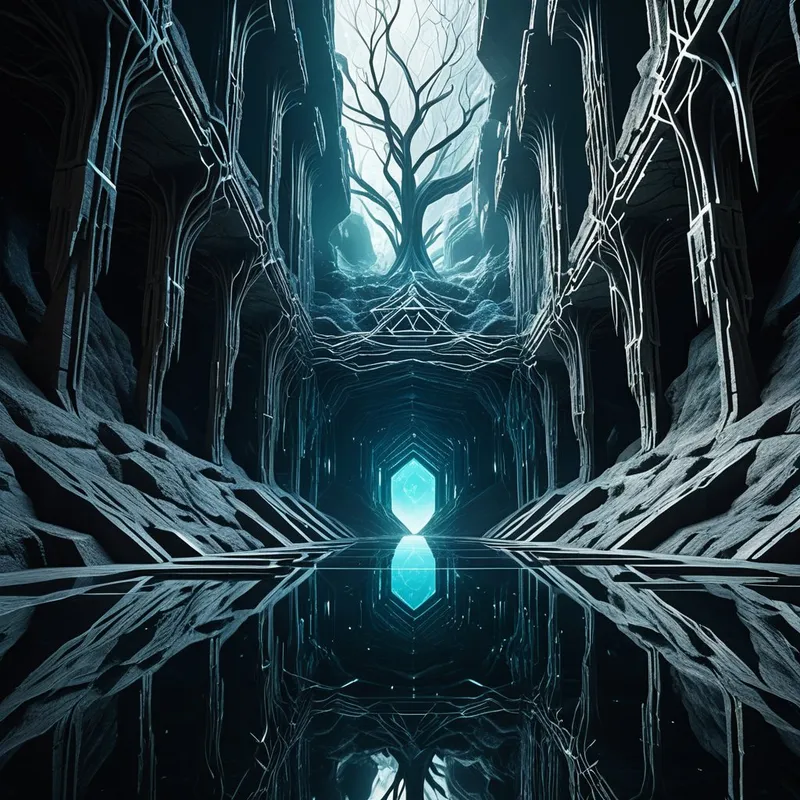
It begins not as a thought, but as a weight. A specific density in the chest, a low hum in the bones. It is the feeling of standing in a long, silent corridor where every door is both an entrance and an exit. There is a pressure, not of panic, but of profound scale—the awareness of being a single sentence in a story that began long before your first breath and will whisper on long after your last. This is the somatic signature of Legacy. It is the body remembering it is made of borrowed stardust and ancestral decisions, feeling the tug of the continuum. The mind may later dress it in images of heirlooms, blueprints, or unborn children, but the first signal is always this: a deep, resonant ache of connection and a terrifying freedom. You are both the inheritor and the architect.
The Dreamer's Log
I am in a vast, silent archive, a hybrid of ancient library and futuristic server farm. My task is to transfer the contents of a single, crumbling leather-bound book onto a blank, luminous tablet. But as I touch the book’s pages, my own memories—not just mine, but echoes of my father’s grief and my grandmother’s resilience—spill into the data-stream, corrupting and enriching the file. The new document becomes something utterly unpredictable, both familiar and alien.
Alchemical Interpretation: The dream presents the core dilemma: legacy is not a passive inheritance to be copied, but a living data-stream that must be personally—and imperfectly—translated through the filter of one’s own lived experience, thereby creating a new original.

The False Lead
This theme is not a morbid preoccupation with death or a simple anxiety about having children. It is not about securing your name in history or the fear of being forgotten. Those are the ego’s literal interpretations, the surface ripples. The deep current of Legacy & Continuity is about structural integrity. It asks: What is the foundational code of my being that I have unconsciously inherited? What chapters of my family’s, my culture’s, my own past story am I compelled to repeat, and which can I consciously edit? A dream of a crumbling family home is not a prophecy of financial ruin; it is an urgent report on the unsustainable psychological foundations you’ve been living within. The terror is not of ending, but of perpetuating—of becoming a mere conduit for patterns that long to be transformed.
Psychological Architecture
To work with this dream theme is to engage in the most profound Shadow excavation. You are not just confronting your personal unconscious, but what Jung called the collective unconscious—the inherited strata of human experience. This is deep Internal Family Systems work on a transgenerational scale. You may discover an exiled part that carries the unexpressed artistry of a grandparent forced into pragmatism. You may meet a firefighter part that rigidly enforces a “family rule” of emotional silence, a legacy of past trauma. The individuation process here is the courageous act of differentiating your true Self from this inherited psychic substrate. It is the process of saying, “This pain is mine to feel, but its origin is not mine to perpetuate. This strength flows to me, and I will channel it into a new form.” You become the conscious editor of a text that was handed to you, often without your consent.
Mythic Resonance
Consider the story of Aeneas, fleeing the burning ruins of Troy. His legacy is not the fallen city itself, but the Penates—the sacred household gods he carries on his shoulders. His destiny is not to rebuild Troy, but to plant those gods in foreign soil, where they will inform the founding of an entirely new civilization, Rome. The legacy is the essential, sacred core, not the literal structure. Similarly, in the Hindu concept of samsara, the cycle of rebirth, the legacy is the karma—the ethical ledger of actions—that passes from life to life. The continuity is not in the personality, but in the consequences of choices, urging the soul toward liberation. These myths tell us that continuity is about the transmission of essence, not form, and that true legacy demands a journey, a sacrifice of the old world to seed the new.
Symbolic Nodes
- Ancestral Homes/Manors: The architecture of the inherited psyche. Attics represent buried memories; basements, foundational (often repressed) instincts; crumbling walls, deteriorating family structures or beliefs.
- Heirlooms, Books, or Sealed Chests: Specific packages of inherited knowledge, trauma, talent, or obligation. The condition of the object and your action toward it (opening, repairing, discarding) is key.
- Bridges, Roots, Rivers, and Data-Streams: Images of connection between past and future, source and destination. A broken bridge indicates a perceived discontinuity; tangled roots suggest confused lineage.
- Unborn Children or Younger Versions of Oneself: The potential future, the next iteration of the self or the lineage. They often appear to receive a message or a warning.
- Blueprints, Code, or Unfinished Art: The plans for the future that are still in your hands to alter or complete.
Archetypal Resonance
The energy at the heart of the Legacy & Continuity theme is that of The Creator Archetype. This is not the shadow Creator, obsessed with a personal monument, but the mature Creator who understands they are a link in a chain of manifestation. The somatic echo—that pressure of scale—is the Creator feeling the weight and potential of all raw material, both inherited and imagined. Its alchemical potential lies in its drive to bring order from chaos, meaning from raw experience. This archetype does not shy from the past; it sifts through the rubble of what was to find the timeless elements—the grief, love, resilience—and uses them as pigments, notes, or words to compose a new work. The dream is the Creator’s workshop, where the legacy of the past is the medium, and the continuity of the future is the emerging masterpiece.
The Alchemical Process
The transmutation here is from Inheritor to Originator. The prima materia is the heavy, often confusing mass of familial, cultural, and personal history. The heat is applied by the conscious, often painful, examination of this material—feeling the full weight of an ancestral grief you did not cause, or acknowledging a talent you were given but have neglected. The pressure is the terrifying responsibility of freedom: realizing you are now the authorizing consciousness, that you can choose to break a chain or bless a lineage.
This is not a gentle process. It requires holding the tension between profound gratitude for what you’ve received and clear-eyed discernment about what is no longer life-giving. You must dissolve the literal, frozen forms of the past (e.g., “We are a family of martyrs”) to extract their essence (e.g., a deep capacity for sacrifice), and then re-coagulate that essence into a new, self-chosen form (e.g., conscious compassion with boundaries). The leaden feeling of fate becomes the gold of authentic, sovereign authorship.
The Integration Protocol
Question 1: If my life to this point were an inherited manuscript, what is one central, recurring chapter title (e.g., “The Silent Grudge,” “The Unstable Foundation”) that I am now ready to edit or conclude?
Question 2: What is one strength or beauty in my lineage that I have received but have not yet fully claimed or embodied as my own?
Question 3: If I were to leave a “toolkit” for the future—not a story of my achievements, but a set of principles, warnings, or encouragements for navigating life—what would be the first three tools in the kit?
Action 1 (Ancestral Inventory): Sit quietly and bring to mind a tangible object you associate with your lineage (a recipe, a saying, a piece of furniture, a place). Without judgment, write down three “codes” or rules this object seems to represent (e.g., “Waste nothing,” “Appearances are paramount”). Circle one you wish to keep. Gently cross out one you wish to release.
Action 2 (Letter to the Continuum): Engage in a piece of unstructured, creative writing. Address it “To My Predecessors and Successors.” Do not write a history or a will. Write a field report from your current position in the timeline. Describe the weather of your soul, the tools that are working, the bridges that are out, the treasures you’ve recently unearthed. Seal it in an envelope. You decide whether to keep it, burn it, or bury it.
Action 3 (Ritual of Translation): Find a family story, tradition, or even a trauma narrative you know well. Your task is to translate it into a different form. If it’s a story of hardship, express its core feeling as a simple melody on an instrument or with your voice. If it’s a tradition of celebration, draw its essential energy as an abstract symbol or color. The goal is not to preserve the literal event, but to transmute its psychic essence into a form that resonates with your soul’s language.
Final Validation
The weight you feel is real. The corridor is long, and the silence can be deafening. To stand at the crossroads of what was and what could be is one of the most disorienting responsibilities of a conscious life. It is right to tremble before it. But within that tremor is a forgotten frequency: the hum of agency. You are not a passive scroll where history inscribes itself. You are the scribe, the editor, and the author of the next passage. The legacy you dream of is not a chain that binds you to the past; it is the raw, living material placed in your hands by all of time, waiting for the unique signature of your choices to transform it into a bridge. The continuity you seek is forged not in the fear of being forgotten, but in the courageous act of creating something true—thereby adding your indispensable verse to the eternal poem.