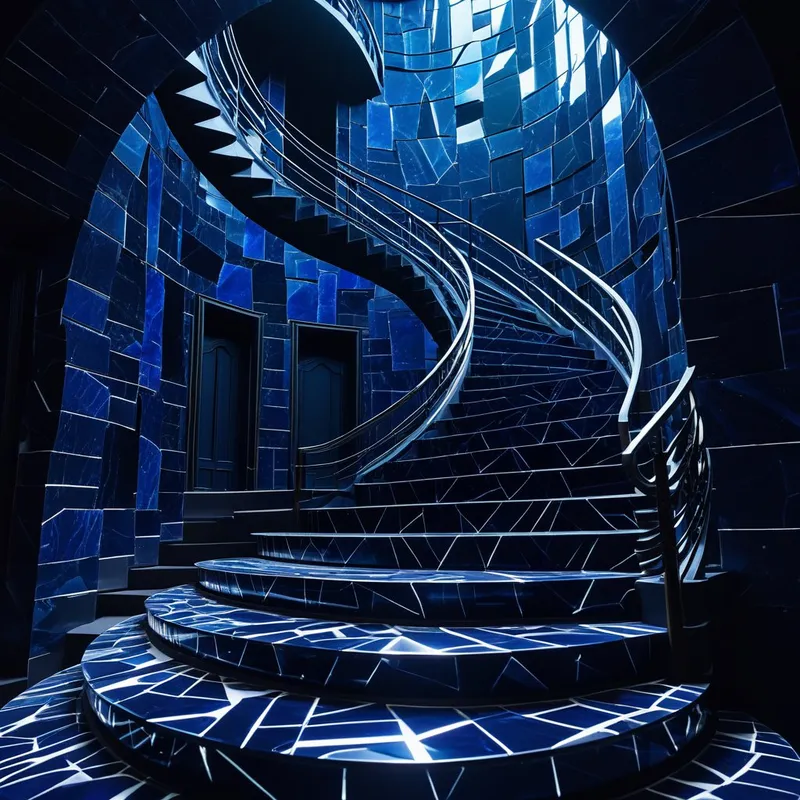
The Dream of Iterative Improvement: The Psyche’s Quiet Refinement
The Somatic Echo
It begins not as a thought, but as a texture in the body. A low-grade hum of almost. A sensation of being perpetually on the cusp of a sigh that never fully releases. The muscles hold a memory of the last attempt, a micro-tension in the jaw, a slight readiness in the shoulders—not for battle, but for the slight adjustment of posture. It is the somatic signature of a system in a state of perpetual calibration. You feel the ghost of the previous version of yourself, a faint afterimage lagging a half-step behind, while the new draft is already forming in the marrow. There is no explosive catharsis here, only the deep, cellular knowledge of incremental shift. The breath itself becomes a metronome for this process: inhale the raw material of experience, exhale a slightly refined understanding. It is the body preparing, again, to edit its own story.
The Dreamer’s Log
Night after night, I find myself in the same cavernous server room. My task is to type a single, perfect sentence onto a page that eternally scrolls. Each time I finish, the sentence is wrong—a clumsy word, a flawed rhythm. The page resets. I begin again, the sentence evolving, becoming clearer, more true, but never quite final. The hum of the machines is the only sound.
This is the alchemy of the draft: the willingness to face the imperfection of the current version as the sole raw material for the next.

The False Lead
This theme is not a narrative of failure or being stuck. To mistake the repetition for a hamster wheel is to misread the entire text. The dream is not saying “you are doomed to repeat,” but rather, “you are compelled to refine.” The difference is everything. A loop of failure is closed, circular, and hopeless. Iterative improvement is a spiral—it revisits coordinates, but from a new altitude. The grief you feel is not for a lack of progress, but for the necessary death of the prior draft. It is the sorrow of the sculptor who must remove more stone, not because the form isn’t emerging, but precisely because it is.
Psychological Architecture
Beneath the surface narrative of repetition lies the profound Shadow work of the internal critic becoming an internal editor. The Shadow here is not a monster, but a perfectionist ghost—a relentless, disembodied standard that once paralyzed you. The individuation process in this theme involves allying with that ghost. You are not trying to silence the voice that says “this could be better.” You are learning to ask it, “How?”
This is the architecture of the self being built in real-time. Each iteration is a negotiation between internal family systems: the Orphan who fears the work will never be good enough, the Ruler who demands order and completion, and the silent, watchful Sage who knows the value of the process itself. The work is to host this council, not to let one member dominate. The terror is the fear of infinite regress, of never arriving. The grief is for the versions of yourself you must leave behind on the drafting room floor. To integrate this is to find sovereignty not in a finished product, but in your authority over the process itself. You become the curator of your own becoming.
Mythic Resonance
We see this firmware in the myth of Sisyphus, but often misunderstand it. The archetypal punishment is not the rolling of the stone, but the moment it rolls back down—the reset. Yet, what if the consciousness of Sisyphus were to shift? What if, in each ascent, he noticed a new fissure in the stone, a different quality of light on the hillside, a newfound efficiency in his stance? The myth then transforms from one of futile punishment to one of ultimate, iterative refinement. The task doesn’t change; the consciousness executing it evolves. Similarly, in the Eastern concept of the potter and the clay, the wheel’s revolutions are not monotonous; each pass of the hands applies subtle, new pressure, coaxing form from formlessness through patient, cyclical touch. The vessel emerges not from a single act, but from ten thousand tiny corrections.
Symbolic Nodes
- Polishing or Sanding an Object: The focus is on the gradual removal of roughness to reveal a latent form.
- Rewriting or Editing Text: The core content remains, but its expression is honed.
- Rehearsing a Piece of Music or Speech: The sequence is known, but the delivery is perfected.
- Navigating a Recurring Maze with New Shortcuts: The environment is familiar, but your efficiency within it grows.
- A Plant Growing in Time-Lapse: The visible change between frames is minimal, but the overall transformation is profound.
- Software Code Compiling, Failing, and Being Debugged: The structure is logical, and errors are necessary information for the next build.
Archetypal Resonance
The energy here is most purely that of The Creator Archetype. Not the Shadow Creator, obsessed with a singular, grandiose vision, but the essential Creator whose fundamental action is to bring form into being through persistent shaping. The somatic echo of almost is the Creator feeling the potential in the raw material. The alchemical potential lies in the Creator’s sacred tolerance for the messy, intermediate draft—the willingness to dwell in the "not-yet" as a place of fertile possibility. This archetype does not fear revision; it understands that creation is revision. Its core energy is not about a flash of inspiration, but the patient, cyclical application of vision to matter, where each cycle incorporates the learning of the last. The dream is the psyche’s workshop, and the Creator is at the bench, sleeves rolled up, engaged in the holy labor of making and remaking the self.
The Alchemical Process
The transmutation here is of Grief into Ground. The base metal is the sorrow for time spent, for efforts that seem lost in the reset, for the idealized version of yourself or your work that must be dissolved. The alchemical vessel is your sustained attention. The heat and pressure are applied by the conscious choice to return to the task after the perceived failure, after the disappointment, after the stone has rolled back down.
This is the Opus Contra Naturam—the work against the ego’s nature, which desires completion and praise. You must apply the heat of patience to the cold grief of imperfection. The pressure is the weight of your own compassionate discipline. In this crucible, the grief does not vanish; it decants. Its volatile elements—self-pity, frustration—burn off. What remains is a dense, fertile residue: the ground of experience. This ground becomes the foundation for the next iteration. You are not starting over; you are building upon the settled sediment of all your previous attempts. The terror of infinite regress transmutes into the profound sovereignty of knowing you are always standing on the ground of your own becoming.

The Integration Protocol
To integrate the dream of iterative improvement is to consciously engage with its spiral.
Question 1: Where in my waking life do I feel the "hum of almost"? Where is there a subtle, persistent call to refine, rather than a demand to abandon or complete?
Question 2: Which internal part of me feels grief or impatience with the cyclical nature of this process? Can I thank it for its desire for completion, while inviting it to witness the value of the draft?
Question 3: If my current challenge is "Version 1.0," what was the key learning from "Version 0.9"? What single, micro-addition or subtraction would create "Version 1.1"?
Action 1 (Somatic Grounding): For one week, practice this upon waking: Before your mind reviews the day's tasks, feel the weight of your body in bed. Acknowledge, without words, "This is the current draft." Breathe into the spaces where you feel the tension of almost. Let the exhale be a release of the need for the final version, just for this moment.
Action 2 (Creative Revision): Take a piece of past creative work—a paragraph you wrote, a simple drawing, a photo you took. Set a timer for 20 minutes. Your task is not to finish it, but to make five distinct, small revisions to it. Change five words. Add five strokes of a different color. Apply five different digital filters. The goal is the act of revision itself, to re-familiarize yourself with the feeling of improving by subtle degrees.
Action 3 (Ritual of the Draft): Find a small, ordinary stone. This is your "current draft." Carry it with you for a day. Each time you feel frustration at a repetitive task or a slow progress, hold the stone. At the end of the day, wash it clean under running water, symbolically clearing the slate for the next day's iterations. Then place it where you will see it in the morning.
Final Validation
It is profoundly difficult to live in the draft. The world rewards finished products, shiny completions. To honor the iterative dream is to court a quiet kind of loneliness, to find your validation in the infinitesimal shift, visible perhaps only to you. This is the path of the true creator, the one who understands that the masterpiece is not a singular event, but the final iteration of a thousand silent, faithful revisions. Your dream is not a record of stuckness, but a blueprint of your psyche’s most elegant and patient technology: the technology of becoming, one deliberate, imperfect, glorious edit at a time. The sovereignty you seek is not at the end of the spiral. It is in your hand, on the wheel, making the next turn.