
The Forgotten Compass: Dreaming of Instincts
The Somatic Echo
Before it is an image, it is a tremor. A vibration in the solar plexus that tightens like a fist. A sudden chill that races up the spine, unrelated to temperature. A taste of copper on the tongue in a silent room. This is the somatic echo—the body’s intelligence speaking in a language older than words. It is not anxiety, though the mind may label it as such. Anxiety is a story spun from that raw sensation, a frantic attempt to narrate the unspeakable. The instinctual echo is the pure, uninterpreted signal. It is the gut knowing the door is wrong before the lock clicks. It is the skin prickling at a smile that doesn’t reach the eyes. In dreams, this echo becomes the landscape itself—a gravity that pulls you toward or away from something with a force that feels geological, not psychological. You are not thinking your way through this terrain; you are being moved by it, a leaf on a deep, subterranean current.
The Dreamer's Log (Case Vignette)
The dreamer is lost in a labyrinthine, rain-slicked city of towering, silent servers. Every corridor looks identical, lit by the cold glow of failing neon. A profound, wordless dread coils in their stomach. Then, from a shadowed alcove, a sleek black cat with eyes like polished jade emerges. It doesn’t meow. It simply looks at them, turns, and pads softly down a side passage they hadn’t noticed. Without thought, the dreamer follows.
The cat is not a guide to be understood, but a movement to be followed—an externalized pulse of the dreamer’s own suppressed somatic knowing, cutting through the maze of over-analysis.

The False Lead
This theme is not a regression to animalistic impulse or unchecked id. The modern mind, terrified of its own loss of control, often mislabels deep instinct as mere aggression, lust, or panic. It is not the shadow’s crude demand, but the core’s sophisticated navigation system. A dream of instinct is not telling you to act out, but to tune in. It is not about unleashing chaos, but about recognizing a more ancient, more reliable order that exists beneath the fragile scaffolding of your rational plans. The false lead is to believe the body is stupid. The truth is, it has been waiting, patiently, for the mind to grow quiet enough to listen.
Psychological Architecture
To engage with instinct in dreams is to undertake the deepest Shadow work: the reclamation of the animal soul. We have exiled it to the basement of the psyche, calling it primitive, dirty, unreliable. Individuation here is not about ascending to a higher spiritual plane, but about descending to recover a lost foundation. It is the process of welcoming back the exiled part of you that knows without knowing how it knows. This is not a merger with the shadow in its antagonistic form, but a reconciliation with the body’s innate wisdom—the part that remembers how to heal, how to sense danger, how to choose the nourishing path. The architecture of the modern self is often built upon the burial ground of this instinct. The dream is the ground shaking, the buried thing stirring. To integrate it is not to become less civilized, but to become more wholly, resiliently human—a being who thinks with the gut, feels through the bones, and decides from a place of embodied congruence.
Mythic Resonance
Consider the story of Odysseus and the Sirens. He has his crew plug their ears with wax and bind him to the mast so he can hear the beautiful, lethal song without being destroyed by it. This is the psyche’s initial, brilliant strategy: bind the instinctual self (the body that would leap overboard) so the conscious self (the mind that desires the experience) can survive. But there is another, older myth. Orpheus, descending into the underworld, does not bind himself. He walks freely, armed only with his lyre—his own embodied, resonant voice. His art is not a barrier against the instinctual realm (Hades), but a bridge. He navigates by vibration, by feeling, by a truth sung from the core. The instinct dream asks: are you still bound to the mast, a prisoner of your own safeguards? Or are you learning, like Orpheus, to move through the underworld with a different kind of intelligence—one that sings to the shadows because it remembers it is made of the same stuff?
Symbolic Nodes
- Animals (especially predators, or ones moving with silent purpose): The unmediated life force, a consciousness that operates purely through sensing and responding.
- Unfamiliar yet compelling paths/doors/tunnels: The body’s directional pull, urging a movement the mind has not yet mapped.
- Sudden elemental shifts (earthquakes, floods, fires): The overwhelming force of somatic truth breaking through mental containment.
- Visceral sensations as the primary event (falling, flying, being pulled): The dream bypassing imagery entirely to place you directly in the kinetic experience.
- A trusted object that "speaks" through vibration or warmth: A symbol of the latent intelligence within the familiar, waiting to be felt, not analyzed.
Archetypal Resonance
The Magician Archetype is the master of this realm. Not the Shadow Magician who manipulates external forces through illusion, but the true Magician who understands that the fundamental transformation occurs within the vessel of the self. The instinct is the raw, uncoded prima materia—the chaotic, living data of the body. The Magician’s work is to provide the sacred space (awareness) and the focused intent (attention) to transmute this raw sensation into conscious knowing. The somatic echo is the first spark of the experiment. The act of heeding it, of following the black cat without understanding why, is the application of the formula. The Magician does not create the instinct; they create the condition for it to reveal its intelligence. This archetype resonates because it moves beyond the duality of mind versus body, becoming the alchemical container where the two can finally converse and coalesce into a third, more sovereign thing: embodied wisdom.
The Alchemical Process
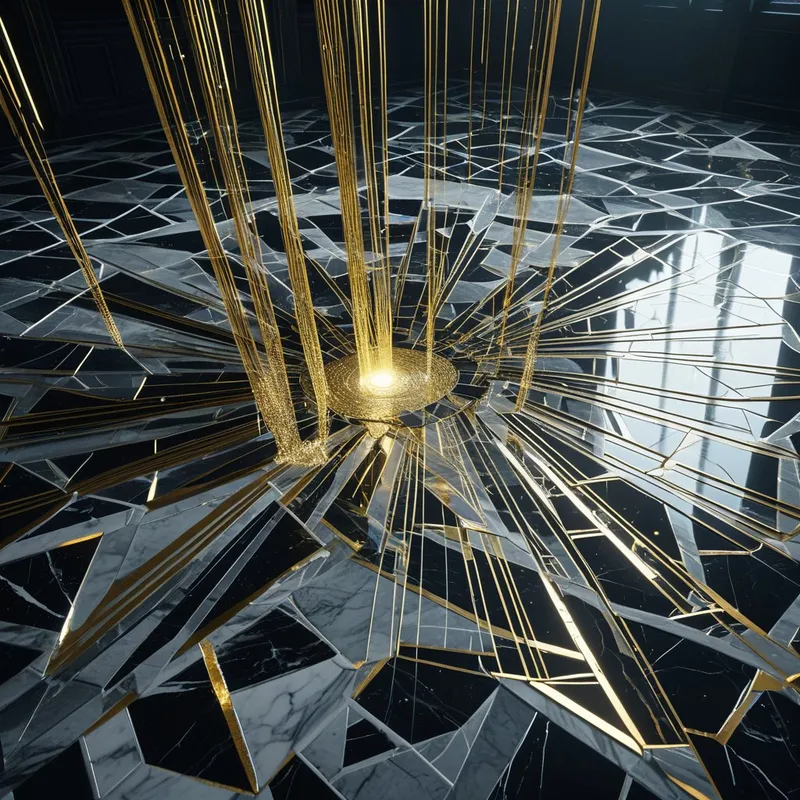
The transmutation of instinct is an alchemy of sublimation—not in the Freudian sense of redirecting base urges, but in the literal, alchemical sense: turning the solid, dense matter of bodily sensation directly into the vapor of conscious insight, bypassing the liquid state of emotional story altogether. The required heat is the intense discomfort of not interpreting. The pressure is the sustained focus on the pure physical echo—the knot in the stomach, the rush of heat—while ruthlessly dismissing the mind’s immediate, frantic narratives (“This means I’m afraid of commitment,” “This proves I’m not safe”). You must hold the sensation in the crucible of your attention until it cracks open not as a thought, but as a knowing. This is the terror: to be without a story. This is the grief: to realize how many times you overrode this quiet pulse with a loud theory. The sovereignty gained is unshakable, for it is rooted in the bedrock of your own sensory truth. You are no longer a passenger in your body, you are its native inhabitant, fluent in its dialect.
The Integration Protocol
Question 1: In your waking life, when did you last have a strong, wordless "gut feeling" that you overruled with logic or "shoulds"? What was the somatic signature of that feeling (e.g., a sinking, a tightening, a flutter)?
Question 2: Where in your dream landscape did you feel most drawn or most repelled, not by plot, but by a magnetic, physical pull? Can you describe that pull as a pure force, without assigning it a meaning?
Question 3: If your instinctual self had a voice that was not words, but a sound, a texture, or a movement, what would it be? Is it a low hum, the smoothness of stone, the uncoiling of a spring?
Action 1 (Somatic Anchoring): For one minute, three times a day, stop everything. Place a hand on your abdomen or chest. Breathe normally. Do not seek calm. Simply feel. Note one pure physical sensation: warmth, coolness, vibration, stillness, pressure, emptiness. Name only the sensation. This trains the mind to attend to the body’s broadcast.
Action 2 (Unstructured Cartography): Take a large sheet of paper and colored pens. Without planning, let your hand draw lines, shapes, and textures that represent the felt sense of a recent instinct dream or gut feeling. Do not draw objects or scenes. Draw the energy, the weight, the movement. Let the body guide the map.
Action 3 (Ritual of Embodied Choice): The next time you face a minor decision (what to eat, which route to walk), pause. Present the options internally, then drop your awareness into your body. Notice if one option creates a sense of expansion, lightness, or flow, and another creates contraction, density, or friction. Choose based on the somatic response. Record the outcome not in terms of "right/wrong," but in terms of the quality of experience it generated.
Final Validation
It is profoundly difficult to listen to a voice you were taught to distrust, to heed a signal from a part of yourself long considered a stranger, even an enemy. The mind’s tyranny is a familiar prison. The raw vulnerability of the instinctual echo can feel like madness. Honor that difficulty. And then, consider this: that tremor, that chill, that pull is the most loyal part of you. It has never abandoned its post. It has been speaking all along, in the only language it knows—the silent, sure language of the flesh. Your dream is not a breakdown of order, but an invitation to a deeper, more authentic one. To integrate this is to stop navigating the world by borrowed maps, and to begin to feel, with every fiber of your being, the true north of your own existence.