
Identity Duality: The Dream of the Split Self
The dream of Identity Duality does not announce itself with words. It arrives first as a tremor in the foundation of being, a somatic echo that vibrates in the marrow before the mind can name it. It is the feeling of inhabiting two bodies at once, one moving through the world with practiced grace, the other watching from a cold, silent distance. It is the vertigo of hearing your own voice speak words that feel both utterly yours and alien, a script written by a ghost in your own machine. The body becomes a contested territory, a house divided. A tightness in the chest, not of anxiety, but of containment—as if one lung breathes air, and the other breathes static. A subtle dissociation in the hands, where your gestures feel both performed and authentic, leaving you wondering who, precisely, is waving. This is the pre-verbal truth of the split: the psyche’s civil war made flesh.
The Dreamer's Log
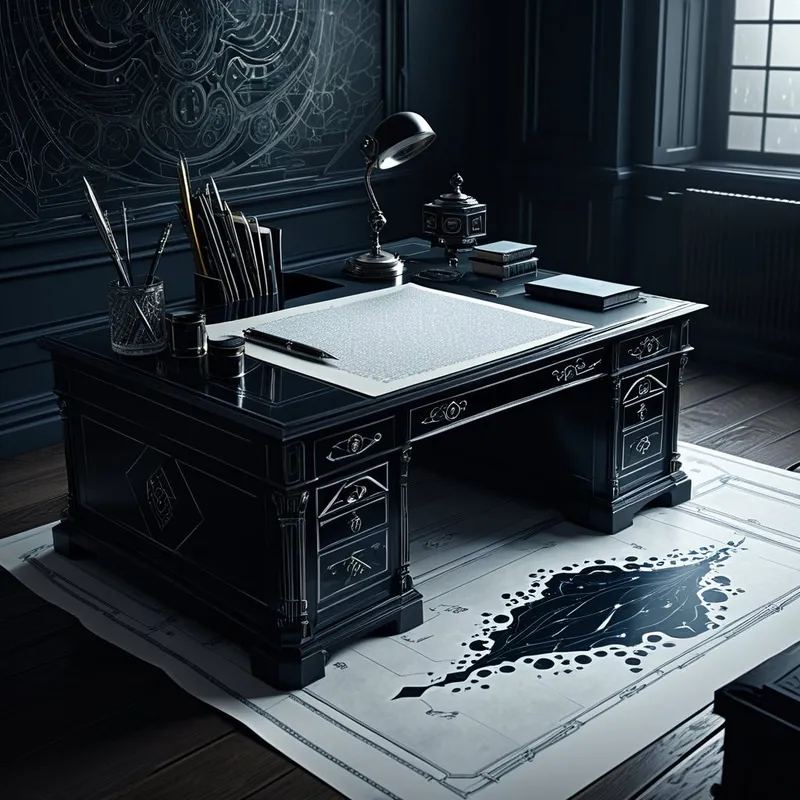
I am in my study, but it is too clean, too silent. I pick up my favorite pen to write, but the ink that flows from it is not mine. It spills onto the page, forming a chaotic, living stain that moves against my will. From the stain, a second version of me begins to coalesce in the reflection of the dark window—wilder, older, watching me with a knowing sadness.
This dream is an alchemical invitation: the controlled instrument of the ego (the pen) is usurped by the unconscious (the wild ink), revealing the shadow self that writes the narratives you dare not claim.
The False Lead
This is not a dream about simple indecision or the stress of wearing different "hats" at work and home. That is role management, a surface dance. Identity Duality points to something far more fundamental: a structural fissure in the sense of "I." It is not about having conflicting desires, but about the terrifying realization that the desiring subjects themselves are multiple and often strangers to one another. To mistake this profound, archetypal rift for mere "burnout" or "imposter syndrome" is to apply a bandage to a fault line. The dream is not reporting a problem of luck or effort; it is diagnosing a condition of the soul.
Psychological Architecture
To encounter Identity Duality in dreams is to be summoned to the deepest layer of Shadow work, the stage of Individuation where the persona—the mask we comfortably wear—cracks to reveal the contradictory figures living beneath. This is not an intellectual exercise. It is the experience of meeting your own ghost in the hallway of your life. One part of you, often the one that pays the bills and follows the rules, sits neatly at the desk. The other, the one brimming with exiled grief, untamed creativity, or feral rage, is the inkblot—formless, potent, and disobedient. The psyche, in its infinite wisdom, uses the dreamscape to stage this confrontation because waking consciousness would too quickly rationalize it away. Here, in the dark, you must feel the truth: you are both the architect of the clean room and the wild substance defacing its order. The path to wholeness, to Individuation, lies not in choosing one over the other, but in enduring the searing tension of their coexistence until a third, more conscious "I" is born from the conflict.
Mythic Resonance
We see this eternal drama etched in the firmware of human story. Take the myth of Janus, the Roman god of beginnings, gates, and transitions, depicted with two faces looking in opposite directions. He was not seen as duplicitous, but as profoundly necessary—the guardian of the threshold who holds the knowledge of both the inner courtyard and the outer road. He embodies the duality of identity not as a flaw, but as the very structure of passage. To move from one state of being to another, you must be able to see where you are and where you are going, to be both the past self and the future self simultaneously. In a more tragic key, Dr. Jekyll and Mr. Hyde is not merely a tale of good versus evil, but a Gothic map of what happens when this duality is denied, when the shadow is not integrated but violently expelled, only to return with autonomous, destructive force. The myth warns us: the self you refuse to acknowledge does not vanish; it gains a life of its own.
Symbolic Nodes
- Mirrors or reflections that behave independently.
- Twins, doppelgängers, or meeting another "you."
- A house or body with a secret, unknown room.
- Possession or being controlled by an external force.
- Mismatched clothing or wearing a uniform that doesn't fit.
- A tool or instrument (like a pen, key, or phone) that functions unpredictably.
Archetypal Resonance
The core energy of Identity Duality resonates most powerfully with The Magician Archetype, specifically in its shadow manifestation. The Magician’s gift is the conscious transformation of reality through will, knowledge, and the manipulation of unseen forces. Its shadow, however, is the Manipulator or Illusionist—the part of us that tries to manage the internal split through deception, both of the self and others.
This shadow archetype is active because Identity Duality creates a profound sense of internal fraudulence. One fragmented self becomes the stage manager, desperately trying to curate a seamless performance for the world (and for the other parts of the self), using illusion to hide the chaos backstage. The somatic echo of tightness and dissociation is the body’s rebellion against this unsustainable performance. Yet, within this shadow lies the alchemical potential: the Magician’s true power is not illusion, but transmutation. The pressure of the duality is the prima materia, the raw substance that the integrated Magician-self must learn to hold and transform, not disguise.
The Alchemical Process
The alchemical transmutation of Identity Duality is the Solve et Coagula—dissolve and coagulate. The intense psychological heat, the nigredo, is generated by the conscious, unwavering acknowledgment of the split. You must stop trying to reconcile the two sides and instead, in a sacred act of courage, fully inhabit the terror of being both. Feel the perfect employee and the lazy rebel. Hold the devoted caregiver and the resentful martyr. This is the dissolution: letting the solid, familiar identity of "I" liquefy in the fire of contradiction. The pressure is the sustained containment of this liquefied state without rushing to re-solidify into a new, but equally partial, identity. From this liminal soup, through patience and inner observation, a new coagulation slowly occurs. It is not a fusion, but a crystallization around a central, witnessing awareness—the true Soror or Frater Astrum, the star sibling within. This sovereign "I" does not erase the duality but becomes the conscious vessel that contains it, transforming internal civil war into a dynamic, creative tension.

The Integration Protocol
Question 1: When in my waking life do I feel a subtle sense of "performance," and who is the audience I imagine for that performance? Who is the "me" backstage, watching?
Question 2: If the two sides of my duality were to sit down at a table, not to fight, but simply to state their deepest need, what would each one say?
Question 3: What one action, feeling, or desire feels most "not me" or forbidden? What would happen if I gifted that exiled part five minutes of genuine, non-judgmental attention?
Action 1 (Somatic Grounding): For one minute, place one hand on your heart and the other on your solar plexus. Breathe into the space between your hands. Do not seek unity; simply feel the distinct energies of each center—the emotional heart, the willful core. Acknowledge both as present.
Action 2 (Unstructured Writing): Take two pens of different colors. Let one color "speak" for the you that manages the world (the neat desk). Let the other color "speak" for the wild, formless ink. Without planning, start a dialogue on paper. Let them argue, question, or simply describe each other. The goal is expression, not resolution.
Action 3 (Threshold Ritual): Find an actual threshold in your home—a doorway, a gate. Stand upon it. Face one direction and name one identity you are consciously leaving behind (e.g., "the people-pleaser"). Then, turn to face the other direction and name the quality you are stepping toward, even if you don't fully own it yet (e.g., "authentic voice"). Step across. Perform this with solemnity.
Final Validation
To dream of your own duality is a terrifying grace. It means your psyche is no longer willing to pay the price of fragmentation. It is stretching you, painfully, because you are capable of containing more truth than you yet believe. The path is not toward becoming a bland, unified whole, but toward becoming a conscious sovereign—a ruler who can hold court for all the citizens of the inner kingdom, the noble and the wild alike. The integration is not an end, but the beginning of true, undivided creativity. You are not broken; you are in genesis.