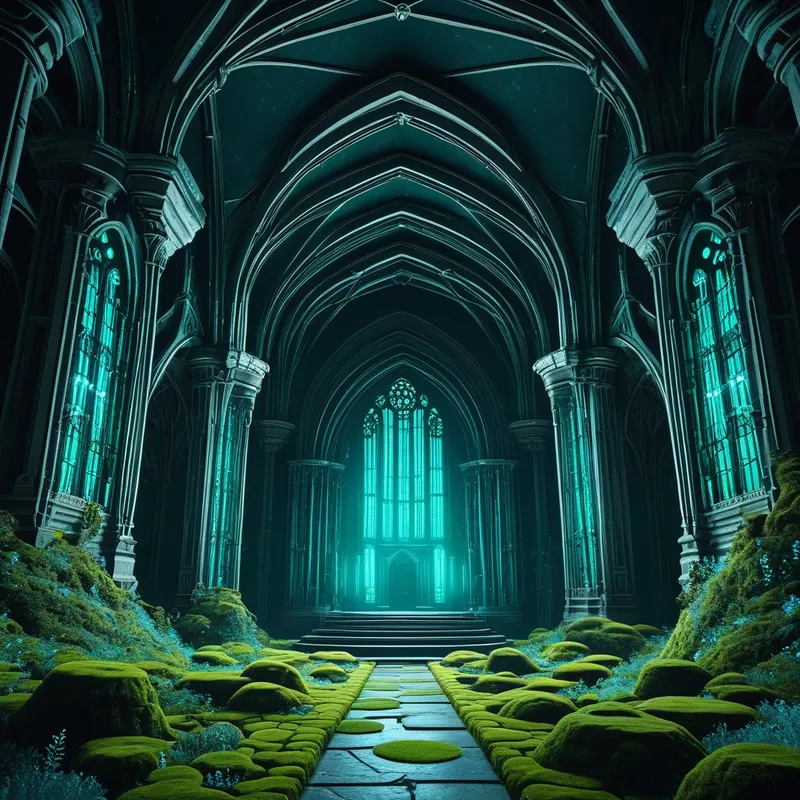
The Hidden Decay: An Alchemy of Dissolution
The Somatic Echo
It begins not as a thought, but as a subtle, internal dissonance—a low hum in the marrow. A feeling that something, somewhere within the architecture of the self, is no longer holding true. It’s the quiet, persistent ache behind a smile that feels genuine. The inexplicable fatigue that lingers after rest. The body knows the truth long before the conscious mind can articulate it: a foundational structure, a belief system, a relational pattern, a way of being, has begun to rot from the inside. This is the somatic echo of hidden decay. It is the weight of an integrity that has been compromised, not by external force, but by the slow, inevitable entropy of time and unexamined life. You feel it as a hollow resonance, a space where certainty used to be, now filled with the silent, creeping chill of something turning to dust.
The Dreamer's Log
The dreamer walks through their pristine, minimalist apartment. Everything is in its place, clean and ordered. Yet, a faint, sweet-sour smell lingers in the air. They are drawn to a smooth, featureless wall. Pressing a hand against it, a hidden panel clicks open. Inside, a dense nest of copper wiring, the nervous system of the home, is revealed. Some wires are frayed, their insulation cracked and brittle. Tiny, sporadic sparks of violet light flicker in the darkness, and a slow, viscous fluid drips onto the floor.
This is the psyche’s diagnostic scan: a perfect facade breached to reveal the failing, vital circuitry of a life-system.

The False Lead
This is not a dream of mere misfortune or external sabotage. To mistake it for a simple omen of "bad luck" is to commit a profound error of translation. The decay is not an invasion; it is a revelation of a pre-existing condition. It is not about something being done to you, but about something that has been living, unseen, within you. The terror of the dream is not in the potential for collapse, but in the undeniable evidence that a collapse is already, quietly, underway. It is the end of plausible deniability. This theme is the antithesis of the victim narrative; it is the psyche forcing an encounter with the parts of the self that have been silently, dutifully, falling apart to make way for what must be.
Psychological Architecture
To engage with hidden decay is to enter the most sacred and terrifying chamber of Shadow work: the demolition of the inner sanctum. We spend lifetimes building internal structures—personas, defenses, coping mechanisms, core beliefs. They serve us. They house us. They become "who we are." But life is motion, and the self must grow. What once was a shelter can become a tomb. The decay is the psyche’s own demolition crew, sent not to destroy the self, but to dismantle the obsolete architecture that confines it.
This is the Individuation process in its most visceral form. It is not about adding more light, but about consenting to feel the full, damp weight of the dark, fertile soil where old walls have crumbled. It requires you to sit in the ruin of a former certainty and, instead of rushing to rebuild, to first learn the language of the rot. What nutrient is being returned to the soil of your soul? What rigid structure, now softened by decay, can finally be reshaped? This work is felt as grief—for the loss of a familiar self—and as terror, for the formless potential of what comes next. It is the ultimate act of self-trust: to believe that your essence is not the crumbling edifice, but the living, intelligent force that orchestrated its necessary fall.
Mythic Resonance
We see this in the myth of the Fisher King, whose wound—a decay in the royal masculine principle—causes his entire kingdom to fall into a parallel state of barrenness and waste. The land and the king are one; the inner decay manifests as an outer blight. The healing does not come from ignoring the wound or painting over the crumbling castle walls, but from a direct, humbling question that acknowledges the rot. In the alchemical tradition, the Nigredo—the blackening, the putrefaction—is the essential first stage. It is the dissolution of the old, fixed form into a chaotic, fertile prima materia. Without this voluntary descent into decay, no genuine transformation, no albedo (whitening) or rubedo (reddening), is possible. The decay is not the failure of the process; it is the process itself beginning its sacred work.
Symbolic Nodes
- Frayed or Corroded Wiring/Nerves: The breakdown of communication, vitality, or connection within the self-system.
- Hidden Mold, Fungus, or Moss: Organic growth that signifies both decay and new, often symbiotic, life emerging from breakdown.
- Crumbling Foundations/Walls: The failure of long-held beliefs, ego structures, or personal boundaries.
- A Sweet or Sickly Odor: The sensory signal of something organic breaking down, often unnoticed by others.
- Polished Surfaces Hiding Rot: The persona or life-facade that perfectly masks internal disintegration.
- Dripping Pipes or Slow Leaks: The gradual loss of essential emotional or psychic energy.
Archetypal Resonance
The energy of hidden decay most profoundly resonates with The Shadow Magician. The Magician archetype governs transformation, the hidden structures of reality, and the power of consciousness to alter form. Its shadow is not merely an illusionist, but the master of unexamined systems—the one who built the flawless facade and the hidden, failing circuitry within it. The somatic echo of decay is the Shadow Magician’s silent alarm, the feedback from a spell of stability that has begun to consume its own source code. Engaging with this theme is to step into the Magician’s chamber not as its victim, but as its successor, learning the dangerous art of dismantling your own creations. The alchemical potential here is immense: to move from being unconsciously manipulated by your own hidden systems to becoming the conscious architect of your own dissolution and rebirth.
The Alchemical Process
The transmutation of hidden decay requires the heat of conscious attention and the pressure of radical acceptance. The "lead" of this experience is the grief and terror of loss—the loss of a known self, a known world. The alchemical fire is lit when you stop fighting the decay and instead bring your full awareness to it. You must study the pattern of the cracks. You must inhale the scent of the damp rot. You must trace the path of the leaking energy.
This intense focus—this meditatio on the ruin—initiates the change. The pressure is applied by refusing the old reflexes: the frantic repair, the fresh coat of paint, the denial. You must hold the tension between the memory of the intact structure and the reality of its collapse. In this crucible of sustained observation, a miraculous shift occurs. The decay ceases to be a symbol of death and begins to reveal itself as a process of life. The crumbling matter becomes fertile ground. The broken wires are seen not as failure, but as the necessary disconnection from an outdated power grid. The grief transmutes into a sober, powerful clarity. The terror becomes the raw energy of potential. What emerges is not a repaired version of the old, but a newfound sovereignty—the authority that comes from having willingly witnessed and participated in the deconstruction of your own prison.

The Integration Protocol
Question 1: Where in my life does my external reality feel polished and "fine," while a deep, internal sense tells me something fundamental is unsound or leaking energy?
Question 2: What old agreement—with myself, my family, or society—have I outgrown, that now sustains itself only through the silent decay of my authenticity?
Question 3: If the decay in my dream is not a threat, but a necessary demolition, what space is it trying to clear for within me?
Action 1 (Somatic Mapping): For one week, carry a small notebook. Each time you feel that subtle, internal dissonance—the hollow ache, the unmotivated fatigue, the low-grade anxiety—pause. Note the time, your location, and what you were doing or thinking about. Do not analyze, just map. Look for patterns in the territory of your decay.
Action 2 (Unstructured Writing from the Ruin): Set a timer for 15 minutes. Imagine yourself sitting in the exact scene from your dream of decay (or the one described here). Write in the first person, from the perspective of the decay itself. Let it speak. What is its function? What is it dissolving? What does it need? Do not censor. This is creative intelligence from the shadow.
Action 3 (Ritual of Sacred Decommissioning): Find a small object that symbolically represents the "polished facade" or the "failing system" in your life—a business card, a worn-out tool, a piece of jewelry, even a printed photo. Go to a natural body of water (a river, the sea) or a place with rich soil. Speak your gratitude to the object for its service, and then your acknowledgment that its function is now complete. Decommission it with intention: bury it, burn it safely, or set it adrift on the water. This is an outward ritual for an inward release.
Final Validation
To dream of hidden decay is to be entrusted with a difficult and sacred truth. It is a sign of the depth of your psyche, not its weakness. The path it illuminates is not one of panic, but of profound courage—the courage to cease upholding what is already falling, to stop pretending the walls are solid when you can feel the damp in the stones. This decay is the dark, intelligent love of your own soul, making space. It is the ruthless, necessary grace that clears the rotten timber so that a structure capable of holding your true life can finally be built. The sovereignty you seek is born in the quiet consent to this dissolution. You are not falling apart; you are being prepared for a more authentic form.