The Somatic Echo
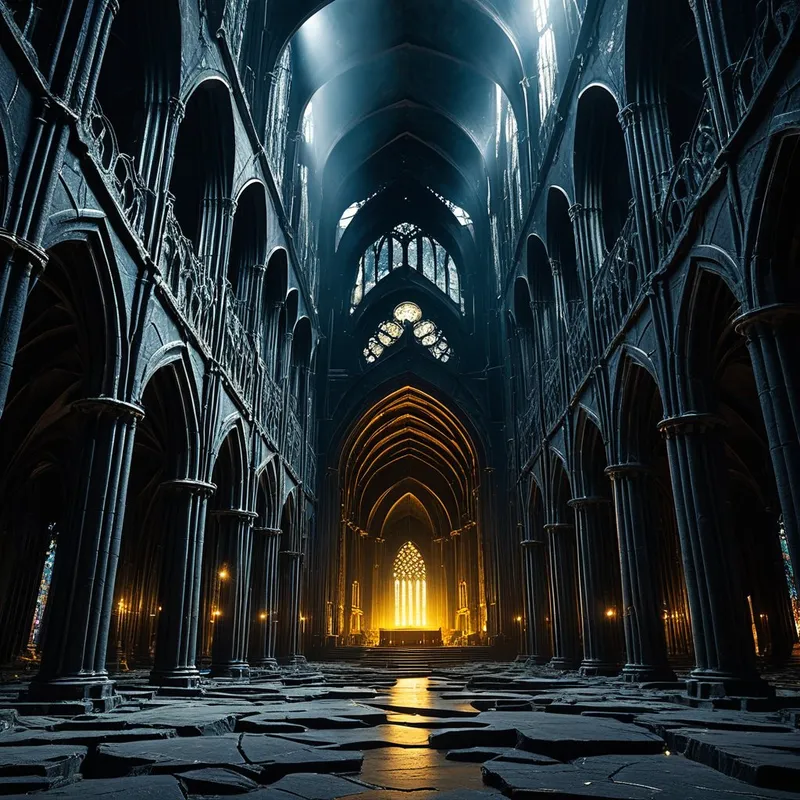
It begins not as a thought, but as a pressure. A subtle ache behind the sternum, a quiet, insistent hum in the marrow. It is the somatic echo of something precious buried under decades of psychic sediment—the forgotten melody, the abandoned gesture, the unspoken truth. This is the body’s memory of a beauty it was told to hide: a sensitivity labeled “weakness,” a wildness called “chaos,” a depth dismissed as “melancholy.” Before the mind can articulate the longing, the body holds the grief of this exile. It feels like a gentle, persistent tug from a place you’ve walled off, a whisper of warmth from a room in your internal house you sealed shut long ago. The dream of hidden beauty is the psyche’s attempt to translate this visceral, wordless pull into imagery, to make the echo visible.
The Dreamer's Log
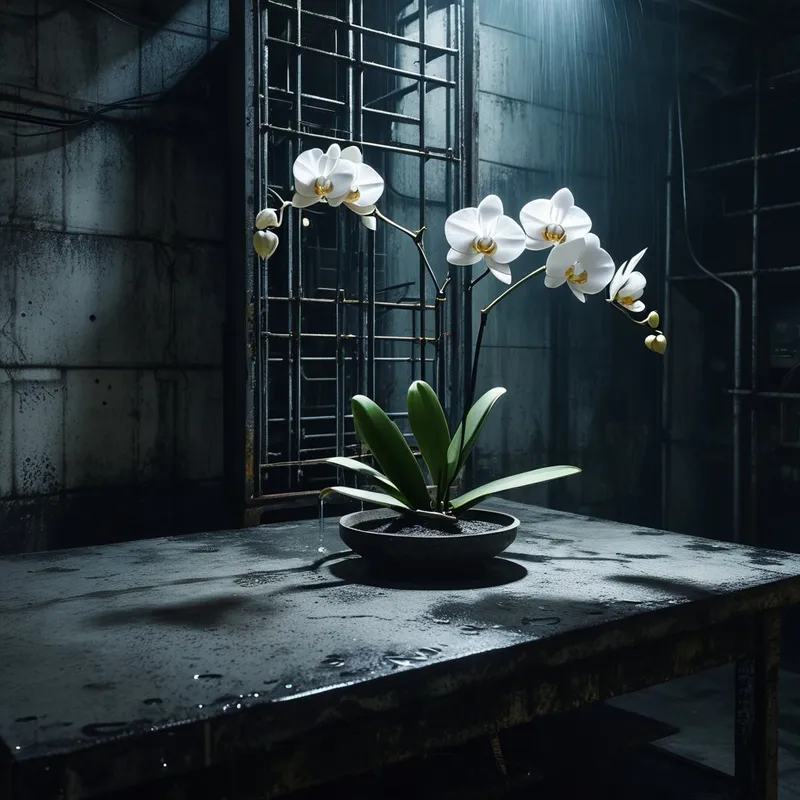
I am in the basement of an old, forgotten building. The air is cold and smells of damp concrete and machine oil. In the corner, behind a stack of obsolete server racks humming with a low, dead frequency, I see a crack in the wall. From it, a single, perfect white orchid is growing, its petals glowing with a soft, internal light that casts delicate shadows on the grime.
Alchemical Interpretation: The dream reveals the soul’s capacity to generate life and radiance from the very places of neglect, decay, and abandoned function.
The False Lead
This theme is not about discovering something externally glamorous or achieving a superficial aesthetic ideal. It is not the dream’s promise of a hidden treasure map to worldly success or validation. To mistake it for such is to commit the error of the false gold in alchemy—chasing a shiny veneer while ignoring the profound transmutation of the base material of the self. The hidden beauty is not a prize to be won, but a disowned part of the self to be reclaimed. It is not about “good luck” arriving, but about the courageous act of turning towards the very aspects of your experience you have labeled as your “bad luck,” your flaws, your private shames, and seeing them with new eyes.
Psychological Architecture
The work here is the archaeology of the soul. It is Shadow work of the most intimate kind, where the “shadow” is not a monstrous enemy, but a weeping child, a silenced artist, a tender vulnerability you were forced to lock away for survival. Individuation, in this context, is the process of reintegrating these exiled “family members” of your internal system. You built a personality—a functional, acceptable self—by saying, “This part of me is too much. That part is not enough.” The hidden beauty resides in those discarded fragments. To approach it is to sit in the basement with that glowing orchid, not to immediately pluck it and bring it upstairs, but to first acknowledge the cold, the damp, the years of silence. It is to feel the grief of its isolation as your own. This is the foundation: recognizing that the beauty and the wound are born from the same source, and that your wholeness depends on welcoming both.
Mythic Resonance
We see this pattern in the myth of Eros and Psyche. Psyche’s ultimate task, set by a jealous Aphrodite, is to descend into the underworld to retrieve a box of beauty from Persephone. The beauty is not found in the light, but in the descent to the land of the dead. It is hidden in the depths. Psyche’s journey is one of confronting impossible trials, a metaphor for the ego’s ordeals as it seeks the soul’s essence. She is forbidden to look inside the box, but she does—and is plunged into a deathlike sleep. This is the critical nuance: the hidden beauty, when approached with the ego’s grasping curiosity alone, can overwhelm. Its integration requires the intervention of a deeper, loving principle (Eros). The myth tells us that the beauty that saves us also requires us to relinquish control, to be vulnerable, to be “awakened” by a love that sees our entirety.
Symbolic Nodes
- Forgotten or Sealed Rooms: Attics, basements, locked closets, sealed vaults.
- Beauty in Decay: Flowers growing from cracks, vines overtaking ruins, moss on stone, light filtering through broken glass.
- Tarnished or Dull Objects: A dusty mirror, a tarnished locket, a painting covered by a sheet, a neglected instrument.
- Internal Light Sources: Lamps under blankets, bioluminescent organisms, gems glowing in the dark, a heart or chest cavity emitting light.
- Veiled or Masked Figures: Someone whose face is in shadow but feels familiar, a statue covered in cloth, a reflection in muddy water.
Archetypal Resonance
The energy of this theme resonates most powerfully with The Lover Archetype. Not the Lover in its shadow form of obsession or promiscuity, but the Lover in its essential function: the capacity to perceive and connect with deep value, passion, and intrinsic beauty. The somatic echo is the Lover’s ache for union—not with another, but with the estranged parts of the self. Its core energy is one of profound appreciation and desire for wholeness. The alchemical potential of the Lover here is to apply that discerning, adoring gaze inward, to fall in love with the hidden, “unlovable” fragments. It is the archetype that whispers, “This too is beautiful,” transforming judgment into intimacy, and exile into embrace.
The Alchemical Process
The transmutation of hidden beauty is the opus contra naturam—the work against the nature of the conditioned self. The base material is the hardened story of “I am not that,” the lead of self-rejection. The heat and pressure required are generated by a specific, intense psychological friction: the conscious, sustained act of holding two contradictory truths in the same space. You must hold the reality of the pain, the neglect, the shame and the simultaneous, emerging reality of the beauty, the strength, the uniqueness within it. This is the solve et coagula: you must dissolve the old, rigid identity that rejected this part, and then allow a new, more inclusive identity to coagulate around the reclaimed truth. The terror is the fear of being overwhelmed by what you’ve hidden; the grief is for the time lost. The sovereignty forged is an unshakeable inner belonging—a love for yourself that is no longer conditional on being only the “presentable” parts.
The Integration Protocol
Question 1: Where in my life, my body, or my history do I feel that subtle, aching “tug” of something forgotten or walled away? Can I describe its emotional texture without judgment?
Question 2: If that hidden part could manifest as an image, an object, or a being in my dream’s “basement,” what would it look like? What is its one, simple need?
Question 3: How has exiling this “beauty” actually served me? What protection did that separation offer, and what is the cost of maintaining that wall now?
Action 1 (Somatic Beacon): For five minutes, place your hand gently over the area of your body where you feel the “echo” or tug most strongly. Don’t analyze. Just breathe into that space, imagining your breath as a soft, neutral light. You are not fixing, just acknowledging presence.
Action 2 (Unstructured Reclamation): Set a timer for 10 minutes. With a pen and paper, write a letter from the hidden beauty (the orchid in the crack, the dusty mirror) to your waking self. Let it speak in fragments, sensations, or metaphors. Do not censor. The goal is expression, not coherence.
Action 3 (Ritual of Illumination): Find a small, mundane object that feels symbolically connected to the “dull” or “forgotten” quality (a plain stone, a piece of scrap wood, a discarded component). In a quiet moment, hold it and consciously project onto it one quality of the hidden beauty you are reclaiming (e.g., resilience, sensitivity, quiet wisdom). Place it somewhere you will see it, as a talisman of integration.
Final Validation
This path is not for the faint of heart. To turn towards the sealed rooms of your own psyche requires a courage that feels like tenderness, a strength that manifests as vulnerability. The difficulty is real—the resistance, the fear, the profound discomfort are all valid signposts on the territory of deep change. But remember: the very fact that your soul is presenting you with this dream of hidden beauty is evidence of its readiness. It is not a taunt from the depths, but an invitation. The light is already there, glowing in the crack. You are not being asked to manufacture it, but simply to have the bravery to sit in the damp dark long enough to see it, and in that seeing, to begin the sacred work of calling yourself home.