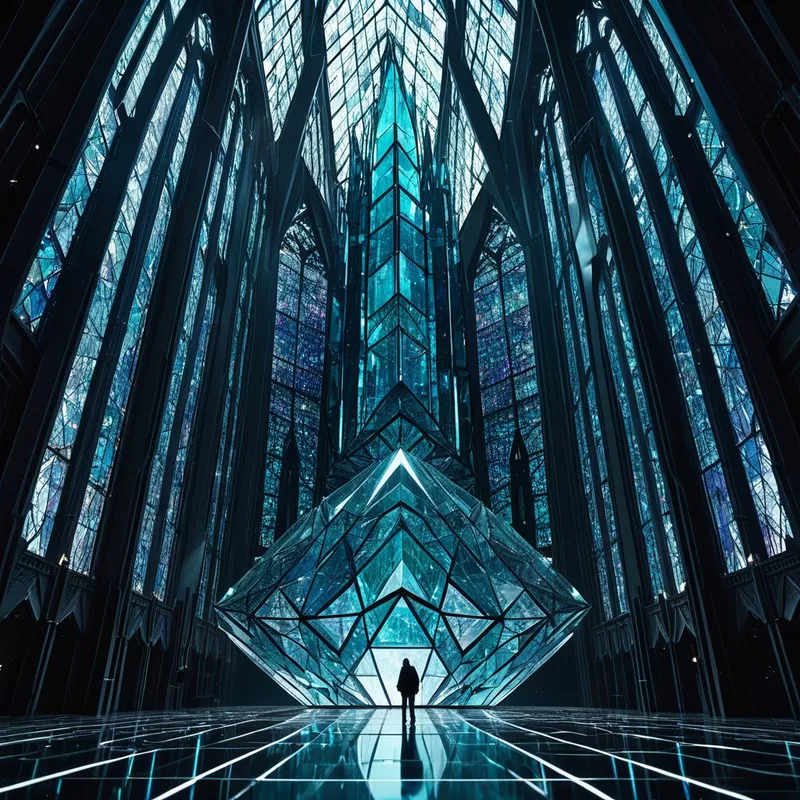
The Alchemy of the Shattered Self: Dreams of Fragmentation & Wholeness
The Somatic Echo
Before the image forms, the body knows. It is a tremor in the foundation, a subtle but pervasive sense of porosity, as if the edges of your being are no longer distinct. You feel like a vessel with hairline fractures, holding a form but sensing the slow, invisible seep. There is a dizziness that is not of the head, but of the center of gravity—a feeling that the core has become particulate, a sand mandala awaiting the next gust. It is the ghost-limb sensation of a part of you that has gone offline, a quiet static where a voice or an impulse used to be. This is the pre-verbal truth of fragmentation: the somatic whisper that the kingdom is no longer unified, that its provinces have declared a silent, internal secession.
The Dreamer's Log
I am standing in a vast, silent data center. Rows of black server racks hum with a cold, blue light. In my hands, I hold a porcelain mask—my own face—but it is spiderwebbed with cracks. I am not trying to put it back together. I am simply observing how each fragment reflects a different scene: a childhood room, an office, a forest path, a stranger’s eyes. The hum of the servers seems to be holding the pieces in a fragile, magnetic stasis.
This dream is not about damage, but about a radical, multi-perspectival awareness. The alchemical interpretation: The conscious self, symbolized by the mask, has dissolved its illusion of singularity to witness the many lives it contains, held in the generative tension of the psyche’s processing power.

The False Lead
This theme is not about mere inconvenience or a string of bad luck. It is not the chaos of a cluttered desk or a busy schedule. To mistake it for such is to confuse a tectonic shift with surface weather. Fragmentation is a structural, not a situational, event. It is the difference between dropping a plate and realizing the plate was always made of separate, pressured shards held together by habit and fear. The terror here is ontological—it questions the very cohesion of “I.” It is the opposite of distraction; it is a hyper-attentive, often painful, gathering of awareness to the fault lines themselves.
Psychological Architecture
The work here is the shadow work of recollection—in the literal sense of re-collecting the scattered parts. From the perspective of depth psychology, this is the individuation process in its most visceral phase. You are not building a new self from scratch. You are conducting a census of a fragmented nation. Each exiled part—the angry child, the people-pleaser, the arrogant critic, the silent sufferer—is a sub-system that split off under an old pressure, a trauma, an adaptation that outlived its purpose. These are not flaws, but survival strategies that became autonomous.
The process feels like civil war because it is. To become whole is not to annihilate these parts, but to end their exile. It requires sitting in the council chamber of your own psyche and listening to the grievances of each faction, especially the ones you have labeled unacceptable. The grief that arises is for the years spent at war with yourself, for the energy spent maintaining internal borders. The shift from fragmentation to wholeness is not an addition, but a subtraction of the walls between.
Mythic Resonance
We see this eternal process in the Egyptian myth of Osiris. Murdered and dismembered by his brother Set, his body parts are scattered across the Nile delta. Isis, his wife and sister, does not accept this state. She embarks on a long, arduous journey to find every piece—all but one, which is lost to the water. She reassembles him, and through her magic, he is restored to a new, sovereign wholeness, becoming Lord of the Underworld. The myth does not shy from the reality: wholeness often follows a brutal scattering. It requires a devoted, patient seeking (Isis) and an acceptance that some parts may be transmuted, not retrieved. The new sovereignty is not that of a pristine king, but of a ruler who has known dissolution and reigns from a deeper, more integrated place.
Symbolic Nodes
- Shattered Mirrors/Glass: Not just reflection broken, but the field of self-perception fragmented into multiple, simultaneous viewpoints.
- Puzzles with Missing Pieces: The intuitive sense that the system is knowable, coherent, but crucially incomplete.
- Scattered Documents or Data: Lost information, disparate narratives of the self that need compiling.
- Disintegrating Walls or Structures: The collapse of internal boundaries that once defined and separated.
- Being Made of Sand or Dust: The somatic feeling of losing cohesive form, of becoming particulate matter.
- Gathering Stones, Shells, or Fragments: The active, often dream-mandated, work of collection and reassembly.
Archetypal Resonance
The core energy of this theme resonates most powerfully with The Magician Archetype, specifically in its shadow phase as the fractured Illusionist.
The Shadow Magician as Illusionist is the master of the fractured sleight-of-hand, the one who has learned to make multiplicity look like unity, to project a cohesive image while the internal components operate in isolated, competing silos. This archetype’s core energy—transformation through knowledge of hidden systems—is here turned inward in a dysfunctional loop. The somatic echo of porosity and static is the Illusionist’s stage failing, the mechanisms becoming visible. Yet, within this lies the alchemical potential. The Magician’s true power is transmutation. To move from Shadow to integrated Magician is to turn the same systemic awareness from maintaining a facade to performing the ultimate magic: the unio mentalis, the union of the mind, where the disparate internal systems are recognized, honored, and consciously integrated into a new, authentic whole. The pressure of fragmentation is the crucible that forges the true Alchemist of the Self.
The Alchemical Process
The alchemical operation here is Solve et Coagula—Dissolve and Coagulate. This is not a gentle process. The Solve is the intense, often terrifying heat of deconstruction. It is the pressure that comes when life circumstances, inner truths, or profound dreams themselves apply the solvent to the glue of your old identity. The grief, anxiety, and disorientation are the necessary fires that melt down the rigid, outmoded structure. You must be rendered into your constituent parts.
The Coagula is the slow, patient work that follows. It is not a return to the old shape. It is the precipitation of a new form from the solution of your experiences. This requires the Lapis Philosophorum, the Philosopher's Stone—which, in psychological terms, is the conscious, loving awareness of the ego. This awareness acts as the binding agent, not through force, but through recognition and relationship. It says to each fragmented part: "I see you. You belong here." The new wholeness that coalesces is not a monolithic block, but a dynamic, resilient ecosystem—a sovereignty born of having known dissolution.

The Integration Protocol
Question 1: When you feel that somatic sense of scattering or porosity, which specific "part" of you feels most absent or distant? Can you give that part a simple name or image?
Question 2: What old agreement, survival strategy, or self-concept finally shattered to initiate this current sense of fragmentation? What was it protecting you from?
Question 3: If your wholeness was not a perfect, seamless statue, but a vibrant, interconnected city, what would be the first bridge you would build between two currently isolated districts of yourself?
Action 1 (Somatic Grounding): When fragmentation anxiety arises, place one hand on your heart and one on your solar plexus. Breathe slowly, not to pull yourself together, but to feel the actual, physical space your body occupies. Whisper: "This vessel holds all of this." Feel the container of your skin.
Action 2 (Creative Council): Take a large sheet of paper. Let different colored markers or pencils represent different "parts" or voices within you (e.g., the Inner Critic, the Wounded Child, the Ambitious Driver). Let each part draw its own symbol or write its core message in its space on the page, without judgment. Then, simply draw lines of connection between them. Do not force a unity; just map the existing relationships.
Action 3 (Ritual of Assembly): Find three small, natural objects (a stone, a twig, a shell). Sit with them separately, assigning to each a quality or fragment of yourself you feel is currently exiled (e.g., grief, wildness, stillness). Spend a moment honoring each one alone. Then, slowly place them together in a small, deliberate arrangement on your windowsill or altar. This is not a final monument, but a temporary, physical acknowledgment of the act of gathering.
Final Validation
To dream of fragmentation is to be entrusted with a difficult and sacred truth: that you were never meant to be a single, solid note, but a chord. The dissonance you feel is not a sign of breaking, but of the individual notes awakening to their separateness before they can learn to resonate together. The path to wholeness is walked by gathering the shards, not by mourning the mirror. It is the most intimate rebellion—to cease being a kingdom divided, and to become, at last, a sovereign.