
The Somatic Echo
It begins not as a thought, but as a tremor. A deep, internal shudder that feels less like fear and more like a tectonic plate shifting in the dark. There is a hollowing in the gut, a sense of groundlessness that precedes any conscious worry. You may feel a profound, inexplicable fatigue—the exhaustion not of muscles, but of the invisible beams that hold you upright. The body knows, long before the mind admits it, that the substructure of the self is under review. It is the visceral prelude to a silent, internal demolition. You are not falling apart; you are being taken down to the studs.
The Dreamer's Log (Case Vignette)
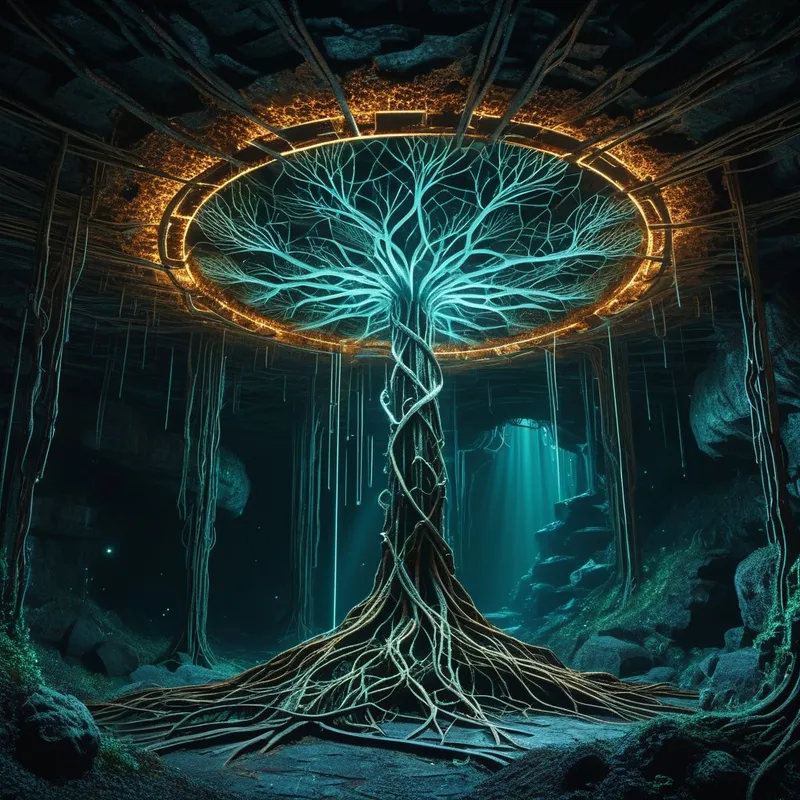
I am standing in the basement of my childhood home, but it is vast and industrial. The concrete floor is cracked. I kneel and brush away the dust, revealing a fissure that glows with a soft, amber light. Peering in, I see not earth, but an intricate, ancient lattice of copper and stone, humming faintly. I know, with absolute certainty, that I must reach in and pull something out, but I am terrified of what will happen if I do.
This is the dream of the architect meeting the archaeologist of the soul: the terrifying, necessary act of exposing the buried blueprints of the self to the light of consciousness.

The False Lead
This is not a dream about simple instability or "bad luck." Do not mistake the cracking of the foundation for the collapse of the house. The psyche is not warning you of impending ruin; it is initiating a sacred, if terrifying, renovation. The anxiety you feel is not a signal to shore up the old, crumbling walls with frantic effort, but an invitation to witness their necessary dissolution. This theme is the opposite of catastrophe; it is the meticulous, often painful, prelude to creation on a scale the conscious self cannot yet imagine.
Psychological Architecture
Foundational development is the Shadow work of the ground upon which you stand. It is the process of Individuation applied not to your personality, but to your psychic bedrock—the unconscious agreements, inherited traumas, and core beliefs you mistook for immutable law. To engage here is to become both demolition crew and master builder. You must consent to the disorientation of seeing the floorboards ripped up, to sitting in the dust with the ghosts of old decisions. This is where you meet the exiled parts of yourself that were buried in the cement of your identity: the child who learned safety was silence, the passion walled up for being too messy, the grief used as filler in the cracks. Integrating them is not adding new rooms; it is changing the entire property’s load-bearing specifications. The sovereignty gained is not over others, but over the very laws of your internal kingdom.
Mythic Resonance
This process echoes in the myth of Ariadne, not in her romance, but in her thread. Theseus enters the labyrinth—a foundational structure of terror and containment—to face the Minotaur, the shadow in the basement. But it is Ariadne’s thread, a slender, conscious connection to the outside world, that allows for navigation and return. The hero’s journey is secondary; the primary act is the laying of a new line through the old, irrational structure. Similarly, in many creation myths, the world is not built from nothing, but from the body of a primordial giant or the fragments of a broken cosmic egg. New foundations are always made from the sacred, dismantled parts of the old.
Symbolic Nodes
- Basements, Cellars, Sub-basements: The unconscious, stored history, and psychic underpinnings.
- Cracks in Floors or Walls: Fault lines in core beliefs, the emergence of repressed material.
- Excavation Sites & Renovations: Active, conscious engagement with psychic restructuring.
- Root Systems (Exposed or Tangled): The often-messy origin points of identity and behavior.
- Cornerstones & Keystones: Foundational beliefs or memories upon which identity rests.
- Sinking or Shifting Houses: The felt experience of outdated structures failing to support present life.
Archetypal Resonance
The energy here is not of the hero who conquers, but of the one who prepares the ground for a new world. It is the essence of The Creator Archetype in its most profound, structural phase. This is not the artist painting on a fresh canvas, but the architect who must first survey the land, clear the rubble, and pour the footings upon which all future beauty will stand. The somatic echo of hollowness and tremor is the Creator’s sacred anxiety before the void of potential. The alchemical potential lies in its capacity to hold the tension between the vision of what could be and the gritty, often unglamorous, reality of dismantling what is. The shadow risk is the "Mad Scientist" who becomes obsessed with the blueprint, forgetting the life that must inhabit the structure, or the narcissist who builds a monument only to themselves.
The Alchemical Process
The alchemy of foundational development is Calcination applied to the soul’s architecture. It is the application of intense, internal heat and pressure—the heat of conscious attention to painful truths, the pressure of life circumstances that no longer fit—to burn away the volatile, false supports of the personality. This is not a gentle process. It feels like a reduction to ash, to essential minerals. The grief is for the familiar rooms that must go; the terror is of the open sky where a roof once was. The transmutation occurs in the stillness that follows the fire, when you sift through the remains and find, not ruin, but the primal, indestructible elements of your true nature: your core values, authentic desires, and innate strengths. From this purified base, the slow, deliberate work of Coagulation—building a new structure aligned with soul, not just survival—can authentically begin.
The Integration Protocol
Question 1: What is one "cornerstone" belief about myself, others, or the world that I have never genuinely questioned, but that my life circumstances are now forcing me to examine?
Question 2: If I imagine my sense of self as a physical structure, what is in the "basement"? What feels stored down there, out of daily sight, that hums or weighs on the foundation?
Question 3: What old "room" in myself—a habit, an identity, a story—am I most terrified to see dismantled, and what might exist in the space it currently occupies?
Action 1 (Grounding Scan): Sit or stand quietly. Feel the physical points of contact between your body and the ground or chair. Now, imagine sending that awareness down, through the floor, into the earth beneath the building, down to the bedrock. Breathe into the stability of that ultimate foundation for five full cycles. You are not your shifting upper floors; you are connected to the bedrock.
Action 2 (Blueprint Sketch): Without planning, take a large piece of paper and draw the "floor plan" of your current internal foundation. Use abstract shapes, lines, and symbols. Where are the strong walls? Where are the cracks, the blocked doors, the hidden rooms? Let the drawing be a non-verbal audit. Do not judge it; witness it.
Action 3 (Keystone Ritual): Find a small, solid stone. Hold it and imbue it with a single, core quality you wish to be the absolute bedrock of your rebuilding (e.g., integrity, compassion, courage). In a quiet moment, take it to a physical location that represents stability to you (a garden, a park, a favorite room). Place it deliberately, stating quietly, "This is my new cornerstone."
Final Validation
To dream of foundations is to be chosen for a task that feels too vast, too deep, and too destabilizing. It is valid to feel unmoored, to grieve the solid ground that turned out to be an illusion. This is not a sign of weakness, but of profound engagement with the real work of a life. You are not being punished; you are being prepared. The sovereignty awaiting you on the other side of this terror is not a louder voice, but a truer ground to stand on—one you have consciously, bravely, built for yourself, stone by sacred stone, from the ashes of what was.