Evolutionary Baggage: The Somatic Archaeology of the Soul
It begins not as a thought, but as a density. A specific gravity in the marrow. You wake with a spine that feels like a column of sedimentary rock, layer upon layer of compressed history. Your shoulders carry not just yesterday’s tension, but a yoke shaped for ancestors you never met. The breath is shallow, held in a chest cavity that seems to house relics—not of your own making, but inherited, like a pre-furnished apartment you’re afraid to rearrange. This is the somatic echo of Evolutionary Baggage: the body’s silent, profound registry of patterns, traumas, and survival strategies that long preceded your conscious “I.” It is the architecture of the unconscious, felt before it is seen.
The Dreamer's Log
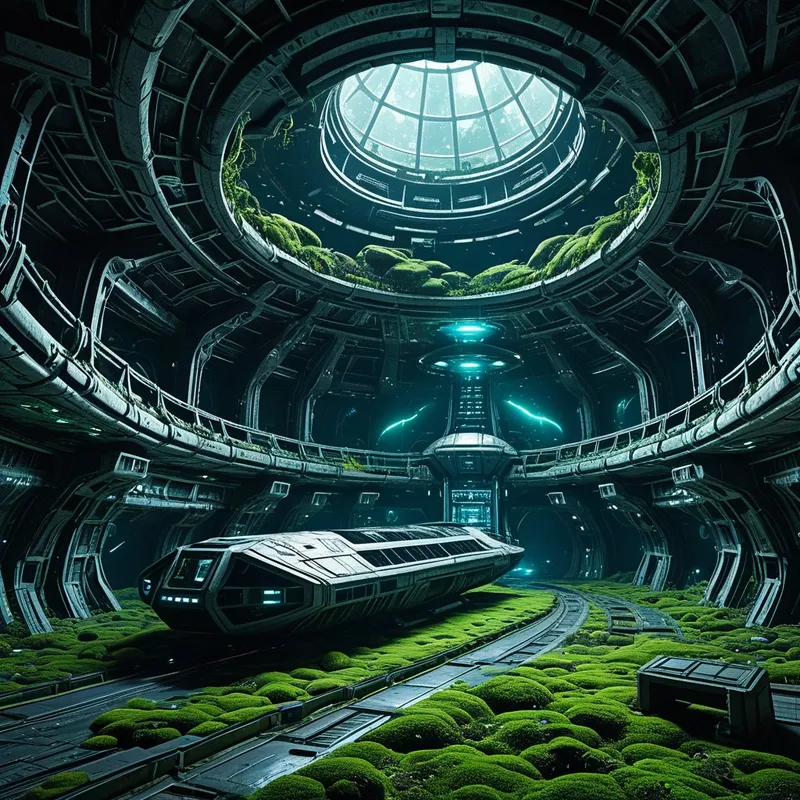
The dream is always the same: I am in the cargo hold of a derelict generation ship, drifting in a silent void. My task is to sort through endless, identical crates marked with glyphs I cannot read. They are impossibly heavy. The air is thick with the smell of ozone and old dust. I know I must jettison most of them to reach the navigation deck, but I am paralyzed by the fear that one contains something vital, something I am meant to save.
Alchemical Interpretation: The dreamer is not sorting physical objects, but the encrypted, inherited scripts of familial and cultural survival, tasked with the terrifying discernment of what is essential life-force and what is obsolete, soul-crushing weight.

The False Lead
This theme is not about personal failure or a simple run of “bad luck.” It is not the clutter in your attic, but the blueprint of the attic itself. To mistake it for a contemporary problem is to pour fresh water into a cracked, ancient vessel, wondering why you remain thirsty. The grief and frustration here are structural, not situational. It is the difference between tripping on a loose floorboard and discovering your entire house was built on a forgotten burial ground. One is an incident; the other is an inheritance.
Psychological Architecture
The work here is a form of somatic archaeology. You are not analyzing memories you own, but excavating the foundational strata of your psyche. This is the Shadow work of the bloodline—encountering the exiled fears, the unspoken griefs, the armored loves that your family system could not integrate. Individuation, in this context, becomes a conscious rebellion against unconscious inheritance. It is the moment you realize the “you” that feels so solid is, in part, a complex, adaptive organism built to navigate an environment that no longer exists. The terror is in the dismantling: if I am not this accumulation of ancestral reflexes, who am I? The process feels less like growth and more like a careful, sacred demolition.
Mythic Resonance
We see this in the Greek tale of Atlas, condemned to hold up the celestial heavens for eternity—a perfect image of a burden that was never his to begin with, a punishment for a war of the previous generation. His relief comes not from strength, but from a trick of perspective, when Heracles temporarily takes the weight. The myth whispers that the burden is a condition, not an identity. Similarly, in many indigenous stories, the hero must return a stolen relic to its rightful ancestral resting place to heal a blight upon the land. The healing is not in keeping the powerful object, but in completing the cycle, in giving back what was never meant to be carried forward.
Symbolic Nodes
- Impossibly Heavy Objects: Suitcases, trunks, backpacks, stones, anchors.
- Archival Spaces: Dusty attics, cavernous warehouses, derelict ship holds, sealed vaults, endless libraries.
- Unreadable Scripts: Faded letters, encrypted files, glyphs on crates, indecipherable maps.
- Obsolete Technology: Broken clocks, non-functional engines, archaic weapons, ghostly transmission static.
- Genetic/Organic Imagery: Twisted family trees, fossilized roots, inherited birthmarks, spectral DNA helixes.
Archetypal Resonance
The Shadow Caregiver is the active force here. This is not the nurturing protector, but its distorted echo: the Martyr and the Smotherer. Its somatic echo is that leaden fatigue in the shoulders, the compressed breath of carrying what is not yours. Its core energy is a loyalty twisted into bondage—a compulsive, often unconscious, vow to hold the pain, secrets, or outdated duties of the lineage, lest the entire system collapse. The alchemical potential lies in the agonizing, gracious act of putting the burden down. This is not abandonment, but a profound differentiation: learning to care from a place of sovereign choice, not from a script of inherited obligation. The Shadow Caregiver, when transmuted, becomes the one who tends the sacred hearth of the present, not the ghost-filled halls of the past.
The Alchemical Process
The transmutation of Evolutionary Baggage is the Dissolution of the Crystalline Script. The prima materia is the hardened, crystalline structure of intergenerational pattern. The heat and pressure required are the sustained, conscious friction between your lived reality and the ancestral ghost-story. This is not a gentle warmth but the forge-fire of contradiction: feeling love while recognizing a pattern of enmeshment, feeling ambition while sensing a legacy of scarcity, feeling fear while noticing it is three generations old. The terror is the feeling of the crystal cracking—the fear of familial exile, of losing the "love" that was conditional on you carrying the load. The grief is for the phantom self you must release, the identity built around this baggage. The sovereign gold that precipitates is Discernment: the capacity to feel the echo of the past without being its puppet, to receive the inheritance and consciously choose what to honor, what to transform, and what to respectfully bury.

The Integration Protocol
Question 1: When you feel that familiar, heavy weight in your body, ask: "Whose fear is this? Whose grief? Does its age feel older than my own lived experience?"
Question 2: What one family story, mantra, or unspoken rule do I find myself perpetually reacting to or rebelling against? What might it have been trying to protect, and what is the cost of that protection now?
Question 3: If I could respectfully return one piece of this inherited weight to the past, symbolically completing a cycle for my ancestors, what would it be? What would my hands feel like empty?
Action 1 (Somatic Unburdening): Stand with your feet firmly on the ground. Feel the weight in your body. With each slow exhale, imagine roots descending from your feet, deep into the earth. Visualize that non-personal, heavy density draining down through these roots, not as a toxin, but as neutral matter returning to the ground of being. Inhale, drawing up only your own, present-moment vitality.
Action 2 (Genealogical Re-scripting): Take a family photograph (or visualize one). With unstructured writing, draft a "letter of release" not to a person, but to a pattern you see embodied in it. Write from the perspective of your future, liberated self, thanking the pattern for its attempted service and clearly stating it is no longer required in your life. Do not send it; burn or bury it as a ritual of closure.
Action 3 (Creative Reclamation): Using any medium—clay, paint, collage, sound—create an abstract "Reliquary for the Unnecessary." This is not a shrine for worship, but a designed, intentional container for what you are consciously setting down. Let its form be beautiful but sealed, a testament to your choice to hold space for the past without being held by it.
Final Validation
The weight is real. The fatigue is not your failure, but a testament to the sheer mass of history you have been asked to carry. To feel it is not a curse, but the first, crucial spark of awareness—the signal that you are different from the burden. You are the consciousness that can feel the weight, and therefore, you are the consciousness that can choose to set it down. This is the most profound sovereignty: to stand at the terminus of a long, echoing line and, with both grief and grace, decide what dies with you, and what you will transmute into a new, unscripted life.