
The Alchemy of Escape and Return
The Somatic Echo
It begins not as a thought, but as a tremor in the solar plexus—a low, tectonic hum of wrongness. The breath becomes shallow, held hostage in the upper chest. Muscles, particularly across the shoulders and jaw, clench into a silent, permanent alarm. This is the body’s pre-linguistic knowing: a containment has become a cage. A system, once a shelter, now registers as a prison. The impulse is pure physics: to flee. To put distance between the self and the source of the pressure. Yet, beneath this urgent current of away, there thrums a deeper, more dissonant frequency—a gravitational pull toward the very center of the tension. It is the somatic paradox of Escape/Return: the frantic need to leave, haunted by the undeniable truth that you must, eventually, come back. Not to the circumstance, but to the part of yourself you abandoned there.
The Dreamer's Log
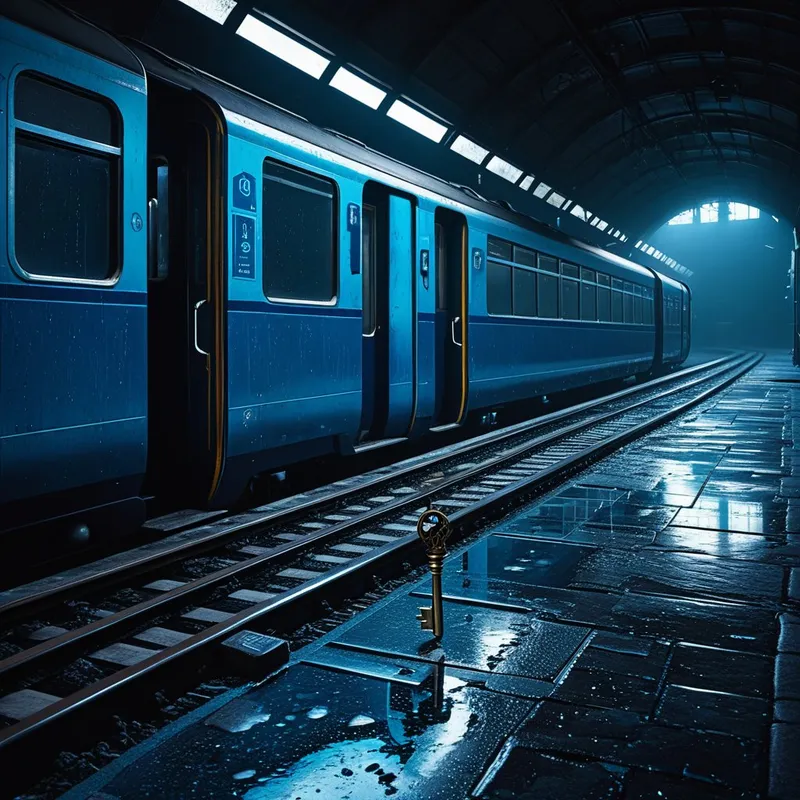
The dream is always the same: standing on a rain-slicked platform, watching a silent, sleek train pull away. I am holding a brass key that fits no lock I own. I turn, and the station is now my childhood kitchen, empty, the back door wide open to a blinding white light. The alchemy here is clear: the departing vehicle is the conscious mind’s solution (escape), the key is an unintegrated power (the return), and the transformed kitchen is the primal self, waiting, offering a different kind of exit.
The False Lead
This theme is not about changing your address, your job, or your relationship. It is not the superficial narrative of “running from your problems.” To mistake it for such is to confuse the symptom for the disease. The dream of escape is not about geography, but about ontology—the structure of your being. The return it demands is not a regression, but a retrieval. A bad day, a streak of misfortune, a simple desire for a holiday—these lack the profound, architectural resonance. The true Escape/Return cycle speaks of a foundational part of the psyche that went into exile for its own survival, and whose absence now creates the very prison from which you wish to flee.
Psychological Architecture
The architecture here is one of internal exile. Within the family system of the soul, a part of you—often the most vibrant, sensitive, or rebellious—was deemed “too much.” Too much feeling, too much need, too much truth. To preserve the fragile peace of the inner world, that part was sent away. It was not destroyed; it was marooned. You, the ruling consciousness, built a life in its absence, a citadel of adapted behaviors and acceptable narratives. But the exile is a phantom limb. Its absence creates a hollow center, a life lived on the perimeter of your own experience. The dream of escape is the citadel finally feeling like a tomb. The dream of return is the exiled self, now a sovereign entity in the wilderness of the unconscious, signaling its coordinates. The shadow work is the brutal, gracious act of dismantling the citadel you built to bring the exile home, recognizing that the warden and the prisoner are both you.
Mythic Resonance
We see this in the stark journey of the Buddha, who performed the ultimate escape—from palace, privilege, and predetermined path—into the austerities of the forest. Yet his enlightenment was not found in the extremity of his renunciation, but in his return to the middle way, to the embodied world under the Bodhi tree. He did not reject the palace to become the forest; he transcended the dichotomy itself. Similarly, the Greek hero Odysseus spends a decade in fantastical escape from the Trojan War, facing monsters and enchantresses. But his entire epic is titled The Odyssey—the journey—for the express purpose of The Nostos—the homecoming. His return to Ithaca is not to the island he left, but to a self remade by exile, capable of reclaiming a throne that is no longer just a place, but a state of integrated being.
Symbolic Nodes
- Missed Transport: Trains, planes, buses departing without you. The vehicle of conventional solution is gone; you are forced to confront the platform—the liminal space.
- Unlocking/Inaccessible Doors: Keys without locks, doors that open to walls or voids. The mechanism of return is present, but its function is not yet understood.
- Familiar Places, Alien Atmospheres: Your home, but empty, distorted, or under threat. The inner landscape has changed, and the old map is useless.
- Being Pursued, with a Sudden Turn: The classic flight dream, where the turning to face the pursuer initiates the return.
- Finding a Forgotten Room: The discovery of disused, beautiful, or terrifying space within your own psychic house. The exiled part’s dwelling.
Archetypal Resonance
The Orphan Archetype is the prime mover in this cycle. Not its shadow aspect of perpetual Victim, but its core essence: the Realist and the Survivor. The Orphan’s fundamental knowledge is that the sanctuary has been lost or was never truly safe. Its first, brilliant act is escape—a survivalist’s pragmatism to flee a hostile environment. This creates the somatic echo of hollow alertness. The Orphan’s alchemical potential, however, lies in the return. Not a return to dependence, but a return with the hard-won knowledge of the wilderness. The integrated Orphan does not seek another external shelter, but becomes the sober, resilient foundation of their own inner kingdom. The return is the Orphan building a home within themselves, ending the cycle of seeking salvation from the outside.
The Alchemical Process
The transmutation is from Flight to Sovereignty. The base metal is the terror of containment, the grief of exile. The heat is applied in the liminal space—the platform after the train leaves, the moment you stop running and turn around. This heat is the unbearable tension of holding two truths: the truth of the prison’s reality, and the truth of your own exiled power. The pressure is the conscious, daily choice to attend to the hollow feeling rather than numb it, to listen to the dreams of forgotten rooms. In this crucible, a profound recombination occurs. The exiled part (the wild, sensitive truth) and the surviving self (the adapted, functional citadel) begin to negotiate. The old, rigid structures of “who I had to be” dissolve in the heat of this meeting. What precipitates is not a compromise, but a new compound: a self that is both grounded and free, pragmatic and visionary. The escape impulse is integrated as discernment—the knowing of when to walk away. The return is actualized as presence—the capacity to fully inhabit your own life.

The Integration Protocol
Question 1: Where in my current life do I feel the most profound sense of “waiting for permission”? What internal authority have I exiled?
Question 2: If the place I wish to escape from is not a location, but a state of being, what three words most accurately describe that inner atmosphere?
Question 3: What forgotten, beautiful, or terrifying “room” in my psyche did I once know, and what one object symbolically belongs in that room?
Action 1 (Somatic Re-Mapping): For one week, when you feel the initial clutch of escape anxiety, pause. Place a hand on your solar plexus. Breathe into that space for three cycles, not to make it go away, but to acknowledge its message: “Something here feels untenable.” This grounds the impulse in the body, transforming panic into data.
Action 2 (Exile’s Journal): Engage in a creative, unstructured writing ritual. Address it to your exiled part. Write as the one who stayed behind, or as the exile itself. Do not seek resolution; seek description. What does its landscape look like? What does it protect? Let the writing be messy, symbolic, and non-linear.
Action 3 (Threshold Object): Find or create a small physical object—a stone, a forged piece of metal, a drawn sigil. Let this object represent the “key” from your dreams or the solidity of the “platform.” Place it where you will see it daily. Its purpose is to anchor you in the liminal space, the place of potential where escape turns into conscious return.
Final Validation
The path of Escape/Return is among the most disorienting the psyche can chart. To feel simultaneously trapped and unmoored, to crave freedom while being haunted by a home you cannot name—this is the legitimate anguish of a self split for its own survival. Honor that fracture. Do not spiritualize it away. The profound empowerment lies in this: the very intensity of your desire to flee is a precise measurement of the power waiting in exile. The prison is not proof of your failure, but the shadow outline of your missing sovereignty. The return is not a going back, but a summoning forth. You are not escaping a life; you are being recalled to your own presence. The dream is the recall notice.