The Alchemy of Dissolution: Dreaming of Erosion & Decay
The Somatic Echo
Before the image forms, the body knows. It is a quiet, subterranean hum—a low-grade vibration of loss that has nothing to do with external events. It feels like a slow leak, a gradual hollowing. You may sense it as a subtle fatigue in the bones, a gravity that feels personal, or a tenderness in the joints as if the very mortar holding you together is becoming porous. This is the somatic echo of erosion: the visceral, pre-verbal recognition that a structure within you—a belief, an identity, a way of being—is undergoing a fundamental, unstoppable weathering. The mind will later furnish images of crumbling walls and rusting metal, but the body registers it first as a deep, organic softening, a yielding to a process older than thought.
The Dreamer's Log
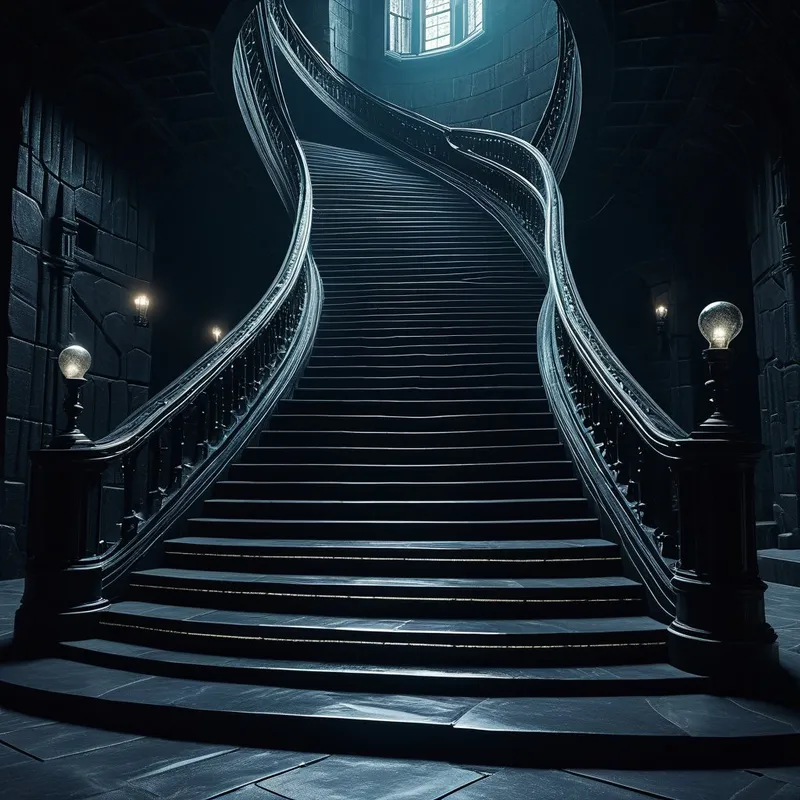
I am standing at the top of a monumental staircase carved from black stone, descending into a cavernous, silent heart. With each step I take, the sharp, geometric edges of the stairs below me soften and wear away, not from my footfall, but from some invisible, patient force. The staircase is becoming a smooth, sloping riverbed of polished obsidian.
Alchemical Interpretation: The dreamer’s rigid, constructed path of ascent is being dissolved by the timeless flow of their own unconscious, transforming a ladder of achievement into the sacred channel of descent.
The False Lead
This theme is not a portent of literal ruin, failure, or aging. To mistake the dream’s profound symbolism for a simple warning of “bad luck” or physical decline is to commit a grave error in translation. The psyche does not waste its most potent imagery on forecasting mundane misfortune. Erosion in the dreamscape is not about the destruction of your life, but the necessary deconstruction of a life-structure that has outlived its integrity. It is the difference between a house collapsing from neglect and the deliberate, careful dismantling of a scaffold once the building can stand on its own. The grief is real, but its object is an internal artifact, not your future.
Psychological Architecture
To dream of erosion is to stand at the precipice of the most sacred kind of Shadow work: the work of permitted decay. Our psychological architecture is built upon foundations we often mistake for bedrock—the “shoulds” inherited from family, the personas polished for society, the coping strategies that once saved us but now confine us. These structures become internal citadels. To individuate, to become whole, we do not always need to storm these citadels. Sometimes, we must learn to stop maintaining them. We must allow the weather of our own truth to touch them.
This is the process at play: the slow, often terrifying, permission for an old self to dissolve. It is the withdrawal of psychic energy from an internal system that has demanded constant upkeep. The grief you feel is for the identity that is passing. The fear is of the open space that will be left behind. Yet, in that hollowed-out space, where the old walls have worn down to sand, the ground becomes fertile for the first time in decades. You are not falling apart. You are being returned to your essential, unstructured state—the prima materia of the soul—from which a more authentic form can organically arise.
Mythic Resonance
We see this universal firmware in the myth of the Phoenix, but not in its fiery climax. We see it in the moment before the flame, in the quiet, inevitable decline of the magnificent bird, its feathers losing luster, its flight growing labored. It must accumulate the psychic weight of its own long life, must consent to its weakening, to become ready for the pyre. Similarly, in the Arthurian cycle, the Wasteland is not a punishment, but a symptom. The kingdom decays—the crops fail, the rivers silt—because the sovereign, the psychic center, is wounded and unable to question his own crumbling paradigm. The land erodes in mirror to the king’s rigid, unexamined heart. Fertility only returns when the old, brittle structure of certainty is dissolved by the quest for the impossible Grail, a symbol of the nourishing, unknown Self.
Symbolic Nodes
- Crumbling Masonry & Foundations: The weakening of long-held beliefs or identity structures.
- Rust & Oxidation: The slow, chemical transformation of once-strong will or passion into something brittle and inert.
- Eroded Paths or Staircases: The softening or disappearance of a previously clear, rigid life-direction.
- Dissolving Paper or Ink: The loss of legibility of an old story, contract, or self-definition.
- Petrified Wood or Stone Turning to Sand: The final stage of a long-held emotional pattern or trauma becoming neutral, workable material.
- A Gently Collapsing Dam: The controlled, inevitable release of a vast reservoir of held-back emotion or potential.
Archetypal Resonance
The energy of erosion and decay resonates most deeply with The Orphan Archetype, specifically in its journey from the Shadow Orphan (Victim/Self-Pity) toward its mature, alchemical expression.
The initial somatic echo—the hollow fatigue, the sense of foundational loss—is the pure cry of the Shadow Orphan, who feels betrayed by the very ground of being. It interprets dissolution as abandonment. Yet, this archetype holds the key to the theme’s transformation. The Orphan’s core gift is realism; it is the part of us that can finally stop pretending the crumbling wall is still solid. It is the one who, in the midst of decay, must learn the ultimate survival skill: not to rebuild the old shelter, but to find the resources within the dissolution itself. By feeling the full weight of the loss without mythologizing it as a cosmic victimhood, the Orphan performs the alchemy. It transmutes the raw material of “what is falling away” into the sober, powerful wisdom of “what is actually here.” It moves from a victim of erosion to the sovereign witness of a necessary process, grounding the dreamer in a profound, unshakable reality.
The Alchemical Process
The alchemical stage here is Solutio, or dissolution. But this is not a gentle melting. It is the application of the aqua permanens—the eternal water—to the solidified salt of our fixed identity. The intense psychological heat and pressure required is the courage to stay present with the dissolution without rushing to repair it. It is the pressure of tolerating ambiguity, of dwelling in the “in-between” where the old form is gone and the new one has not yet coalesced. The terror must be felt in the body, not rationalized away. The grief must be given its voice, not silenced as “negative thinking.”
This process transmutes the leaden fear of annihilation into the golden sovereignty of the witness. You are not the wall that is crumbling. You are the space in which the wall exists and the consciousness that observes its transformation. Sovereignty is born when you realize you can provide a holding environment for your own collapse. The authority shifts from the external structure to the internal, unwavering awareness that contains the entire process. The decay becomes not something happening to you, but a process you are consciously hosting.

The Integration Protocol
Question 1: In my waking life, what rigid structure, belief, or role feels most like it is under a gentle, inexorable pressure—not to break, but to soften and change shape?
Question 2: If the erosion in my dream is making space, what is it making space for? What quality, long dormant, might begin to grow in this newly cleared inner ground?
Question 3: Where in my body do I feel the resonance of “hollowness” or “weatheredness,” and if I could speak from that place with compassion, not fear, what would it say?
Action 1 (Grounding in the Hollow): For five minutes, sit quietly and place your awareness on the physical sensation that feels most like the “erosion” (e.g., the hollow in the chest, the softness in the joints). Breathe into that space. Imagine your breath not as filler, but as a gentle wind moving through a sacred, open canyon. Do not try to change it. Simply acknowledge its existence as a real, valid landscape within you.
Action 2 (Unstructured Writing of the Decay): Set a timer for 10 minutes. Without planning, begin writing from the perspective of the decaying object in your dream (the wall, the staircase, the rusted metal). Let it describe its own process. “I am no longer holding this shape. The pressure of holding is leaving me. I am becoming…” Do not edit or direct. Let the writing itself be an act of permitted dissolution.
Action 3 (Ritual of Gratitude for the Form): Find a small, natural object that symbolizes solidity to you (a stone, a piece of wood). Hold it, acknowledging the service and stability its form has provided. Then, take it to a body of moving water—a stream, the sea, even a steady rain—and submerge it or leave it at the water’s edge. Verbally or silently thank the old form and release it to the erosive, transformative care of the element that changes all things. Walk away without looking back.
Final Validation
To dream of erosion is to be entrusted with a difficult grace. It means you are spiritually mature enough to handle the truth that not all foundations are meant to last forever, and that the most profound strength is often found in the courage to stop reinforcing what needs to fall. The process is slow, often lonely, and it asks everything of you. It is valid to grieve the familiar architecture of your self, even as it confines you. But know this: the psyche only initiates this sacred decay when it knows you are ready to meet what lies beneath the fortress. You are not being dismantled. You are being returned to your source material, so that what rebuilds you—from the inside, this time—will be authentically, irrevocably your own.