
The Dream of Dissolving Forms: An Alchemy of Impermanence
The Somatic Echo
It begins not as a thought, but as a hollowing. A sudden, quiet vacancy in the solar plexus, as if a vital organ has been gently removed, leaving only a cool, echoing chamber. The breath catches, not in panic, but in a profound suspension—a recognition that the ground is not solid, but a skin of ice over deep water. This is the visceral signature of the Ephemeral Nature. It is the body’s ancient, wordless knowing of transience. The skin might prickle with a phantom breeze, a sensation of being lightly brushed by the passage of time itself. There is a grief here, but it is not the hot, sharp grief of loss; it is the cool, blue grief of the ocean, a vast and patient acceptance that everything you hold is already in the process of returning to the source from which it came.
The Dreamer's Log
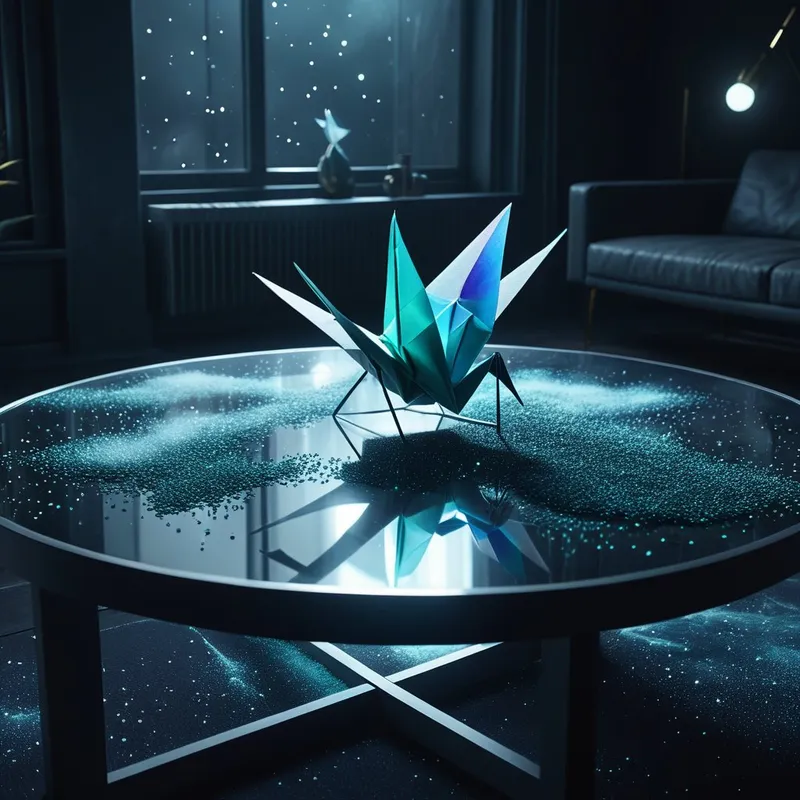
The apartment was all clean lines and soft light. On the glass table sat a single, perfect origami crane, folded from paper the color of a winter moon. As I watched, a corner began to fray, not into torn paper, but into a shimmering dust of microscopic, geometric shapes—tiny pyramids and spirals of light. They drifted upward, catching the lamplight, until the crane was no longer a form, but a constellation suspended in the air above the table.
In the dissolution of the meticulously crafted form, the psyche reveals its deepest truth: that the value of a thing is not in its permanence, but in the beauty of its becoming and unbecoming.
The False Lead
This theme is not a simple omen of "bad luck" or a warning of impending loss. To interpret it as such is to mistake the map for the territory. The terror of the ephemeral is not a signal of failure or a prophecy of lack. It is not the Shadow Orphan’s cry of victimhood, lamenting a cruel world that takes things away. That is a misinterpretation born from the ego’s desperate clutch for control. The dream of dissolving forms is a far more radical and generous intelligence. It is an invitation to feel the fundamental rhythm of existence—the inhale of creation and the exhale of release—and to discover what, if anything, remains sovereign when all that is familiar turns to vapor.
Psychological Architecture
To engage with this theme is to enter the most profound chamber of Shadow work: the confrontation with the part of us that believes we are the permanent authors of a permanent story. This is the architecture of the ego, a magnificent and necessary castle built on the premise of continuity. Dreams of ephemerality begin to dissolve its mortar. The psychological process is one of de-identification. You are not the castle. You are not even the land it stands upon. You are the awareness that witnesses both the construction and the gentle, inevitable weathering of the stones.
This is the core of Individuation in the face of impermanence. It is not about building a stronger, more resilient self to withstand the storm of change. It is about discovering the self that is the very space in which the storm arises and passes. It requires letting the internal "Manager" parts—those frantic interior architects who believe safety lies in solidity—step back and exhaust themselves. In that exhaustion, a deeper voice emerges. It does not speak in plans or assurances. It hums. It is the hum of the process itself, the silent, vibrant field from which all temporary forms coalesce and into which they retreat.
Mythic Resonance
We see this firmware update in the myth of the Navajo Yei, spirit beings who create intricate, temporary sand paintings—mandalas of breathtaking complexity—only to destroy them upon completion, scattering the colored sands to the wind. The healing power is not captured in the fixed image, but in the act of its creation and its conscious return to the formless. Similarly, in the Japanese aesthetic of wabi-sabi, beauty is found explicitly in transience and imperfection—in the moss on a stone, the crack in a bowl repaired with gold (kintsugi). The myth is not about preserving the pristine object, but about honoring the history of its fracture and repair, seeing its ephemeral journey as the very source of its depth.
Symbolic Nodes
- Melting Ice or Wax: Substance losing its defining structure, returning to fluid potential.
- Fading Photographs or Inscriptions: Memories or identities losing their sharp edges, becoming soft impressions.
- Sandcastles Dissolving at the Tide: Elaborate, conscious creations yielding to a larger, rhythmic force.
- Bubbles or Soap Froth: Perfect, iridescent forms existing for a single, glorious moment.
- Mist or Fog Obscuring a Known Landscape: The solid world rendered soft, ambiguous, and mysterious.
- Biodegradable or Composting Objects: The integration of "waste" or "end" back into the cycle of nourishment.
Archetypal Resonance
The energy of the Ephemeral Nature is most intimately aligned with The Magician Archetype, specifically in its shadow aspect of the Illusionist. The Magician’s core power is the understanding of the fundamental laws of reality and the ability to transform one state into another. The Shadow Magician, however, becomes attached to its own tricks, believing the illusions of permanence and control it has conjured are real. The dream of ephemerality is the psyche’s ultimate alchemical act: it applies the heat of truth to this shadow, forcing a confrontation with the illusion of solidity. The somatic echo—that hollow, suspended feeling—is the moment the illusion fails. The alchemical potential lies in the Magician reclaiming its true power: not to fight the law of transience, but to become a conscious, graceful agent of it, finding freedom in the flow rather than fear in the fixation.
The Alchemical Process
The alchemy here is Sublimation in its truest sense: the transformation of a solid directly into a vapor, bypassing the intermediary liquid state. The psychological "heat" required is the sustained, courageous gaze at the void where a cherished form used to be. It is the pressure of resisting the immediate urge to rebuild, to replace, to fill the hollow. This heat cooks the raw grief of "it’s gone" into the profound insight of "it was never mine to hold in that way."
You must sit in the ashes of the dissolved and not call them ashes. You must perceive them as the primordial substance, the prima materia, now freed from a particular shape and ripe for infinite possibility. The terror of the ephemeral is the ego’s death rattle. The grief is the solvent. The sovereignty that emerges is not a new, more permanent structure, but the realization that you are the crucible itself—the timeless, witnessing space in which all temporary forms of life, relationship, and identity are lovingly formed and compassionately released.
The Integration Protocol
Question 1: What form, relationship, or aspect of my identity have I been treating as a permanent installation in the gallery of my life, and what becomes possible when I see it as a temporary, sacred exhibit?
Question 2: Where in my body do I feel the clutch of "holding on," and if I were to breathe into that space and imagine it softening into an open palm, what sensation arises?
Question 3: If my life’s purpose is not to build a monument, but to dance a singular, beautiful pattern in the river of time, what does that dance feel like in this moment?
Action 1 (Grounding in the Hollow): For five minutes, sit quietly and focus on the physical sensation of the "hollow echo" described in the Somatic Echo—often in the chest or gut. Do not try to fill it or analyze it. Simply breathe as if that hollow space is a vast, open room, and your breath is a gentle wind moving through it. Observe how the sensation changes when met with spacious attention instead of fear.
Action 2 (Ephemeral Artifact): Create a small, deliberate piece of art meant to decay. Build a mandala of fallen leaves and petals in your garden. Write a short poem or a forgiveness on a piece of paper and safely burn it, watching the words turn to smoke. The act is not in the preservation, but in the conscious, respectful release of the creation.
Action 3 (The Unfinished Letter): Write a letter to someone (living, dead, or a part of yourself) with no intention of sending it. Write until you feel a natural pause. Instead of concluding it, leave the last sentence unfinished. Place the letter in a drawer. Revisit it in a week, not to finish it, but to observe how the feeling-tone of what you wrote has already, subtly, changed.
Final Validation
To dream of dissolving forms is to be invited to the edge of the known world. It is, understandably, terrifying. The mind that built its home on the premise of continuity will scream that the foundation is vanishing. Honor that fear; it is the loyal guardian of a cherished illusion. Then, take one breath beyond it. For in that breath, you will sense it: the profound, unshakable peace that does not reside in any form, but is the very ground of being from which all forms arise and pass. Your sovereignty is not in defying the ephemeral nature of life, but in finally, gracefully, agreeing to dance with it.