
The Architecture of Belonging: Dreams of Environmental Fit
It begins not as a thought, but as a pressure. A low-grade hum in the marrow, a subtle torsion in the connective tissue. You feel it as a constant, quiet friction—the sense that your internal weather system is perpetually out of sync with the atmospheric pressure of your life. Your laughter lands a half-beat too late. Your convictions feel like artifacts in a museum of the future. You are a sentence written in a syntax the world no longer parses. This is the somatic echo of a soul questioning its habitat. It is the body’s deep knowing, long before the mind admits it, that the architecture of your being no longer fits the foundation upon which it was built.
The Dreamer's Log
The dream is of a vast, silent server farm. I am tasked with maintaining it, but I do not understand the language of its lights. My tools are made of warm, worn wood and brass, useless against the sleek black monoliths. I need to insert a key—a simple, ornate iron thing—but every port is a smooth, featureless surface. The hum of the machines is not a sound, but a vibration that makes my teeth ache.
Here, the psyche renders the crisis of fit in stark, cyber-alchemical terms: the soul’s archaic, authentic tools are incompatible with the modern, impersonal system it is forced to serve.

The False Lead
This is not about a bad day, a difficult phase, or mere dissatisfaction. To mistake it for simple "bad luck" or a "toxic environment" is to stay on the surface. The dream of environmental fit is a structural report, not a complaint about the decor. It speaks to a fundamental misalignment between the core, evolving Self and the total environment—which includes your job, your relationships, your beliefs, and even the identity you’ve worn like a familiar coat. It is the difference between a ship in a storm and a fish out of water. One battles the elements; the other realizes it is, itself, the wrong element.
Psychological Architecture
The work here is Shadow work of the most profound order: the dismantling of a world you helped build. The individuation process demands you outgrow not just your limitations, but sometimes the very platforms that once supported your growth. The pain is that of a tree splitting the patio stones laid around its sapling self. You are not rejecting the world; you are being rejected by it, because the "you" that world was designed for is dying. The grief is for that former self and its familiar habitat. The terror is of the raw, unformed potential that now has no container. This is the psyche’s foundation shifting, and every room in the house of your identity groans in protest.
Mythic Resonance
We see this in the tale of the Mabinogion’s Bran the Blessed, a giant-king so vast he could wade across seas. He is a sovereign whose very body is incompatible with the human-scale world; he cannot fit in houses or ships built for ordinary men. His myth is one of profound power coupled with profound displacement—his strength is also his exile. Similarly, the alchemical parable of the Homunculus in its glass vessel speaks to this: a created being, conscious and yearning, but trapped in an artificial womb that both sustains and suffocates it, destined to shatter its own container to seek a fit it can never truly find. These are not stories of failure, but of scale and essence colliding with form.
Symbolic Nodes
- Ill-Fitting Clothes or Armor: Costumes of a role that now constricts.
- Wrong Tools for a Task: Instincts and skills that have become obsolete.
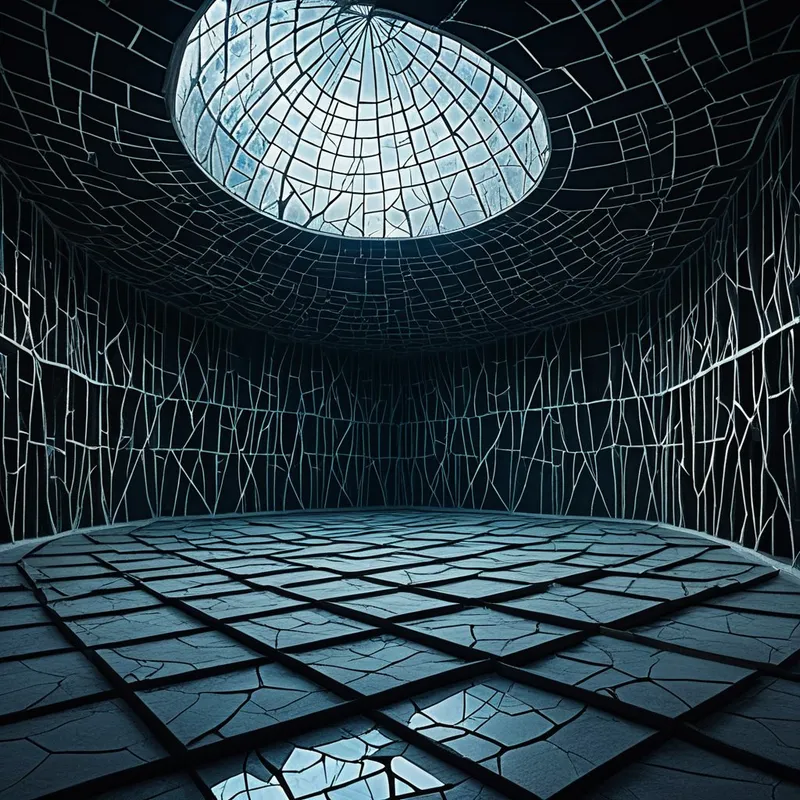
- Architectural Incongruity: A thatched roof on a skyscraper, a cathedral in a desert.
- Incompatible Interfaces: Plugs that don’t match sockets, keys for nonexistent locks.
- Altered Gravity or Atmosphere: Walking through glue, breathing underwater.
- A Room That Changes Size: The walls press in or recede to infinity.
Archetypal Resonance
The Orphan Archetype is the prime mover here, not in its shadow victim-state, but in its core, realist energy. The Orphan’s fundamental question is "Where do I belong?" It is the archetype that feels the chill of existential homelessness most acutely. Its somatic echo is that deep, hollow ache of disconnection, the child’s knowledge that it has been placed in the wrong story. The alchemical potential lies in the Orphan’s brutal honesty. It refuses the false solace of a ill-fitting home. Its grief is the necessary solvent that dissolves the glue of false belonging, forcing the terrifying, sovereign journey to find or found a world that is truly its own.
The Alchemical Process
The transmutation of this theme is a process of Soul-Smelting. The intense heat and pressure are generated by holding the tension between two unbearable truths: the profound grief of losing your psychic habitat, and the terrifying freedom of being structurally adrift. This is the nigredo, the blackening. You must let the old "fit" burn away, not as a failure, but as a spent fuel. The alchemy occurs in the willingness to inhabit the liminal, formless state—to be the fish aware of water, the tree feeling the stone. From this dissolution, a new sovereignty is forged: not the power to change the environment to fit you, but the authority to discern which environments are worthy of your essence, and the courage to construct them from the ashes of the old.
The Integration Protocol
Question 1: Where in my waking life do I feel the most visceral, silent "click" of misalignment—not as frustration, but as a deep, bodily hum of wrongness?
Question 2: What cherished part of my identity or belief system has become like an antique tool—beautiful, meaningful, but functionally useless for the life I am now building?
Question 3: If my current environment is a language, what is one true sentence about myself that it is incapable of speaking or hearing?
Action 1 (Somatic Cartography): For one day, track the somatic "pinches." Notice not just emotions, but physical sensations—a clenching jaw in a certain room, a lightness in the chest with a particular person, a foggy head during a routine task. Map the geography of your body's yes and no.
Action 2 (Unstructured Material Eruption): Without planning, using charcoal, mud, torn paper, or any raw material, create a physical representation of the "interface" between you and your world. Don't sculpt a self-portrait; sculpt the connection point. Is it frayed wires? Rusted gears? A seamless weld? Let the material show you.
Action 3 (Ritual of Decommissioning): Choose one small, symbolic object that represents an old "interface" that no longer fits (an old business card, a gift from a departed relationship, a book representing a discarded dogma). With solemnity, decommission it. Submerge it in water until the ink runs, bury it in soil, or burn it safely. Thank it for its service, and acknowledge its work is complete.
Final Validation
The anguish of misfit is a holy signal. It is the intelligence of your deepest architecture refusing to compromise its integrity for the sake of an old blueprint. This pain is not proof that you are broken, but evidence that you are outgrowing a shell that was never meant to be permanent. The friction you feel is the grind of a new form being born from the constraints of the old. To feel this profoundly dislocated is to be precisely on the threshold. The world that fits you will not be found; it will be built, brick by psychic brick, from the raw, authentic material of a self no longer willing to be a guest in its own life.