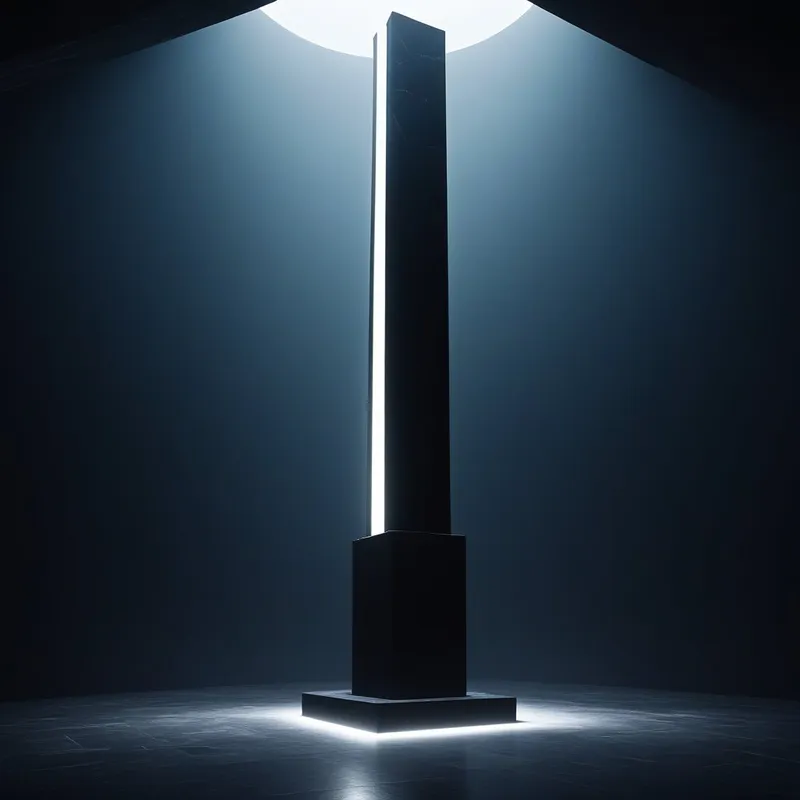
The Alchemy of the Void: Dreaming of Empty Space
The Somatic Echo
It arrives not as a thought, but as a sensation. A hollow resonance in the chest, a quieting of the internal hum. It is the feeling of standing in a room after the furniture has been removed, where your own breath echoes against walls that once held pictures. This is not anxiety’s frantic buzz, but its opposite: a deep, gravitational pull into stillness. The body registers the absence before the mind can label it loss. The stomach may feel weightless, unmoored; the shoulders might drop, not in relief, but in a surrender to a sudden lack of resistance. It is the somatic signature of a system pausing, a psychic intake of breath held at the threshold. You feel both lighter and more substantial, as if the empty space around you is also within you, clearing a chamber for a frequency not yet heard.
The Dreamer's Log
I am standing in the data center where I used to work. The servers are gone. The constant drone of cooling fans is replaced by a silence so thick it presses on my eardrums. The only thing left is a single, tarnished silver key lying in the center of the dustless floor.
The dream alchemically renders the release of an obsolete identity—the "server" of old roles and data—revealing the key to the next chamber lies not in accumulation, but in the cleared ground of what has been surrendered.

The False Lead
This theme is not mere loneliness, boredom, or a simple fear of lack. To mistake the void for vacancy is to confuse the blank canvas with the absence of art. The empty space in these dreams is not a deficit, but a potential field. It is not the aftermath of a disaster, but the carefully prepared site before a foundation is poured. The terror it can evoke is not about having nothing, but about facing the pure, unbounded responsibility of the something you must now, from your own essence, choose to create. It is the structural shift, not the circumstantial setback.
Psychological Architecture
To encounter empty space in the dreamscape is to be invited into the most intimate shadow work: the confrontation with your own inner tabula rasa. This is the Individuation process in its most raw phase—after the personas have been tried and found wanting, after the complexes have been named and acknowledged, there comes a moment when all those familiar inner characters fall silent. The internal family system experiences a ceasefire. The caregiver rests, the rebel has nothing to fight, the achiever has no task. What remains is the Self, not as a contented king, but as a sovereign standing in the cleared throne room of its own psyche.
This architecture is one of dissolution for the sake of integration. The ego, which builds its home from relationships, achievements, and narratives, experiences this space as a death. But the soul perceives it as a necessary demolition. The grief is real—it is the grief for the comforting, known confines of a smaller life. The empty space is the psychological requirement for a new pattern to coalesce from a higher order of complexity, one that can include more of your totality. You are not being erased; you are being unspecificed, so you can re-specify yourself from a deeper source.
Mythic Resonance
This is the moment in the hero’s journey spent in the belly of the whale—a dark, formless container of disintegration before rebirth. It is the bardo of Tibetan tradition, the transitional, dream-like state between death and a new existence, where all old forms are stripped away and the essence awaits its next manifestation. We see it in the myth of the goddess Inanna, who must descend, surrendering a symbol of her power at each of the seven gates to the underworld, until she stands naked and bowed before her shadow sister, Ereshkigal. Her empty-handedness is not defeat, but the ultimate prerequisite for her return with greater wisdom. The empty space is that underworld throne room—a place of utter reduction that alone makes true enlargement possible.
Symbolic Nodes
- Vast, empty halls, warehouses, or stations.
- Cleared fields, barren landscapes under immense skies.
- Blank pages, empty screens, or erased whiteboards.
- Silent rooms in a normally bustling house.
- A container (vase, chest, room) that is conspicuously empty.
- A missing object in its expected place, highlighting the void around it.
Archetypal Resonance
The Magician Archetype is the primary force activated by the theme of empty space. Not the Magician as performer, but as the alchemist of the potential field.
The Magician’s core power is transformation, and transformation requires a vas—a vessel, a sacred space set apart. The empty space in the dream is that vessel. The somatic echo of hollow resonance is the Magician sensing the chamber being prepared within the psyche. The terror of the void is the Shadow Magician’s fear—the illusionist who cannot work without props, who mistakes the emptiness for a failure of his tricks, who fears that without external tools (roles, relationships, busyness) he himself is nothing. The alchemical potential lies in the Magician’s understanding that the void is the primary ingredient. From this silent, empty center, the prima materia of the true self can be recognized and the new reality invoked. The empty space is the Magician’s most essential tool: the cleared ritual circle from which all genuine creation begins.
The Alchemical Process
The alchemical transmutation here is Solution, followed by Coagulation. The empty space is the solvent—not a passive state, but an active, dissolving force. The intense psychological heat and pressure come from sustaining the gaze into the void without rushing to fill it. This is the nigredo, the blackening, where all familiar forms dissolve into a uniform, dark mass. The grief and terror are the fires of this stage.
The transformation occurs when one stops seeing the space as “empty of something” and begins to perceive it as “full of nothing”—a pregnant, fertile nothing. This is the shift from spatium vacuum (vacant space) to spatium potentiae (space of potential). The sovereignty is born the moment you realize the emptiness does not negate you; it awaits you. You are not the missing furniture; you are the architect who gets to design the next room. Coagulation begins not by importing old furniture, but by allowing the first, authentic impulse—a feeling, an image, a knowing—to crystallize from the silent solution. The new structure that forms will be of a wholly different order, native to your core, because it was born from the cleared ground of your being.

The Integration Protocol
Question 1: What specific role, identity, or belief has recently been “cleared out” in my waking life? Can I honor the space its departure has created, rather than immediately lament its absence?
Question 2: If this empty space in my dream were not a void, but a sanctuary, what quality of being does it invite me to embody here (e.g., silence, patience, sovereignty, potential)?
Question 3: What is the most fragile, authentic impulse or idea that has tried to emerge in me recently that I may have dismissed because it didn’t fit my “furnished” self-concept?
Action 1 (Somatic Grounding): For five minutes, sit or stand in a physically empty space in your home. Do not meditate on a concept. Simply feel the air on your skin, notice the sound of silence, and feel your body’s weight held by the floor. Let your awareness inhabit the physical emptiness until your internal chatter settles into the same quality of space.
Action 2 (Creative Expression - The Vessel): Take a blank sheet of paper or a digital canvas. Do not aim to create an image of something. Instead, make a mark, a color field, or a texture that feels like the quality of the empty space from your dream. Is it a soft gray wash? A single, small dot in a vast charcoal field? A textured, raw canvas? Let the work be an embodiment of the space itself, not an illustration of it.
Action 3 (Ritual of Invitation): Place a single, meaningful object (a stone, a ring, a written word) in the center of a clean, clear surface—a table, an altar, a windowsill. This object represents the first conscious “coagulation” you wish to invite from the void. Leave it there for a week, observing it daily not as a solution, but as a seed placed in the cleared soil of your attention.
Final Validation
To dream of empty space is to be asked to endure a profound and unsettling grace. It is difficult because it calls upon a courage deeper than action: the courage to be still, to be undefined, to hold the threshold. This is not the work of a day, but the gestation of a new self. Trust the hollow resonance in your chest. It is not an echo of loss, but the sound of your own inner architecture expanding. The void does not negate you; it is the sacred, cleared ground from which your most authentic form is finally permitted to rise.