
The Alchemy of Weight: Dreaming of Emotional Burdens
It begins not as a thought, but as a density. A gravitational pull deep in the marrow, a slow sedimentation in the joints. The shoulders become geological, bearing epochs of unshed tears and unspoken truths. The chest cavity feels like a reliquary filled not with sacred bones, but with stones—smooth from constant handling, cold to the touch. This is the somatic echo of the emotional burden, the body’s faithful transcription of a psyche that has taken on more than it can consciously hold. It is the physical memory of a contract the soul never signed, written in the language of tension and fatigue. Before the mind can name the grief, the fear, the resentment, the body is already an archive of its weight.
The Dreamer's Log
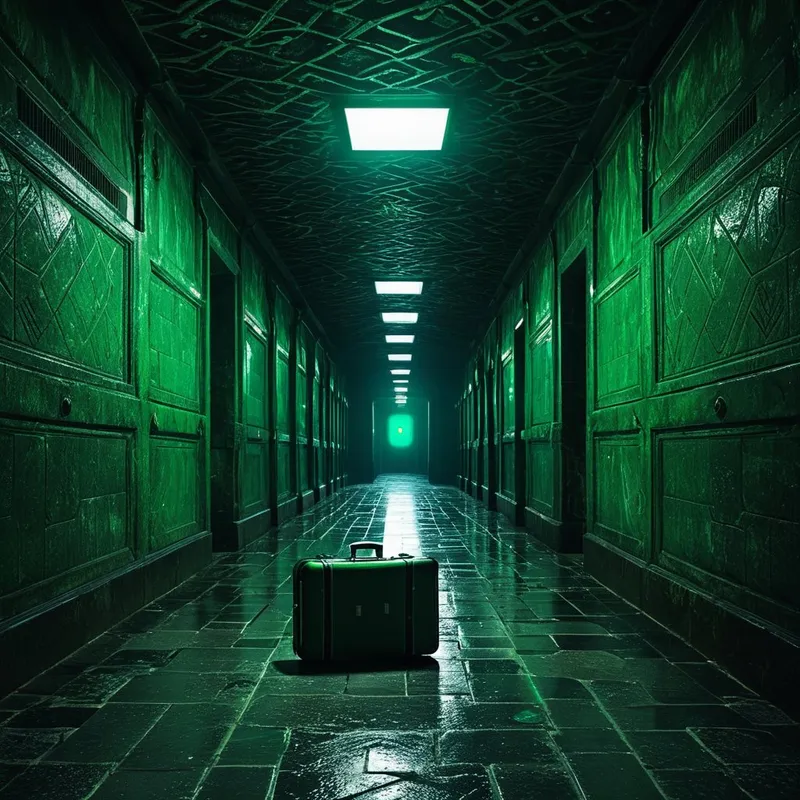
The dream is always the same: I am in an endless, low-ceilinged stone corridor, carrying a leaden suitcase. Its handle has fused to my palm. I know I must reach a door at the far end, but with each step, the case grows heavier, its contents shifting like wet sand, threatening to pull my arm from its socket. I cannot put it down; the floor, I am certain, will not hold it.
This is not a dream about luggage. It is the psyche’s stark portrait of a loyalty to a pain that has outlived its purpose—a cry for the alchemical courage to finally set down what was never yours to carry alone.
The False Lead
This theme is not about the transient stress of a bad day or a streak of misfortune. To mistake it for such is to confuse a tectonic shift with a surface tremor. The emotional burden in dreams is not the weight of circumstance, but the weight of identity forged in that circumstance. It is the internalized responsibility, the silent vow, the story of “I must” or “I alone” that has become so enmeshed with the self it feels like the self. It is structural, not situational. The dream is not complaining about your load; it is questioning the architecture of the carrier.
Psychological Architecture
Here, in the shadowlands of the dream, we encounter the profound work of psychic disaggregation. The burden is rarely a single thing, but a compound entity—a system of feelings, obligations, and memories that have clumped together into a single, seemingly monolithic mass. This is the territory of Internal Family Systems, where the burden is often a protector part, a loyal soldier who took on a crushing duty long ago to shield a more vulnerable exile: the child who learned to be the parent, the heart that learned to be a fortress, the joy that agreed to be quiet to keep the peace.
The individuation process here is one of gentle, terrifying dissolution. It requires listening to the burden not as an enemy to be defeated, but as a forgotten ally to be understood. What is it protecting? What ancient treaty is it still upholding? The work is to thank this heavy, loyal part for its service—a service that may have saved you once—and to negotiate its retirement. To show it that the exile it guards is now strong enough to be felt, that the war is over, and that standing sentinel in this way is costing you your life. This is the shadow work: to reclaim the energy bound up in carrying, and to redirect it towards becoming.
Mythic Resonance
We see this eternal process in the figure of Atlas, condemned to bear the celestial spheres upon his shoulders for eternity. His burden is not a punishment for evil, but a consequence of being on the losing side of a cosmic war—a fate born of loyalty and circumstance. The weight is his identity; to set it down is unthinkable, the very order of the world seems to depend on his suffering. Yet, in some tellings, the hero Heracles temporarily relieves him, revealing a profound truth: the structure of the world can endure a moment of release. The myth asks us, what in our personal cosmos feels so foundational that its support must cause us perpetual strain? Are we, like Atlas, mistaking a temporary role for a permanent sentence?
Symbolic Nodes
- Impossibly Heavy Objects: Suitcases, backpacks, stones, anchors, bodies.
- Fused or Stuck Loads: A bag whose straps have become part of your skin, a weight grafted to your body.
- Fragile Containers: Overstuffed bags splitting at the seams, glass boxes holding swirling storms.
- Unending Journeys: Corridors, staircases, or roads where the destination never draws nearer.
- Sinking or Crumbling Ground: The fear that setting the burden down will cause catastrophic collapse.
Archetypal Resonance
The energy here resonates most deeply with The Orphan Archetype, specifically in its Shadow manifestation as the Victim. The Shadow Orphan has forgotten its innate resilience and survival wisdom, and has instead become identified with the burden itself. The weight is not something it carries; it becomes the proof of its abandonment, the core of its identity—“I am the one who is weighed down.” This archetype’s somatic echo is the slump of resignation, the breath held in anticipation of the next blow. Its alchemical potential, however, is immense. Within this very identification lies the key: by feeling the full, brutal truth of the weight, the dreamer touches the authentic experience that was too much to bear at the time of its origin. This raw, unfiltered contact is the first, crucial step of transmutation—the leaden truth that must be acknowledged before it can be changed into something else.
The Alchemical Process
The transmutation of the emotional burden is an alchemy of dispersion, not compaction. The goal is not to build stronger shoulders, but to dissolve the false cohesion of the mass. The required heat is the fierce, compassionate attention you bring to each separate element within the burden. The pressure is the willingness to feel the original grief, the ancient fear, the old anger as distinct energies, rather than as a single, suffocating lump.
First comes Calcination: the burning away of the story that “this is just who I am.” This is the searing honesty that acknowledges, “I am in pain.” Then, Dissolution: the painful, relieving tears that begin to soften the hardened mass, allowing the components to separate. “This is grief. This is rage. This is a promise I made at ten years old.” Separation follows, as you consciously sort the inherited obligation from the authentic care, the traumatic fear from the present-moment caution. Finally, Coagulation sees the reclaimed energy reform not as a burden, but as a foundation—the resilient wisdom of the survivor, the clear boundaries of the sovereign, the compassionate strength of the one who knows the weight of things and chooses what to hold with conscious love.

The Integration Protocol
Question 1: If the burden in your dream could speak, not with words, but with a single, pure emotion, what would that emotion be? Not a story about it, but the raw feeling itself.
Question 2: What is the oldest memory you have of feeling this same gravitational pull in your body? Don't analyze it; just locate its origin in time.
Question 3: What tiny, beautiful thing might be growing in the dark, fertile space directly beneath where this weight sits? What life have you been protecting all this time?
Action 1 (Somatic Mapping): Sit quietly and scan your body for the primary site of the "weight." Place your hand there. Breathe into that space for five minutes. Don't try to change it. Simply acknowledge its presence with your breath and touch, as you would the hand of a tired friend.
Action 2 (Unburdened Writing): Take a pen and paper. Set a timer for 7 minutes. Write from the perspective of the burden itself. Let it describe what it's made of, why it clings, what it fears would happen if it dissolved. Do not censor. Let the voice of the weight speak, and listen.
Action 3 (Dispersal Ritual): Find a small stone that feels "heavy" to you. Hold it, imbuing it with a single, specific aspect of your burden (e.g., "this is my father's disappointment"). Go to a moving body of water—a river, stream, or the sea. Tell the stone thank you for its lesson, and then let the current take it from your hand. Witness it being carried away by a force greater than yourself.
Final Validation
The weight is real. The fatigue is not a failure of your strength, but a testament to the incredible load you have borne, often so others would not have to. To feel crushed by it is a sane response to an insane demand you placed upon your own soul. And yet, within that very feeling—that authentic, somatic truth—resides your liberation. The burden dreams itself into your nights not to break you, but to show you the exact location of the forgotten treaty, the loyal protector, the fused identity ready to be met, thanked, and transformed. You are not the weight. You are the alchemist who can finally, gently, set it down.