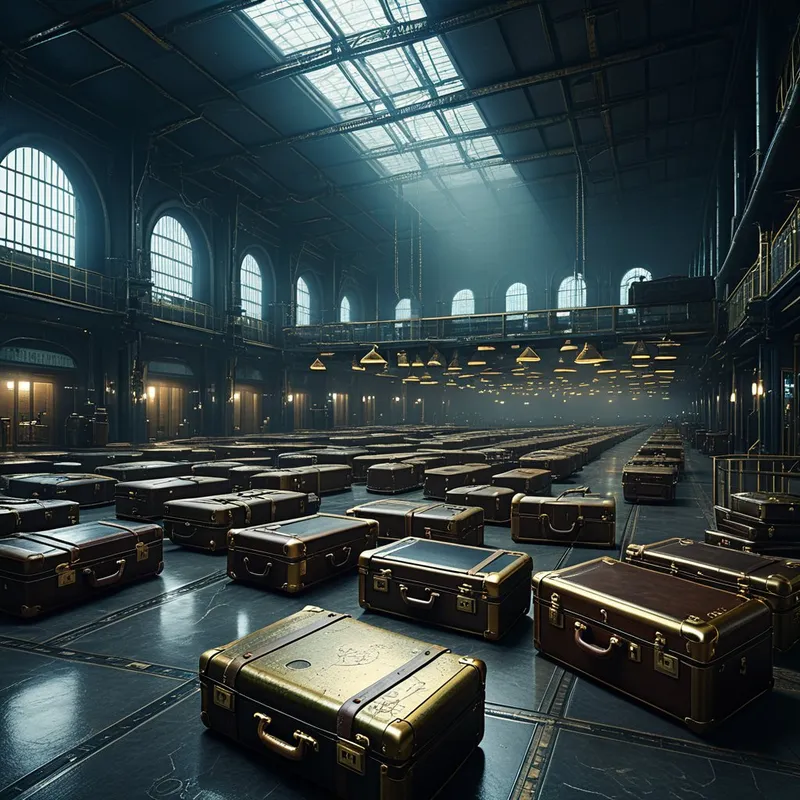
The Unbearable Weight of What We Carry
The Somatic Echo
Before the image forms, the body knows. It is a density in the chest, a low-grade ache in the shoulders, a gravity that pulls at the spine. You wake with a jaw clenched against a weight you cannot name, a fatigue that sleep did not touch. It is the somatic echo of a burden carried not in muscles, but in the very architecture of your being—a psychic mass, a history condensed into a physical sensation. The breath feels shallow, as if the lungs themselves are crowded by unseen occupants. This is the body’s logbook, recording the cargo of unlived grief, unspoken rage, and unmet longing long before the dreaming mind presents you with the symbol of the suitcase, the overfull room, the impossible load.
The Dreamer's Log
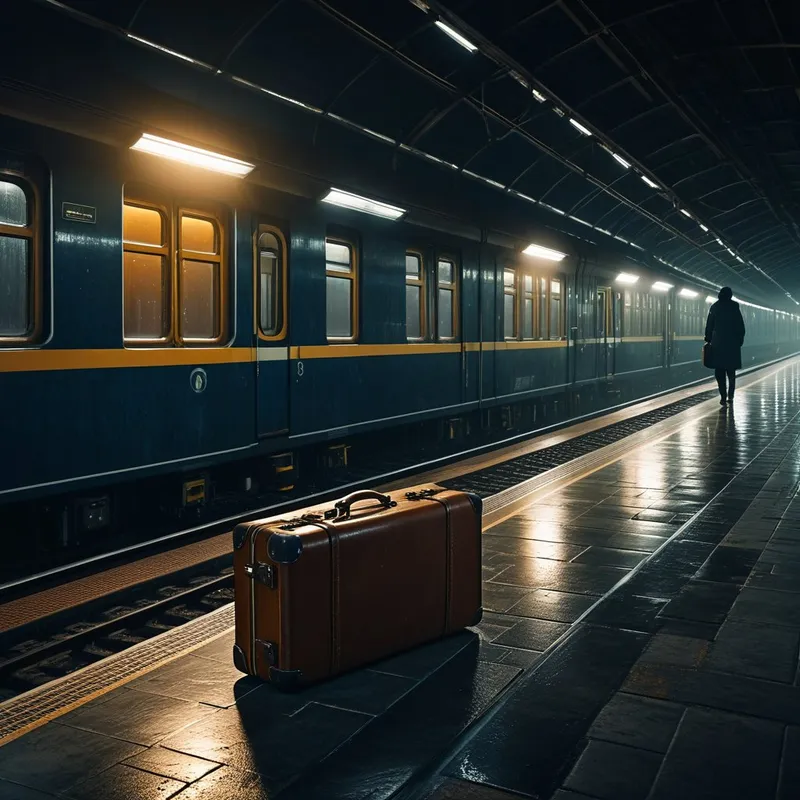
The dream is always the same: I am running to catch a train I cannot see, through a terminal that stretches into infinity. My arms are wrapped around a leather suitcase, its latches straining, its weight threatening to dislocate my shoulders. I know I must board, but the case is too heavy to lift onto the step. The train departs in a sigh of steam, leaving me alone on the platform, holding everything I could not leave behind.
This is not a dream about travel, but about the internal systems that insist we must carry our entire history with us, moment to moment, at the cost of missing the departure into our own future.
The False Lead
This theme is not about simple nostalgia or the gentle recollection of a past love. It is not a sign of "bad luck" or an external curse. To mistake it for such is to personalize a structural issue. The weight is not the memory itself, but our unconscious relationship to it—the hidden loyalty, the unprocessed charge, the identity we forged in that old pain. The dream is not saying, "You had a bad childhood," but rather, "You are still living from that childhood, and its governing rules are the hidden contents of your baggage." It points to a psychic economy where we pay for the present with the currency of the past.
Psychological Architecture
To engage with this theme is to begin a profound audit of the internal family. Within us, exiled parts—the hurt child, the betrayed lover, the silenced rebel—have been packed away, sealed with vows of "never again" or "I must always." We carry them not as memories, but as active, frozen legislators of our present behavior. The Shadow work here is one of reclamation and repatriation. It is the slow, courageous process of opening the overstuffed case not to be overwhelmed by its contents, but to meet each exiled fragment. To say to the grief, "I feel you," to the shame, "I see you," and in that seeing, to change your relationship from one of carrier to one of witness. This is the heart of Individuation: no longer being defined by what happened to you, but becoming the conscious author of what you do with it. The baggage does not disappear; its mass is transmuted into substance. The weight becomes ballast, then foundation.
Mythic Resonance
We see this eternal process in the figure of Atlas, condemned to bear the celestial spheres upon his shoulders for eternity. His burden is not a punishment for evil, but for defiance—for taking a side in a war of generations. He is frozen, a permanent monument to a single moment of conflict, holding up the very sky of his old world. His release does not come from someone taking the weight, but from a shift in perspective—in one version of the myth, the trickster Hero Heracles temporarily assumes the load, but the true liberation for Atlas is fleeting, a reminder that the only permanent freedom is in a fundamental re-negotiation with the structure of the cosmos itself. Similarly, in the Bag of Winds given to Odysseus by Aeolus, we see the peril of baggage unopened at the right time. The bag holds all contrary winds, a gift of safe passage, but his crew, believing it to contain treasure, opens it prematurely, releasing a storm that blows them far off course. The contained, managed energy of the past, when breached without conscious intent, unleashes chaos.
Symbolic Nodes
- Overstuffed Suitcases, Locked Trunks, Heavy Backpacks: The burden itself, often with broken latches or mysterious, weighty contents.
- Cluttered Rooms, Attics, Basements: The internal storage space, jammed with forgotten or unresolved emotional artifacts.
- Missed Trains, Buses, Boats: The opportunities for movement or transition that the burden prevents you from catching.
- Staircases That Become Heavier to Climb: The effort required for personal growth or aspiration, magnified by the unseen load.
- Carrying Someone Else's Load: Often points to enmeshment or inherited family trauma.
Archetypal Resonance
The core energy of this theme resonates most powerfully with The Orphan Archetype, specifically in its shadow manifestation as The Victim. The Orphan's gift is realism and resilient survival, but its shadow believes the world is fundamentally unsafe and that its wounds are its defining identity. The somatic echo—the ache, the weight—is the Victim’s bodily testament to its proof of suffering. The overfull suitcase is its curated museum of evidence. Yet, within this very archetype lies the alchemical potential: the Orphan, by fully feeling its abandonment and acknowledging its load, initiates the journey toward authentic belonging. It must move from carrying its story as a burden to holding it as a testament, from a weight that crushes to a truth that grounds. The integration of this archetype is not about becoming weightless, but about developing the strength to carry your truth with sovereignty, not servitude.
The Alchemical Process
The transmutation of Emotional Baggage is an alchemy of liquefaction. The process requires the application of intense, focused heat—the heat of conscious, embodied attention. The frozen mass of petrified feeling—the "lead" of our suffering—must be melted. This heat is the friction of honest self-reflection, the pressure of allowing long-avoided grief to finally move through the body in tears or tremors, the courage to speak a buried truth. It is profoundly uncomfortable, for it feels like dissolution, like losing the very shape of a familiar pain. As the solid, burdensome story liquefies, its components separate. What was a single, heavy block of "my terrible past" becomes distinct streams of sorrow, anger, fear, and love. In this liquid state, it can be filtered. The pure essence of the experience—the wisdom, the empathy, the clarified desire—can be distilled. The dross—the toxic shame, the limiting belief, the outdated vow—is left behind to evaporate. The leaden suitcase becomes a vessel for a new, fluid awareness.
The Integration Protocol
Question 1: If the weight in the dream had a single, core message from your past self to your present self, what would it be pleading for you to finally acknowledge or feel?
Question 2: What current situation or relationship in your waking life feels like "trying to run while carrying this suitcase"? Where is the old burden actively limiting your movement?
Question 3: If you could unpack one single, small item from that overstuffed case and lay it to rest with honor, what would it be? What ritual of release would do it justice?
Action 1 (Somatic Inventory): For one minute upon waking, before you move, scan your body. Locate the densest point of sensation—the clenched gut, the tight chest, the heavy limbs. Breathe into that space without trying to change it. Simply acknowledge its presence as a physical fact. Say inwardly, "This is the weight. I feel it."
Action 2 (Unstructured Unpacking): Set a timer for 10 minutes. With pen and paper, begin with the sentence: "What I have been carrying is..." Do not lift the pen. Write in a stream of consciousness, allowing images, memories, single words, or emotions to flow out. This is not an essay; it is a psychic unpacking. When the timer ends, burn or shred the paper as a symbolic act.
Action 3 (Ritual of Relocation): Find a physical object (a stone, a small box, a piece of wood) to represent one specific piece of your emotional baggage. Take it to a threshold—a bridge, a shoreline, a park entrance. Acknowledge the burden it represents, then consciously leave it there. You are not abandoning it, but relocating it from inside your body to a point in the external world, changing your relationship from carrier to observer.
Final Validation
The weight is real. The fatigue is earned. To feel crushed by a history you did not choose is a testament to your sensitivity, not your failure. This burden was, at some point, a strategy for survival—a way to keep your world intact, to protect a fragile truth. Honor that. And then, know this: the very dream that shows you the suitcase is also the first, gentle strain against its latches. Your psyche is not torturing you with the weight; it is presenting you with the invoice, now that it believes you are strong enough to consider paying it. The integration is not an act of dismissal, but of profound reverence—for the self that carried it, and for the self that is now ready to set it down, piece by sacred piece, and walk forward into a lighter, more authentic dawn.