
The Crucible of Contradiction: Emotional Ambivalence in Dreams
The Somatic Echo
Before the mind can name it, the body knows the state of ambivalence. It is not a lack of feeling, but a surfeit—a paralyzing fullness. It feels like a deep, resonant hum in the solar plexus, a vibration that is neither pleasant nor painful but holds the potential for both. It is the sensation of being pulled in two directions with equal, undeniable force, creating a stillness at the center that is not peace, but suspended animation. The breath catches, not in fear or excitement, but in a third, unnamed state that contains them both. Muscles are neither tense nor relaxed; they are held in a perfect, exhausting equilibrium, ready to spring toward or away from a target that has not yet declared its nature. This is the somatic ground from which the dreams of ambivalence grow: a living paradox made flesh.
The Dreamer's Log
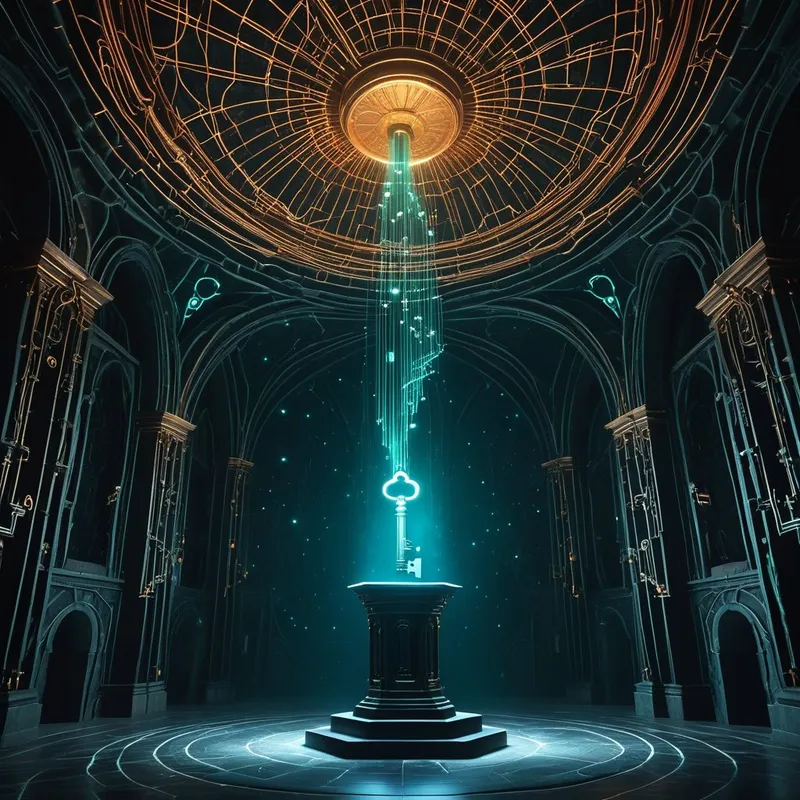
I stand in a vast, silent archive. On a pedestal before me lies a single, ornate key that pulses with a soft, warm light. I know it will unlock a door I have sought for years. Yet, as I reach for it, a cold dread washes over me. My hand trembles, suspended inches from the metal. I want it more than anything. I am terrified to touch it. The dream ends with my hand still hovering, the key’s light reflecting in my frozen fingertips.
This dream is an alchemical tableau: the key is the prima materia, the raw substance of a profound life change, and the suspended hand is the necessary mortificatio, the death of simple wanting, where desire and fear are revealed as two faces of the same sacred coin.
The False Lead
Emotional ambivalence in dreams is not indecision, nor is it a sign of being "wishy-washy" or uncommitted. To mistake it for weakness is to profoundly misread the script of the soul. Indecision is a cognitive stall, often born of a lack of information or clarity. Ambivalence is an emotional and spiritual event of the highest order. It is the conscious, felt experience of the psyche holding two entire worlds, two potential futures, two core identities in its hands simultaneously. It is not the absence of a path, but the overwhelming presence of two. This is not a malfunction; it is the system operating at the edge of its capacity, preparing for a quantum leap in complexity. It is the labor pain before a new consciousness is born.
Psychological Architecture
The architecture of ambivalence is the psyche’s most sophisticated holding pattern. It is Shadow work in its most immediate, visceral form. Here, the process of Individuation—the journey toward becoming an integrated, self-defined whole—hits its most potent friction. To move forward toward a new state of being (the unlocked door, the committed relationship, the career leap) requires the death of an old self. The part of you that clings to the familiar, even if it is painful or limiting, is at war with the part that yearns for growth. This is not a civil war with clear sides, but a dissolution of sides altogether. The "you" that is afraid is also the "you" that desires. The love and the resentment, the yes and the no, are not battling for dominance; they are intertwined roots of the same tree. To experience this consciously is to stand at the threshold where the ego’s either/or logic breaks down, and the soul’s both/and reality begins. It is terrifying because it demands you contain your own opposites without splitting them apart, to feel the full weight of your own complexity without seeking a premature, simplifying escape.
Mythic Resonance
We see this eternal firmware in the myth of Thetis dipping Achilles in the River Styx. The goddess, desperate to make her son invulnerable, holds him by the heel and submerges him in the magical waters. This is the ultimate ambivalent act: a gesture of perfect love and protection that simultaneously creates the fatal flaw. The point of contact—the hand on the heel—is the locus of both salvation and doom. The love does not cause the vulnerability; it is the same gesture. Our own moments of profound ambivalence are these mythic dips. The commitment that offers security also feels like a trap. The freedom we crave carries the chill of exile. We are held by the heel of our own deepest contradictions, made powerful and vulnerable in the same transformative stream.
Symbolic Nodes
Dreams speak the language of this tension through potent, paradoxical images:
- Bridges that are both crumbling and being built.
- Doors that are simultaneously open and locked.
- A loved one’s face morphing into a stranger’s, and back again.
- A vehicle (car, train, ship) with two steering wheels or engines pulling in opposite directions.
- A plant that is both blooming vibrantly and withering at the root.
- Food or drink that tastes exquisitely sweet and bitterly foul at once.
These are not symbols of confusion, but of co-existence. The psyche is rendering the felt reality of holding two truths in one image.
Archetypal Resonance
The energy of emotional ambivalence resonates most powerfully with The Magician Archetype in its shadow aspect. The Magician’s core power is transformation, the ability to work with the raw materials of reality to create change. The Shadow Magician, however, is trapped in the potential for transformation, paralyzed by seeing all possible outcomes and manipulations at once. This is the precise energy of ambivalence: the terrifying, god-like awareness of multiple realities and truths, without the will to catalyze one into being. The somatic echo—the humming, suspended tension—is the Shadow Magician’s power circulating without release, a circuit held open. The alchemical potential lies in moving from this paralyzed, manipulative self-consciousness into the authentic Magician’s act: to choose, to catalyze, and to accept the consequences of the transformation one initiates, thereby reclaiming sovereignty from the prison of infinite possibility.
The Alchemical Process
The alchemy of ambivalence is called Separatio-Coniunctio, a separation that leads to a higher union. The process is not about choosing one feeling and annihilating the other. That is mere repression, which creates a brittle, lopsided psyche. True transmutation begins with the intense, internal heat of conscious containment. You must hold the love and the hate, the desire and the dread, in full awareness, without acting, without judging either as "good" or "bad." This pressure cooker of the soul is the nigredo, the blackening. In this dark night, a miraculous separation occurs: you begin to differentiate the feeling from the identity. You are not "a person who is conflicted about X." You are a consciousness experiencing the powerful, dual energies of attachment and fear around "X." This separation is the albedo, the whitening. From here, a new, third thing can be born—not a compromise, but a synthesis. It might be a deeper, more conscious form of love that includes respectful boundaries. It might be a decision born of clarity rather than impulse. This is the rubedo, the reddening: the creation of a sovereign self large enough to host its own contradictions without being ruled by them.

The Integration Protocol
Question 1: In the moment of ambivalence, where in my body do I feel the "yes" most vividly? Where do I feel the "no"? Can I feel them both at once without trying to change them?
Question 2: If each side of my ambivalence (the desire and the fear) were a protector, what ancient part of me is each one trying to save? What would happen if they both succeeded?
Question 3: What old story about myself—as a loyal person, a free spirit, a cautious soul—would I have to release in order to move through this ambivalence?
Action 1 (The Bilateral Breath): When feeling paralyzed, sit quietly. As you inhale, imagine drawing the energy of the "yes," the desire, into the right side of your body. As you exhale, imagine releasing the energy of the "no," the resistance, from the left side. Do not force a resolution; simply let the breath become a circuit that allows both energies to flow without fusing or fighting.
Action 2 (Ambivalent Mapping): Take two sheets of paper. Title one "The Case For." Title the other "The Case Against." Do not write pros and cons. Instead, on each sheet, using unstructured writing or drawing, express the full emotional, sensory, and imaginative world of that pole. What does the world look like if you fully embrace the "for"? What is the texture, color, and sound of the "against"? Let them be complete, separate universes.
Action 3 (The Ritual of the Held Object): Find a small, natural object—a stone, a twig, a shell. Hold it in your dominant hand and pour into it all the energy of your desire, your "yes." Feel it charge. Then, transfer it to your non-dominant hand and pour into it all the energy of your fear, your "no." Feel its weight change. Finally, cradle the object in both hands at your heart center. Sit with the object as a single, complete entity that now holds your full ambivalence. Bury it, place it on an altar, or carry it with you as a talisman of your capacity to contain wholeness.
Final Validation
To feel true emotional ambivalence is to be engaged in the most honest and demanding work of your life. It is uncomfortable, maddening, and exhausting because it is real. It is the friction of genuine growth. The easy answers, the clear-cut choices, are often the territories of a sleeping soul. Your tension is a sign of awakening, of a psyche that refuses to betray its own complexity for the cheap coin of false certainty. This is not your undoing; it is your remaking. The sovereignty you seek is not found by resolving the tension, but by developing the strength to stand, fully alive, in its electric and generative field. You are not stuck. You are in gestation.