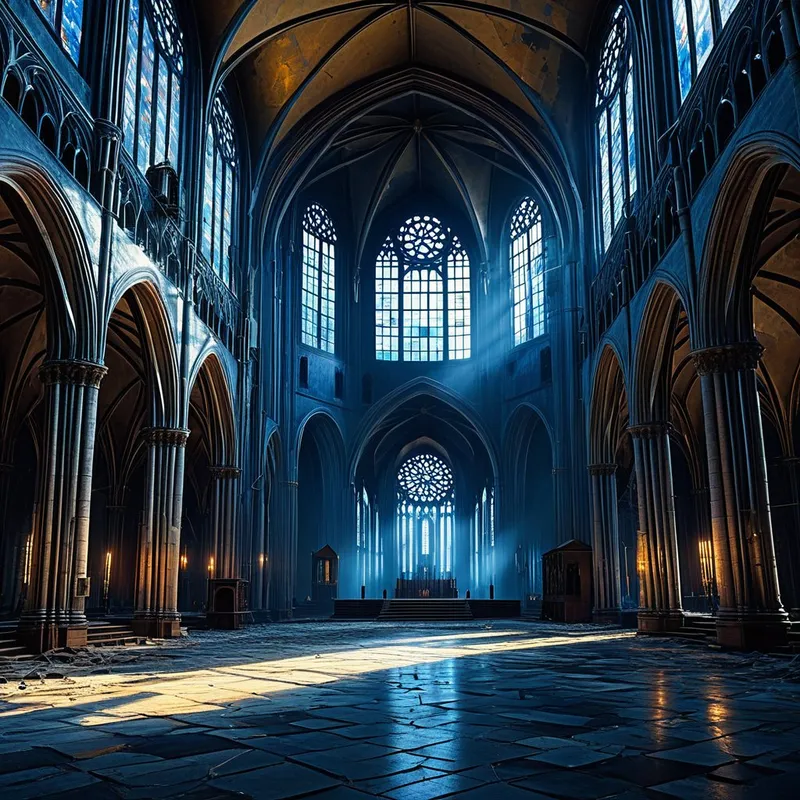
The Somatic Echo: The Weather Within
Before an image forms, before a story unfolds, you feel it. It is the dream’s first language, spoken not in symbols but in sensation. A dense, humid pressure in the chest, the air thick with unspoken grief. A brittle, electric crispness that makes the skin prickle with unnamed anticipation. A hollow, resonant chill that seems to echo from the marrow of your bones. This is the Emotional Ambiance—the foundational weather system of the inner world. It is the somatic echo of the psyche’s current climate, the visceral ground from which all dream narratives sprout. To ignore it is to read a novel by its chapter titles alone, missing the prose that gives them meaning. This ambiance is the direct, unfiltered broadcast from the core self, a felt-sense of the emotional energies currently in circulation, or more crucially, those held in stasis, waiting to be metabolized.
The Dreamer's Log: A Case in Crimson
The dreamer finds themselves in a cavernous, abandoned server farm. The air is cold and still, smelling of ozone and dust. Rows of monolithic black server racks stretch into darkness, their only life the slow, rhythmic pulse of tiny indicator lights, each one glowing a deep, sorrowful crimson. There is no task, no threat, only the immense, humming weight of silent, stored data.
Alchemical Interpretation: The crimson pulse is not a warning, but a heartbeat—the somatic echo of a vast, archived grief the conscious mind has powered down but cannot delete.

The False Lead: It's Not the Plot
The most common misinterpretation of Emotional Ambiance is to conflate it with the dream’s plot or its overt emotional reactions. A dream of being chased is not about fear; the chase is the narrative shape given to a pre-existing ambiance of anxiety or vulnerability. The ambiance is the cause; the story is the effect. This theme is also not about transient "mood" or the psychic residue of a bad day. While daily stressors can tint the glass, a recurring or profoundly potent Emotional Ambiance points to something structural—a foundational emotional setting within the psyche’s architecture that colors perception itself. It is the difference between a passing storm and the climate of a continent.
Psychological Architecture: The Shadow's Climate
To work with Emotional Ambiance is to engage in the most subtle form of Shadow work. We are not confronting a repressed figure or a denied memory, but the very atmosphere in which those figures live. This ambiance is often the emotional inheritance of an exiled part—the orphan’s loneliness, the rebel’s simmering rage, the caregiver’s heavy worry. The psyche, in its wisdom, does not present the exiled part directly if the ego is not ready. Instead, it allows us to first experience its environment. We are invited to feel the cold of the room where the orphan shivers, or the stifling heat of the chamber where the rebel is locked away. This is the beginning of Individuation: not by forcefully retrieving the lost part, but by first acclimating to its native climate, developing a somatic tolerance for its emotional weather. The process is one of emotional hospitality. By consciously abiding in the dream’s felt-sense upon waking—dwelling in that hollow chill or that pressurized dread for a few conscious breaths—we begin to reintegrate the climate itself. We signal to the inner system that this weather, too, is permitted to exist within the wholeness of the self.
Mythic Resonance: The Cauldron and The Labyrinth
This work finds its mirror in the myth of the Cauldron of Poesy from the Celtic tradition. The bard Taliesin describes not one, but three cauldrons within the human form: the Cauldron of Warming, the Cauldron of Motion, and the Cauldron of Wisdom. Their orientation—upright, on their side, or inverted—determines one’s capacity for inspiration and feeling. An inverted cauldron cannot receive. The Emotional Ambiance is the felt experience of these cauldrons’ positions. Are we open, flowing, and warmed? Or are we tipped, stagnant, and cold? Similarly, the Labyrinth of Crete was not merely a prison for the Minotaur; it was the architectural manifestation of a tangled, oppressive emotional state—King Minos’s shame, Pasiphaë’s unnatural desire, the collective dread of Athens. To navigate the ambiance is to walk the labyrinth of one’s own inner climate, not to slay the beast at the center, but to understand the terrain that sustains it.
Symbolic Nodes: Landscapes of Feeling
Common images that carry Emotional Ambiance include:
- Specific, Unchanging Light: A perpetual, sourceless twilight; a harsh, sterile fluorescent glare; a warm, honeyed, afternoon glow.
- Qualities of Space: Oppressively low ceilings; vast, echoing halls; cluttered, impassable rooms; smooth, endless corridors.
- Atmospheric Conditions: Still, dead air; a howling, directionless wind; a slow, cold drip from unseen places; a visible, colored fog or haze.
- Soundscapes: A distant, monotonous hum; a profound, weighted silence; the echo of your own footsteps; indecipherable whispers in the walls.
Archetypal Resonance: The Internal Weather-Maker
The archetype most active in shaping and responding to the Emotional Ambiance is The Magician Archetype. The Magician’s domain is the unseen forces, the hidden energies that govern reality. In its integrated form, the Magician understands and transmutes these forces. In the context of dream ambiance, the Magician is the aspect of the psyche that generates this inner climate—it is the weather-maker. The dense fog of melancholy, the electric crackle of anxiety, the clear light of peace—these are the Magician’s raw, unconscious creations. The shadow of this archetype, the Manipulator or Illusionist, is at play when we refuse to acknowledge this power, believing the weather simply happens to us, that we are passive victims of our own emotional climate. The alchemical potential lies in reclaiming the Magician’s wand: to move from being subjected to the ambiance to becoming a conscious participant in its regulation and transmutation. The somatic echo is the Magician’s first spell, cast upon the self; to feel it fully is to begin the counter-incantation.
The Alchemical Process: From Climate to Crucible
The transmutation of Emotional Ambiance requires the heat of conscious, sustained attention—a psychological solve et coagula (dissolve and coagulate). First, the solve: you must dissolve the ego’s habitual flight from discomfort. This is the heat. It is the difficult, patient work of staying present with the somatic echo—the tightness, the hollow, the buzz—without rushing to label it, analyze it, or fix it. You allow the ambiguous weather to simply be, to wash over you in the safe container of waking awareness. This conscious endurance begins to break down the solid, frozen state of the unattended emotion. Then, the coagula: from this dissolved state, a new form coalesces. The oppressive weight becomes a sense of grounded density. The frantic buzz becomes vibrant energy. The hollow chill becomes spacious clarity. The ambiance is not destroyed; its elemental quality is purified and reorganized into a usable force. The grief-pulse in the server room, once held in silent storage, becomes accessible data—the raw material for compassion, depth, and connection.

The Integration Protocol
Question 1: If the dream's ambiance were a physical place you had just stepped out of, what three adjectives would you use to describe the air on your skin?
Question 2: What exiled part of you might live comfortably in this exact emotional climate? What does it protect, and what does it need?
Question 3: If this ambiance had a message for your waking life, not in words, but as a guidance for how to be, what would it be? (e.g., "Slow down," "Make space," "Speak the unspoken.")
Action 1 (Somatic Mapping): Upon waking, before moving, spend one minute physically tracing the ambiance in your body. If it's a pressure, where are its edges? If it's a color, where does it glow? If it's a sound, where does it vibrate? Just map; do not change.
Action 2 (Ambiance Palette - Creative): Using any medium—watercolor, pastels, digital sliders—create a simple color or texture palette that represents the dream's ambiance. No scenes or objects, just 3-5 swatches of the "emotional weather." Title it with a single, felt word.
Action 3 (Ritual Respiration): Later in the day, find a quiet moment. Recall the dream's ambiance. Inhale, imagining you are drawing that specific quality of air (the cold, the thick, the electric) into your lungs. Exhale, imagining you are breathing out a quality that would balance it (warmth, clarity, calm). Do this for three breaths only. This is a treaty with the inner climate.
Final Validation
To feel the profound strangeness of your own inner weather is a sign of depth, not dysfunction. It is difficult, often terrifying, work to stand in the private climate of your soul—to feel its unmediated rains and silences. This difficulty is the measure of the ambiance’s importance; it guards something essential. Yet, in that very act of conscious feeling, you perform the ultimate alchemy. You are no longer a subject of the climate, but its sovereign. You begin to hold the atmosphere, rather than being held by it. And in that space, the very weather of your being becomes a language, a guidance system, and finally, a home.