Divine Creation: The Psyche's First Command
The Somatic Echo
It begins not as a thought, but as a pressure. A deep, tectonic hum in the marrow of your bones, a silent frequency that vibrates the space behind your sternum. It is the feeling of a vast, unformed potential gathering its mass in the dark of your inner world—a gravity well of becoming. Your breath may feel shallow, not from anxiety, but from the sheer density of what is waiting to be born. There is a tingling in the fingertips, not of excitement, but of a nascent conductivity, as if your very cells are preparing to become conduits for a current not your own. This is the somatic prelude to a dream of divine creation: the body sensing the architecture of a new self before the mind has drawn the first line of the blueprint.
The Dreamer's Log (Case Vignette)
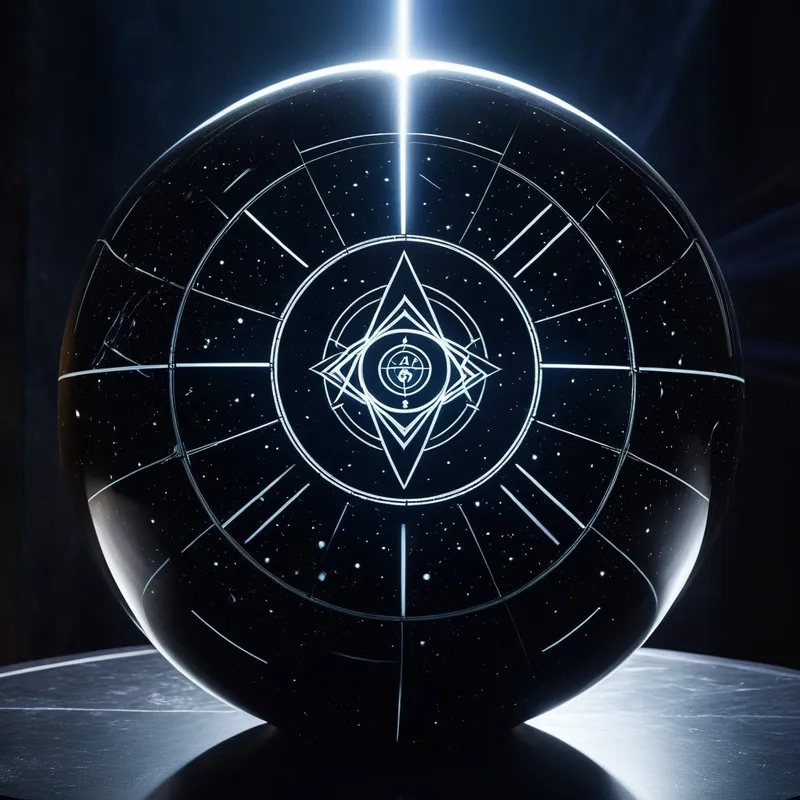
I stood in a circular chamber of polished black stone. In the center, on a low altar, rested a sphere of pure mercury. I did not touch it, but as I gazed, complex geometric sigils—circles within triangles, spiraling lattices of light—began to etch themselves into the air above it, humming with a silent, potent frequency. I knew, with absolute certainty, that I was not drawing them; I was the chamber in which they were being drawn.
This dream is not about making art, but about becoming the vessel through which a fundamental pattern of existence chooses to articulate itself.
The False Lead
This theme is not about productivity, genius, or even conventional creativity. To mistake it for a call to simply "make something" is to confuse the birth of a universe with the assembly of furniture. It is not a manic, ego-driven compulsion to build a legacy or prove one's worth. The terror or awe it invokes is not stage fright, but the profound disorientation of the ground of your being reorganizing itself. It is the difference between painting a beautiful landscape and discovering that the laws of perspective within your own mind have irrevocably changed. A dream of divine creation announces a structural shift in the psyche's operating system, not the launch of a new application.
Psychological Architecture
To dream of divine creation is to stand at the raw interface between the personal and the transpersonal. The "divine" here is not a theological figure, but the psyche's own deepest, most impersonal ordering principle—what Jung called the Self. The creation is the new configuration of your consciousness that this principle demands. The Shadow work is brutal in its simplicity: you must relinquish the architect's pen. The conscious ego, which believes it directs the show, is confronted with its role as scribe, midwife, or even raw material. The Individuation process here involves a sacred humiliation, a dismantling of the "I" as author, to allow the "I" as a living artifact to be authored. You are not creating the blueprint; you are the parchment upon which it is being inscribed, the site where it is being built. The grief is for the old, familiar structure of identity that must be decommissioned. The terror is the free-fall of not knowing what will take its place.
Mythic Resonance
We see this in the Polynesian myth of Ta'aroa. In the beginning, Ta'aroa existed alone in his cosmic shell. He did not decide to create the world; creation was an inevitable expression of his own being. He broke his shell, and its pieces became the sky and earth. He then used his own body as the substance of creation: his spine became a mountain range, his feathers the trees, his blood the oceans. The dreamer experiencing this theme is Ta'aroa in the moment of cracking: the old, confining shell of identity must break, and the very substance of their known self—their memories, their wounds, their traits—will be alchemized into the landscape of their new existence. It is a creation that is simultaneously an act of self-dismantling and self-revelation.
Symbolic Nodes
- Immaculate or Self-Generating Objects: A glowing orb that births smaller stars, a book that writes itself, a seed that instantly grows into a complex crystal.
- Sacred Geometries & Blueprints: Mandalas, labyrinths, fractals, or architectural plans that appear in the air or on surfaces, often emitting light or sound.
- Empty Vessels or Chambers: A pristine workshop, a silent temple, a vacuum-sealed room waiting to be filled with a new atmosphere.
- Elemental Transmutation: Watching water turn into light, stone becoming transparent, fire freezing into intricate sculptures—all without an obvious agent.
- The Unseen Architect: A profound sense of an intelligent presence or force that is designing, composing, or assembling, with you as a witness or component within the scene.
Archetypal Resonance
The energy at the core of this theme is that of The Creator Archetype. This is not the shadow creator, obsessed with personal legacy and control, but the archetype in its purest, most surrendered form. Its somatic echo is that deep, magnetic pull in the core—the urge to bring the unmanifest into form. Its alchemical potential lies in its willingness to become a conduit. The Creator here understands that true originality does not spring from the personal ego, but from the ability to faithfully translate the whispers of the deep psyche into the language of the lived world. The dream is the psyche's studio, and the Creator archetype is the faculty of attention that shows up, not to impose, but to observe what is already being born.
The Alchemical Process
The alchemical vessel for this theme is surrender, and the heat is applied as sacred frustration. The old ego-structures will cling, insisting they are the artist. The alchemical fire is the growing, agonizing tension between the ego's desire to claim the creation and the soul's imperative that it must be received. This is the pressure: the feeling of being pregnant with a destiny you did not consciously choose. The transmutation occurs in the moment of exhaustion, when the ego's resistance breaks. This is not a defeat, but a crucial phase change. In that release, the identification shifts from "I am creating" to "Creation is happening through me." The base metal of personal ambition is transmuted into the gold of authentic vocation. The sovereignty gained is not over the creative output, but over the capacity to hold the vessel of your being steady while the mysterious work is done within you.
The Integration Protocol
Question 1: Where in your waking life do you feel that deep, magnetic pull towards a form of expression or being that simultaneously exhilarates and terrifies you because it feels bigger than your personal story?
Question 2: What familiar identity, role, or self-narrative would have to crack open or be dismantled for this new creation to have space to emerge?
Question 3: If you imagined your body and mind as the chamber from the dream, what is the silent, humming "sphere" at the center that everything else is arranging itself around?
Action 1 (The Silent Chamber): For ten minutes each day, sit in complete silence. Do not meditate with a goal. Simply be the empty, polished chamber. Notice what images, shapes, or pure sensations begin to "etch themselves into the air" of your awareness without your direction. Do not analyze, just witness.
Action 2 (Blueprint Scribbling): Take a large piece of paper. Without thinking, let your hand draw non-representational lines, shapes, and patterns. Do not make "art." Let it be a direct, physical transcription of the somatic echo—the pressure, the hum, the density. This is not a drawing of something; it is the graphic residue of the creative force moving through your nervous system.
Action 3 (Elemental Consecration): Choose a simple, single object that represents "raw material" to you (a stone, a bowl of water, a blank notebook). Place it in a dedicated space. Each day, for a moment, place your hands near it (or on it) and consciously state: "I am not your maker. I am your witness and your ground. Take the form you must." Observe it without expectation.
Final Validation
This path is not for those who seek tidy answers or guaranteed outcomes. It is for those who have felt the foundations tremble and, instead of rushing to repair the old floor, dared to listen to the blueprint being sung from the cracks. It is profoundly difficult because it asks everything of you, only to reveal that the "you" it asks of is not the one you thought you were. The integration is the courage to live as the creation-in-progress, to inhabit the half-built temple of your becoming, and to find a holy sovereignty in the sheer act of saying "yes" to the unseen architect within.