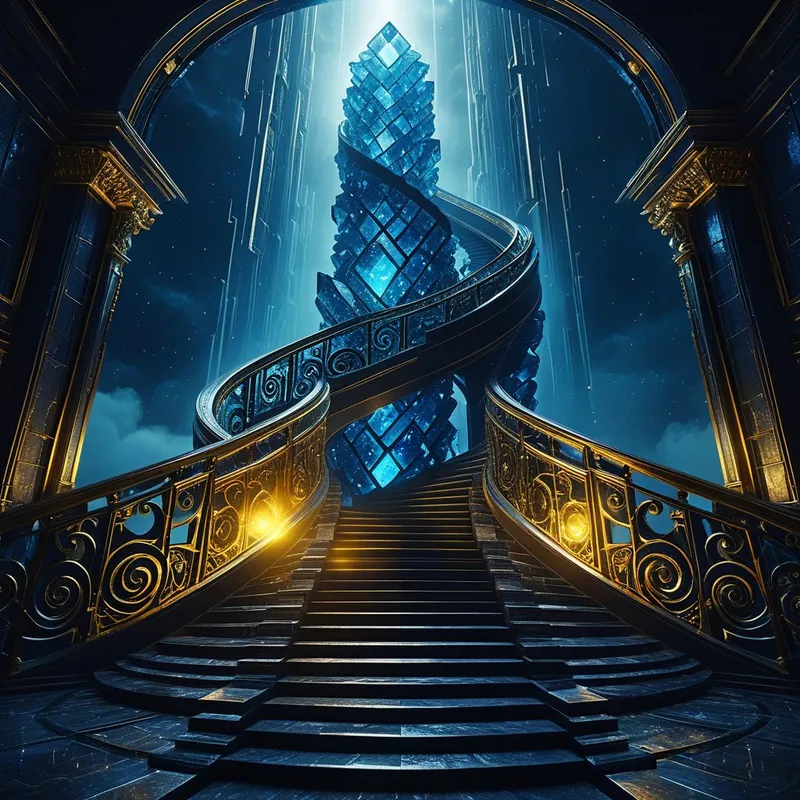
The Vertical Axis: On the Dream Theme of Descent and Ascent
The journey is not forward, but vertical. It is the oldest, most fundamental architecture of the soul. Before the mind can map it, the body registers the shift: a sudden, gravitational lurch in the solar plexus, a hollowing out of the chest as the floor of your known world gives way. Or its opposite: a lightness behind the sternum, a subtle buoyancy as if the marrow of your bones has been replaced with air. This is the somatic echo of the vertical axis. It is the feeling of being pulled into the cellar of yourself, or of being drawn up toward a skylight you never knew was there. The psyche does not travel in straight lines; it plunges and soars.
The Somatic Echo
To descend is to feel the weight of forgotten things. It is a pressure in the joints, a cool dampness on the skin even in a dry room, a literal heaviness in the step as if walking through deep water. The breath becomes shallow, guarded, as if the air itself is thicker, older. It is the body preparing for a confrontation with density—the density of memory, of grief, of all you have buried to keep the surface world functional.
Ascent, in its initial tremors, is often mistaken for anxiety. It is a flutter in the diaphragm, a quickening of the pulse not from fear, but from a sudden, terrifying lack of resistance. It is the vertigo of a tether being cut. The body, so accustomed to the familiar gravity of its problems, interprets liberation as a threat. True ascent, when integrated, feels like a deep, cellular sigh—a permission for the spine to straighten, for the crown of the head to gently lift, as if an internal keystone has finally been set into place.
The Dreamer's Log
I am in a vast, derelict data-center, a cathedral of dead servers. I find an old, ornate elevator. I step inside, and instead of buttons, there is a single lever. I pull it. The cage plummets, not down through floors, but through layers of dark, humming rock and glittering, frozen code. It doesn't stop falling.
Alchemical Interpretation: The conscious mind (the data-center) is obsolete; the lever is a commitment to a journey the rational self cannot control, a willing plunge into the substrate of personal history and primal pattern (rock and code) to locate the original source of power.

The False Lead
This theme is not about circumstantial ups and downs. It is not the "bad week" followed by a "lucky break." Those are horizontal events, waves on the surface. The dream descent/ascent speaks to a foundational restructuring of the internal landscape. A dream of falling is not a premonition of failure; it is an invitation into the bedrock of your being. A dream of soaring is not mere escapist fantasy; it is the somatic blueprint of a potential integration, earned only by first visiting the depths. To mistake this profound, mythic process for everyday fortune is to remain a tourist in your own psyche.
Psychological Architecture
The architecture here is one of inversion. The conscious persona lives in the penthouse, furnished with identity, achievement, and managed narratives. But the foundation rests in the basement, on pillars sunk into shadow—the disowned rage, the unspoken grief, the abandoned creativity, the raw vulnerability deemed too dangerous for daylight. Individuation, in this vertical frame, is not about adding more rooms to the penthouse. It is the terrifying, necessary work of descending to that basement, not as a critic, but as a curious heir. It is meeting the exiled parts of yourself—what Internal Family Systems might call the "firefighters" and "exiles" who took up residence in the dark. You do not conquer them. You listen. You retrieve the artifact they guard. This act of deep, shadowy hospitality is what alchemically alters the building's center of gravity. The ascent that follows is not an escape from the basement, but a rising with its integrated contents. The penthouse and the basement begin to breathe as one organism.
Mythic Resonance
We see this in Inanna's ancient, uncompromising journey. The Sumerian goddess of heaven and earth descends through seven gates to the underworld, stripped of her symbols of power at each one, until she stands naked and dead before her dark sister, Ereshkigal. Her resurrection and return are not a reversal, but a transformation; she ascends changed, carrying with her the knowledge of the deep. This is not a hero's conquest, but a queen's necessary errand into the heart of her own totality. Similarly, Dante does not circumvent Hell to get to Paradise; he must travel through its very core, guided by the integrated shadow of Virgil (human reason), to be forged into a vessel capable of beholding the divine. The myth is clear: the summit is only accessible through the pit.
Symbolic Nodes
- Staircases, ladders, elevators, shafts, pits, wells, tunnels, caves.
- Falling, flying, floating, climbing, being pulled or pushed vertically.
- Basements, cellars, attics, rooftops, mountain peaks, ocean trenches.
- Roots, foundations, ceilings, skylights, chasms, geysers.
- Elevation changes in landscape: sudden drops, sheer cliffs, rising plateaus.
Archetypal Resonance
The most active archetype in this vertical drama is The Magician Archetype. The Magician’s domain is the axis itself—the hidden lever, the secret passage, the knowledge that reality is structured and can be restructured. The somatic echo of descent is the Magician’s "solve" (dissolve), the willing dissolution of form to access raw potential in the shadow. The feeling of ascent is the Magician’s "coagula" (recombine), the integration of that potential into a new, more sovereign form. The Shadow Magician—the Manipulator or Illusionist—is the part that fears the true descent, opting instead for cheap shortcuts, spiritual bypassing, or the manipulation of surface symbols to simulate an ascent that has no foundation. The alchemical potential lies in becoming the sovereign of your own inner axis, transforming base material (shadow) into gold (consciousness) through the precise, often painful, heat of attention.
The Alchemical Process
The alchemical vessel for this theme is the spine itself—the central column that contains both the plunge and the rise. The "prima materia" is the burden of the unlived life, the compressed energy of the shadow. The heat is applied through the act of conscious descent: the voluntary turning of attention toward the inner abyss, the feeling of the fear, the grief, the shame, without anesthetic. This is the nigredo, the blackening. The pressure is sustained containment: not acting out the old patterns, not spiraling into identification, but holding the tension of the opposites—the desire to flee upward into spiritual illusion and the urge to collapse downward into total despair. In this pressurized heat, a separation occurs; the pure essence of the experience is distilled from the dross of the story you've told about it. Then, the albedo, the whitening: a clarifying insight, often silent, that arises from the depths. The final ascent is the rubedo, the reddening, where this distilled essence rises to inform your conscious life, not as a theory, but as a lived, embodied truth. Sovereignty is earned when you realize you are both the pit and the peak, and can navigate the distance between them at will.
The Integration Protocol
Question 1: In your waking life, where do you feel a subtle, persistent "gravity"—a situation, relationship, or internal state that feels like it is pulling you down? Can you describe the physical sensation of this pull without analyzing its cause?
Question 2: What one piece of "data," one memory or feeling, have you consigned to the basement of your psyche because it was too painful, chaotic, or shameful for your conscious self to host? What might it need from you now?
Question 3: If your recent ascent/descent dream were a map of your inner territory, what lies at the very bottom of the descent? What is waiting at the highest point of the ascent? What is the relationship between those two points?
Action 1 (Grounding the Axis): Stand barefoot. Feel your feet rooted. Imagine a cord of light descending from your tailbone, down through the floors of the building, through the soil, into the bedrock of the earth. Then, imagine a cord from the crown of your head rising into the sky. Breathe, feeling both connections simultaneously for two minutes. This somaticizes the axis.
Action 2 (Creative Cartography): Without planning, draw or paint your inner landscape as a vertical cross-section. Let the image emerge: What's on the surface? What's in the middle? What's in the deep? Use colors, shapes, and textures—not realistic images. Let the art show you the architecture.
Action 3 (Ritual of the Threshold): Find a physical stairwell, a hill, or even a single step. Before moving, set an intention: the descent represents consciously acknowledging a hidden burden; the ascent represents integrating its lesson. Walk slowly, one step at a time, holding the intention in your body. At the bottom, pause and whisper a release. At the top, pause and state a claim of new ground.
Final Validation
The path of descent is not for the faint of heart; it is the most courageous act the self can undertake. To willingly go down into the dark, when every fiber of your being is wired for survival and light, feels like a betrayal of sanity. It is not. It is a betrayal only of the prison you mistook for a palace. The terror is real. The grief is vast. And on the other side of its integration lies not a simplistic "happiness," but a profound and unshakable sovereignty—the kind that comes from knowing the full blueprint of your being, from basement to spire, and finding it, at last, wholly your own.