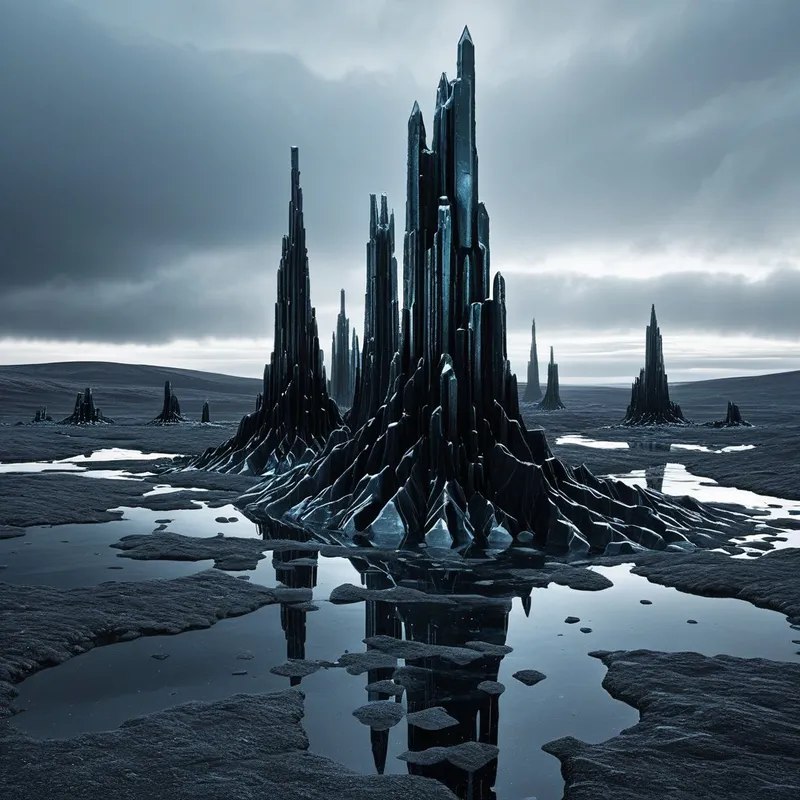
The Dream of Depression: The Alchemy of the Leaden Soul
The Somatic Echo
Before the mind names it, before the story of sadness begins, depression announces itself as a physics of the interior. It is a specific, visceral gravity. The body does not feel tired; it feels dense, as if its molecules have been replaced with a heavier, colder element. The air itself thickens, becoming a slow, resistant medium through which every thought and gesture must labor. This is the somatic echo: a profound, cellular deceleration. The world’s colors don’t fade; they are seen through a filter of this internal density, which mutes their frequency and absorbs their vitality. It is the feeling of being an island of lead in a sea of ordinary matter, pulled by a private, crushing orbit. The breath becomes shallow, not from anxiety’s quick clutch, but from the sheer weight resting upon the diaphragm—the silent, immovable guest in the room of the self.
The Dreamer's Log
I am in a vast, abandoned data center. The servers are silent monoliths, their indicator lights dark. My task is to find the core processor to restart the system, but the floor is flooded with a thick, black, non-reflective liquid. I know I must wade into it, but the thought fills me with a dread that is less fear and more a certainty of dissolution. I stand at the edge, unable to move, as the silence presses in.
Alchemical Interpretation: The dream presents the psyche’s core processing functions in a state of intentional, protective shutdown, with the vital, feeling-self (the black liquid) perceived not as lifeblood, but as an immobilizing, engulfing threat to the old identity.

The False Lead
This theme is not a narrative of misfortune, nor is it the transient shadow of a bad day. To mistake it for mere sadness is to confuse a tectonic shift for a passing tremor. Depression in dreams is rarely about the external events it sometimes costumes itself in—the lost job, the failed relationship, the generic grief. These are its symbols, not its cause. It is not a sign of a broken psyche, but of a psyche engaged in a profound, if brutal, restructuring. The danger of the false lead is to interpret the feeling as the final truth, rather than as the intense pressure and heat of a transformative process. It is the materia prima, the base lead of the soul, awaiting its operation.
Psychological Architecture
The architecture of depression, when seen from within the dreamscape, reveals a collapse of internal bridges. The parts of the self that usually communicate—the ambitious striver, the social connector, the curious child—fall silent. They are not gone; they have retreated to their own chambers, and the corridors between them are flooded with that heavy, black liquid. This is Shadow work of the most fundamental kind: not battling a monster, but experiencing the dissolution of the familiar landscape that kept the monster contained. The ego, the familiar “I,” finds itself marooned, ruler of a kingdom that has ceased to respond to its commands. This is the Individuation process in its most challenging phase: the nekyia, the night sea journey, where the conscious personality must descend into its own underworld not to fight, but to be unmade. The old identity, the one built on certainties and achievements, is being composted from within. The grief felt is for that dying self, and the terror is of the formlessness that follows.
Mythic Resonance
We see this architecture in the myth of Inanna’s Descent. The Queen of Heaven does not fall by accident; she chooses to descend into the underworld of her sister Ereshkigal, the goddess of the dead and raw, unadorned reality. At each of the seven gates, she is stripped—of her crown, her jewels, her royal robes—until she arrives naked and prostrate. This is not a punishment, but a necessary reduction. The depressive state is this stripping. It is the psyche, like Inanna, voluntarily submitting to the loss of all its identifying ornaments (roles, status, vitality) to meet the raw, foundational Self. Similarly, the alchemical stage of nigredo—the blackening, the putrefaction—was not seen as failure, but as the essential first step. The old composite must blacken and dissolve before any new unity can be glimpsed. Depression is the living nigredo.
Symbolic Nodes
- Stagnant or Black Water: Pools, floods, tar pits, or any liquid that impedes movement and reflects nothing.
- Abandoned or Empty Structures: Vast warehouses, silent factories, derelict houses, empty theaters—architectures built for purpose now devoid of activity.
- Failing or Absent Light: Dimming bulbs, dead batteries, perpetual twilight, eclipsed suns.
- Heavy or Encumbering Materials: Lead weights, stone coats, moving through mud or concrete.
- Silenced Communication Devices: Dead phones, disconnected wires, static-filled radios, blank screens.
- Barren or Monochromatic Landscapes: Grey deserts, frozen tundras, lifeless moonscapes.
Archetypal Resonance
The core energy of the depressive dream is the domain of The Shadow Orphan. The Orphan in its essence is the realist, the one who feels separate and knows that, ultimately, one must face existence alone. Its shadow, however, is the Victin, who believes that this separateness is a permanent sentence of abandonment and powerlessness. The somatic echo of density and cold is the Victin’s conviction of being fundamentally unloved and unsupported by life itself. Yet, within this very conviction lies the alchemical potential. The Orphan’s journey is from victimhood to sovereignty. By fully feeling the utter isolation and despair of the Shadow Orphan—the leaden weight—the dreamer touches the raw truth of their existence separate from external validation. This is the brutal but necessary ground from which a truly self-authored, resilient identity can be forged. The depression is the Orphan’s winter, a season where all external supports are revealed as illusory, forcing a confrontation with the bare core of the self.
The Alchemical Process
The transmutation here is from Lead to Gold—from the dense, cold, passive weight of despair to the luminous, sovereign, and conductive quality of integrated awareness. The required heat is not the fire of rage, but the slow, persistent warmth of attention without judgment. The pressure is the courage to stay present within the immobilizing field, to feel the density without rushing to label it or fix it. The operation is one of solutio—dissolution. The ego’s structures must soften and liquefy in the waters of the unconscious (the black pool in the dream). This feels like a death, because it is. The alchemist does not fight the blackening; they tend to it as the necessary first phase. The transmutation occurs when, from within the stillness and silence, a new form of perception arises—not one that seeks to escape the leaden feeling, but one that can hold it. The gold is not the absence of the lead, but the discovery of a consciousness vast enough to contain it without being defined by it. Sovereignty is born when you realize you are the crucible, not the metal burning within it.

The Integration Protocol
Question 1: In the dream’s heaviness, what specific quality of my waking life does it most feel like? Is it the weight of an unlived life, an unshed tear, or a truth I am refusing to acknowledge?
Question 2: If the depression were not a mistake, but a purposeful, protective shutdown of my system, what is it protecting? What older, more vulnerable version of me is being sheltered in this silence?
Question 3: What tiny, almost imperceptible thing in my dream or waking life was not heavy, dead, or grey? A sliver of light, a faint sound, a texture that was different? What if my task is not to fight the darkness, but to protect that sliver?
Action 1 (Somatic Mapping): For one minute, sit with the somatic echo. Do not try to change it. Instead, map its geography in your body. Where is the density most pronounced? What is its shape, temperature, texture? Describe it to yourself in neutral, physical terms. This separates the raw sensation from the story of despair.
Action 2 (Unstructured Glyphs): Take a blank page and charcoal or a soft, black pencil. Without intending to draw anything, let your hand make marks that feel like the internal landscape of the dream—the weight, the stagnation, the resistance. Let it be a messy, non-representational glyph of the feeling. Then, with a white chalk or gel pen, make one single mark, line, or shape that represents the space around the heaviness, or the awareness that holds it.
Action 3 (Threshold Ritual): Find a small, natural body of water—a puddle after rain, a pond, a slow-moving stream. Sit beside it. Speak aloud, in a whisper, one thing you feel the depression has “shut down” or taken from you. Then, drop a single, small stone into the water. Watch the ripples distort and then erase the reflection. The action is not to throw away the feeling, but to physically witness a disturbance interacting with a receptive, fluid medium, and returning—changed—to stillness.
Final Validation
To walk through this landscape is one of the most arduous journeys the human psyche can undertake. Its weight is real; its silence is profound. Please, do not let anyone—including the voice within—tell you this is a sign of weakness or failure. It is the opposite. It is evidence of a depth that can no longer be satisfied with surface living. You are being called, however brutally, into a deeper layer of your own being. The dream of depression is not your enemy. It is the stark, unadorned ground of your becoming. The sovereignty waiting for you on the other side of this descent is not a louder version of your old self, but a quieter, more resilient, and infinitely more authentic one. The lead is not your final form; it is the ore. You are the alchemist, and the fire is your unwavering attention.