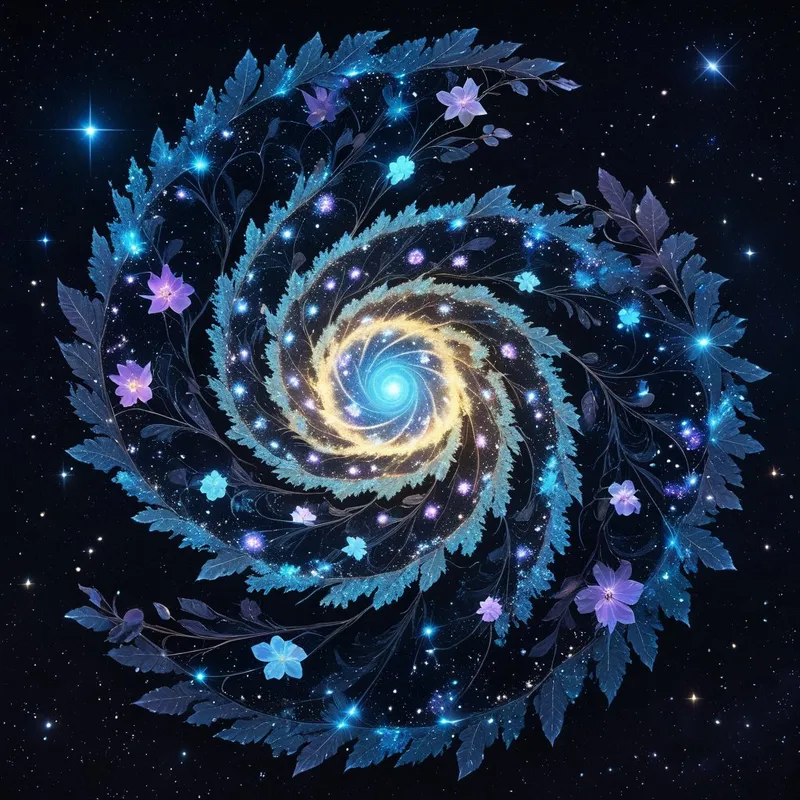
The Cycle of Life: The Psyche’s Architecture of Death and Rebirth
The Somatic Echo
Before the mind can parse the symbols—the falling leaves, the turning wheel, the empty room—the body knows. It is a deep, resonant hum in the marrow, a hollowing out beneath the sternum that feels like the ground has dropped away, leaving only a quiet, vertiginous suspension. This is not panic, but its profound ancestor: the somatic recognition of an ending. It is the chill of autumn in the blood, the weight of soil in the lungs. Simultaneously, and paradoxically, there is a faint, insistent quickening, a flutter in the solar plexus like the first green shoot pressing against frozen earth. The body holds both the decay and the seed, the exhale and the imminent inhale, in a single, wordless tension. This is the visceral prelude to the dream of the cycle, where the psyche prepares to ritualize a transformation the conscious self may still be resisting.
The Dreamer's Log (Case Vignette)
I am in a vast, silent library of impossible scale. I know I must find one specific book, but the shelves stretch into darkness. Finally, I reach for a heavy, leather-bound volume. As I open it, the pages are blank. Then, one by one, the words begin to fade in, written in a language of light, only to dissolve into ash as soon as I try to read them. The library itself starts to dissolve from the edges inward, into a fine, gold dust.
Alchemical Interpretation: The dreamer’s old identity-narrative is being ceremoniously erased by the psyche to make space for a new, unlanguaged truth.

The False Lead
This theme is not a simple narrative of "bad luck" or a linear "ending." To mistake the cycle for mere misfortune is to stand in a forest and see only fallen trees, missing the mycelial network already weaving nourishment from their decay into the roots of saplings. It is not a punishment, nor is it the universe "closing a door." That is the language of the ego, which perceives all change as loss. The Cycle of Life is the fundamental architecture of the psyche itself—a structural, non-negotiable process of shedding and synthesis. It is the difference between a storm that damages your house and the inevitable, necessary erosion of a coastline that reshapes the entire continent of the self.
Psychological Architecture
To engage with this cycle is to consent to a form of psychic death. The Shadow work here is the brutal, compassionate act of dis-identifying. It requires you to sit in the ruins of a role that once defined you—the accomplished professional, the devoted partner, the certain believer—and to feel the terrifying freedom of its absence. This is the Individuation process in its most raw form: the conscious ego must release its grip on a completed stage of life, allowing those energies to be reclaimed by the unconscious. It is a dissolution of the internal family system where one dominant "part"—the Manager, the Protector, the Pleaser—has served its term and must now be honorably retired, its duties redistributed or rendered obsolete by your growth. You are not destroying this part, but composting it. The grief is real, for you are mourning a version of yourself. The process feels like being unmade, because you are.
Mythic Resonance
We see this architecture etched into our oldest stories. The Egyptian myth of Osiris is not merely a tale of murder and resurrection; it is a precise map of the cycle. Osiris is dismembered—his unified king-self scattered into 14 fragments across the land. This is the experience of a life phase ending: a sense of being pulled apart, your coherence lost. Isis does not simply put him back together. She gathers the pieces, wraps them in linen, and through her magic, reconstitutes him into a new form—the Lord of the Duat, the ruler of the fertile underworld. The alchemy is in the wrapping, the conscious, ritualized act of gathering what remains and sanctifying it for a new purpose in a different realm of being. Likewise, the Phoenix does not just die in flames; it builds its own pyre, an active participation in its combustion, so that from the ashes, the same bird can arise. The psyche demands both the fire and the agency within it.
Symbolic Nodes
- Seasons in rapid transition (e.g., watching a tree bloom, fruit, and shed leaves in moments).
- Tides, spinning wheels, spirals, ouroboros.
- Empty nests, deserted houses, vacant rooms you must leave.
- Molting snakeskins, chrysalises, hollow seed pods.
- Grandparents holding infants, photographs aging in your hands.
Archetypal Resonance
The energy most active in the Cycle of Life is that of The Magician Archetype. Not the stage illusionist, but the deep alchemist who understands the fundamental laws of transformation. The Magician’s core principle is that reality is malleable to consciousness, and here, the reality being reshaped is the very structure of the self. The somatic echo—that hollow, potent suspension—is the Magician’s vas, the sacred vessel where the work takes place. The alchemical potential lies in the Magician’s ability to hold the tension of the opposites: to see the end in the beginning and the beginning in the end, and to consciously participate in the transmutation of one into the other. When this archetype is active, you are not a victim of the cycle; you are its reluctant, then sovereign, practitioner.
The Alchemical Process
The transmutation here is Putrefaction to Multiplication. The prima materia is the spent form, the outgrown identity, the completed story. The required heat is not anger, but the sustained, unbearable warmth of grief observed. This is the pressure: to stay present with the dissolving image in the mirror without rushing to paste a new one over it. You must let the old self "rot"—not with contempt, but with the respect a gardener shows to compost. This psychological decomposition is active; it is the psyche breaking down complex emotional compounds into essential nutrients. The terror is the illusion of annihilation; the grief is the price of attachment. The sovereign emerges not by avoiding this process, but by becoming the vessel that contains it. You are the library and the book turning to ash and the space that remains, clear and ready for a new text. Sovereignty is earned by claiming authorship of the entire sequence.

The Integration Protocol
Question 1: What chapter of my life feels like it has reached its final, period? Not what I wish were over, but what has genuinely, organically completed its narrative arc?
Question 2: If the "me" that inhabited that chapter were a character in a book, what was their primary function? What did they protect, achieve, or carry for me that I may now be ready to carry myself?
Question 3: What single, small object symbolically represents that completed chapter? What would it feel like to thank it, and then to literally or metaphorically bury it, burn it, or set it adrift on water?
Action 1 (Somatic Anchoring): For one week, upon waking, place one hand on your heart and one on your lower abdomen. Breathe deeply, and simply acknowledge, aloud, "Something is ending. Something is beginning." Do not define them. Just hold the space between the two statements.
Action 2 (Unstructured Writing): Set a timer for 10 minutes. Write a letter of gratitude and release to the "character" from Question 2. Thank them for their service. Tell them what they taught you. Then, write their letter of resignation back to you, freeing you from their singular role.
Action 3 (Elemental Ritual): Find a natural body of water—a stream, river, or the sea. With intention, drop a leaf or a small stone into the water. Watch it be carried away. Then, find a stone or shell to take with you. The act is a physical enactment of the cycle: releasing the old form to the flow, and accepting a new talisman from the same source.
Final Validation
It is terrifying to feel the ground of a familiar self give way. The disorientation is not a sign of failure, but of profound engagement with the deepest law of your own being. You are not falling apart; you are being rearranged by a wisdom older than your name. The cycle does not ask for your permission, but it awaits your conscious participation. To say "this is ending" is not a lament of loss, but the first, brave word of the incantation that will call your next self into form. The sovereignty you seek is not control over the turn of the wheel, but the unshakable knowledge that you are both the clay upon it and the hand that shapes what emerges from the spin.