The Unwritten Symphony: Dreams of Creativity and Expression
The Somatic Echo
It begins not as an idea, but as a pressure. A density in the chest, a humming in the bones, a silent vibration behind the eyes. It is the somatic echo of a formless thing yearning for form. This is the pre-language of the psyche, a gathering storm of potential that has not yet found its lightning rod. You feel it as a restless ache in the hands, a phantom itch to shape, to carve, to release. It is the body’s intelligence whispering of a backlog of unlived life, of emotions and perceptions that have been cataloged but not consecrated. Before the mind can articulate a desire to paint, to write, to build, the nervous system is already mapping the contours of the void that this creation must fill. This is the raw ore of being, heavy and potent, awaiting the alchemical fire of attention.
The Dreamer's Log
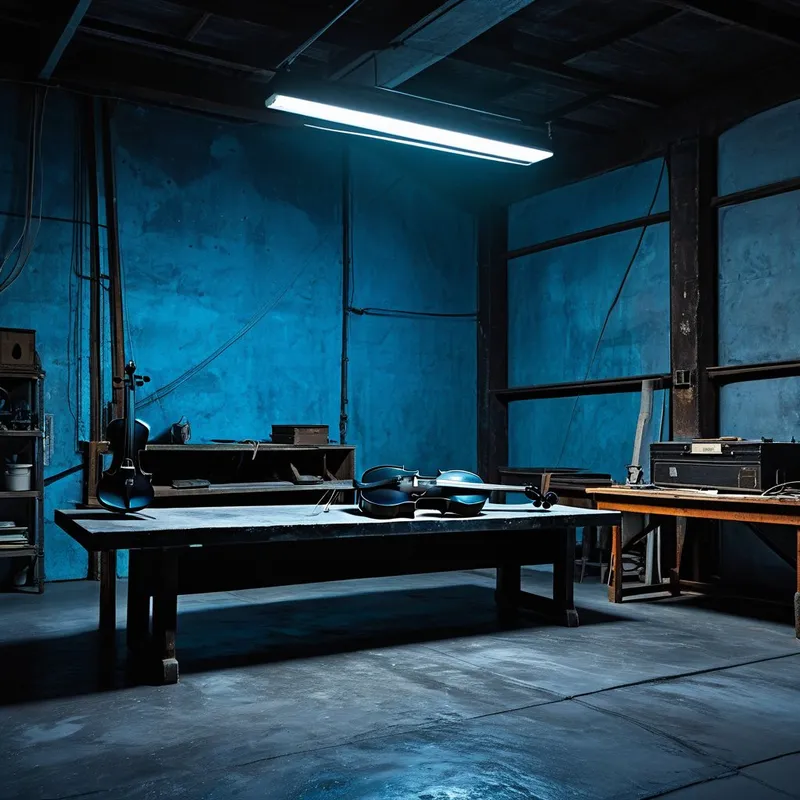
In the dream, I am in a vast, forgotten warehouse. I know I must play a violin to open a sealed door, but my fingers are numb. On a workbench lies a violin made of dark, polished stone. When I finally touch it, the strings emit not sound, but colors that bleed into the air and dissolve the door.
The stone violin is the hardened, unexpressed self; the dissolving door is the alchemy of true expression, which transmutes obstacle into passage through the medium of felt experience.
The False Lead
This theme is not about talent, skill, or the production of art for an audience. To mistake it for a call to become a "better" painter or a more prolific writer is to confuse the soul’s imperative with the ego’s project. It is not a demand for perfection, but a demand for process. A dream of a blank canvas is not about a fear of failure; it is about the terror and exhilaration of the unmediated encounter with the pure potential of the inner world. The shadow here is not a lack of creativity, but its perversion into performative display or its burial under the weight of internal criticism—the voice that says "it’s not original enough" before a single mark is made.
Psychological Architecture
Beneath the dream of the unwritten poem or the silent instrument lies a profound structural negotiation within the psyche’s internal family. Often, the creative impulse—the wild, curious, and boundless Child—is held in check by a vigilant Manager part, whose job is to maintain order, predictability, and safety from shame. The Manager bricks over the wellspring, fearing the chaos of what might emerge. The dream, then, is the exiled Creator’s rebellion. It stages a scenario where the usual rules are suspended, where stone can sing and color can act as a key. This is the essence of shadow work in this realm: not to kill the Manager, but to introduce it to the Exile. To show the protective part that the chaos of creation is not a threat to the system, but its necessary update—the way the psyche grows, integrates, and becomes more whole. Individuation here is the courage to let the internal family reorganize around a new prime directive: not security, but authenticity.
Mythic Resonance
We see this eternal drama in the figure of Hephaestus, the lame god of the forge. Cast out from Olympus, he descended not into oblivion, but into the volcanic depths. There, in the heat and pressure of his exile, he became the master craftsman, creating objects of sublime beauty and terrifying power. His lameness is not a weakness, but the very signature of his process—the wound that compelled the descent into the creative fire. His myth tells us that the capacity to shape reality is born not in the heights of approval, but in the depths of rejected, raw experience. Similarly, the Rainbow Serpent of Aboriginal Australian cosmology dreams the world into being, its winding path creating rivers, its shed skin forming the land. Expression is not something we do; it is the fundamental motion of a conscious universe moving through us. We are not the painter, but the brushstroke.
Symbolic Nodes
- Ink that won’t flow, paint that dries to dust, instruments with broken strings: The frustration of blocked expression, often tied to a critical inner object or a frozen emotional state.
- Forgotten rooms filled with half-finished projects, sealed archives, locked chests: The psyche’s storehouse of unlived potentials and abandoned selves, waiting for reclamation.
- Speaking in a language no one understands, singing a song that shatters glass: The raw, pre-verbal power of expression that bypasses consensus reality to affect the world directly.
- Malleable materials (clay, light, water) that respond to thought alone: A direct encounter with the magician-like power of consciousness to shape its reality.
- A tool that transforms in your hand (a pen becomes a key, a brush becomes a scalpel): The multidimensional purpose of true expression—it reveals, it unlocks, it heals.
Archetypal Resonance
The energy at the core of this theme is that of The Creator Archetype. Its impulse is the fundamental urge to bring something into being that did not exist before, to leave a mark of one’s inner vision upon the outer world. The somatic echo—the pressure, the hum—is the Creator’s energy building in the vessel of the self. Its shadow, the Mad Scientist or Self-Centered artist, emerges when this archetype is severed from the heart, creating for the sake of control, legacy, or sterile novelty alone. The alchemical potential of the Creator lies in its willingness to enter the chaos of the unformed, to hold the tension between vision and limitation, and to midwife the new into existence—not for fame, but for the sacred necessity of the act itself. It is the archetype that understands that to create is to participate in the ongoing creation of the self.
The Alchemical Process
The transmutation here is from Potential (Lead) to Manifestation (Gold). The prima materia is the dense, chaotic, and often painful mass of unlived experience—the grief, joy, rage, and love that has been felt but not formed. The alchemical vessel is your own attentive consciousness. The required heat is not comfort, but the pressure of necessity—the growing, intolerable sense that to remain silent is a kind of soul-death. This is the nigredo, the blackening: the frustration, the self-doubt, the encounter with the blank page or the silent studio. The albedo, the whitening, occurs in the moment of surrender, when you cease trying to "make something good" and simply become a conduit for the material itself. The final rubedo, the reddening, is the moment of release—the note sung, the line written, the shape carved. The gold is not the finished product, but the reclaimed sovereignty that comes from knowing you can, and must, translate your inner world into the shared language of existence.
The Integration Protocol
Question 1: Where in my body do I feel the "pressure" of something unexpressed? Can I describe its texture, temperature, and weight without trying to change it?
Question 2: What internal voice or "part" of me is most afraid of what might emerge if I truly gave form to this feeling? What is it trying to protect me from?
Question 3: If the thing I feel compelled to create had a voice, what one sentence does it most need to say to the world, or to a specific part of myself?
Action 1 (Somatic Mapping): For five minutes, let your hand move freely on a large sheet of paper without any intention to "draw." Follow the impulses from the pressure in your body. Let the lines be chaotic, repetitive, or angry. The goal is not an image, but a direct transcript of the somatic echo.
Action 2 (Dialogue with the Tool): Choose an object related to expression (a pen, an instrument, a lump of clay). In a journal, write a dialogue between yourself and this object. Let it speak. Ask it what it needs from you, what it fears, and what it remembers being used for last.
Action 3 (Ritual of Release): Create a simple, private ritual to "complete" an unfinished project from your dream or waking life. This could be writing the last line of an abandoned poem and burning it, or playing three notes on an instrument to "answer" the dream melody. The act is symbolic, sealing the circuit between impulse and action.
Final Validation
It is a profound and difficult thing to be a conduit. To feel the tectonic plates of your inner world shifting and know you are responsible for giving voice to the earthquake. The frustration, the fear, the sense of inadequacy—these are not signs you are doing it wrong. They are the friction of creation, the necessary heat of the forge. Your dreams are not mocking you with images of what you lack; they are showing you the blueprint of what you already are—a creator, by nature. The symphony is not unwritten. It is playing already, in the humming of your bones. Your lifelong task is not to compose it from nothing, but to learn, courageously and imperfectly, how to transcribe it.