The Creative Impulse: The Unborn Thing That Demands to Be Born
It begins not as a thought, but as a pressure. A tectonic restlessness in the marrow. A low-grade fever behind the eyes that has nothing to do with illness. It is the somatic echo of something not yet formed knocking against the walls of your being, a psychic pregnancy that announces itself first in the body. You feel it as a humming in the teeth, a tightness in the hands that crave a shape to hold, a peculiar fullness in the chest that is neither joy nor sorrow, but pure, undifferentiated potential. The mind, lagging behind, will later try to name it: an idea, a project, a change. But in the dreamspace, it arrives in its raw, pre-verbal state—an imperative, not an invitation.
The Dreamer's Log
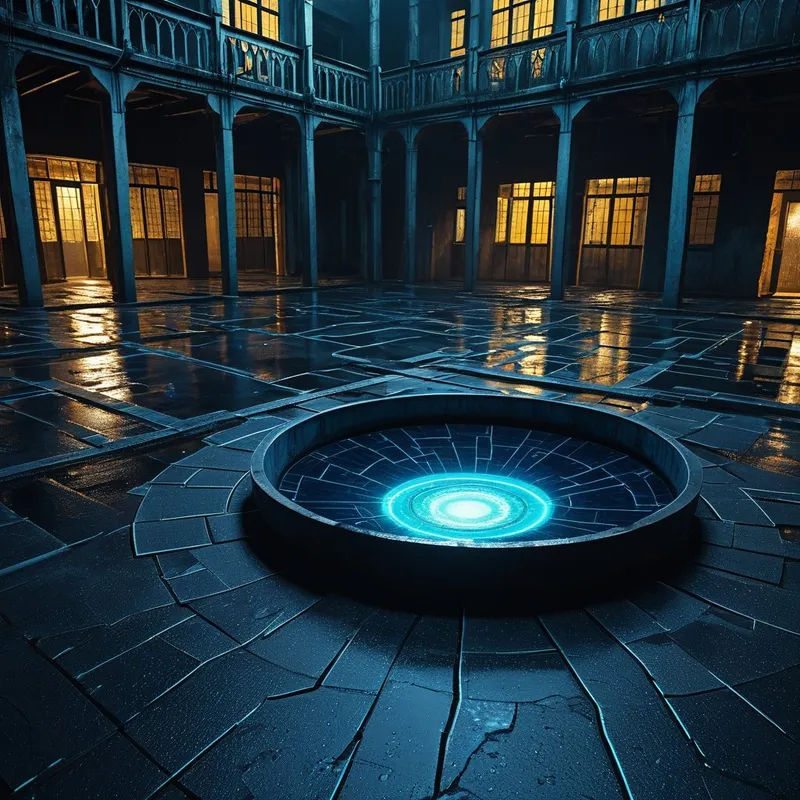
The dreamer stands in a derelict industrial yard under a bruised twilight sky. Rain has filled a long, cracked concrete basin to overflowing. From its fissures, a viscous, phosphorescent liquid seeps out, not spreading like water, but crawling across the asphalt in intricate, branching patterns that glow with a soft, internal light. The dreamer knows, with absolute certainty, that this substance is both immensely precious and dangerously volatile. The imperative is clear: it must be contained, shaped, given a vessel, or it will evaporate into the damp air, lost forever.
This is the alchemy of containment: the unconscious delivers the prima materia—the luminous, chaotic substance—and the dream ego is tasked with providing the vessel of conscious form.
The False Lead
This is not mere daydreaming or casual inspiration. The creative impulse in dreams is not the pleasant fantasy of a future accomplishment; it is the often-uncomfortable, urgent demand for that accomplishment’s birth. To mistake it for simple “having a good idea” is to confuse the lightning strike with the years-long labor of building the lightning rod. It is also not the shadow of procrastination or creative block, though those may be the guardians at the gate. The block is the resistance; the impulse is the force. The dream does not show you the barrier; it shows you the immense, pent-up energy that makes the barrier necessary to hold it all back.
Psychological Architecture
To heed this call is to engage in the most intimate form of Shadow work. For the creative impulse is never pure, pristine genius. It is alloyed with the terror of exposure, the grief for the simpler self you must leave behind, and the raw, chaotic energies of your unlived life. The psyche, in its wisdom, does not offer you a polished sculpture. It delivers a quarry.
The individuation process here is one of courageous midwifery. You must descend into the inner workshop where the puer aeternus (the eternal youth with endless ideas) and the senex (the old critic who declares nothing worthwhile) are locked in eternal debate. Your task is not to side with one, but to become the third thing: the artisan who listens to the puer’s vision and respects the senex’s discipline, transmuting both into a sustained practice. This is the architecture of a new self—one capable of holding the tension between boundless inspiration and limiting form, and in that holding, allowing a new reality to precipitate.
Mythic Resonance
We see this in the figure of Hephaestus, the lame god of the forge. Cast out from Olympus, he descended into the volcanic depths. His creative impulse was born not in the light of reason, but in the dark heat of exclusion and pain. In his subterranean workshop, he transmuted his isolation into exquisite, living artifacts—the automatons, the armor of gods, the chains that bound Prometheus. His myth tells us that the vessel for creation is often forged in the very wounds we seek to hide. Similarly, the Hindu concept of Shakti, the dynamic feminine creative power, lies coiled and dormant until awakened by the conscious, masculine principle of Shiva. The dream of the creative impulse is often the dream of Shakti stirring, demanding recognition and union to bring the manifest world into being.
Symbolic Nodes
- Overflowing Vessels: Wells, fountains, cups, basins spilling their contents.
- Unformed Substances: Luminous liquids, molten metal, clay, raw dough, swirling mist or plasma.
- Seeds and Eggs: Often of impossible size or brilliance, pulsating with life.
- Barren/Wild Landscapes: Untilled fields, empty looms, silent studios, wild forests adjacent to orderly gardens.
- Architectural Imperatives: Being commanded to build, repair, or assemble a structure with unknown tools.
Archetypal Resonance
The energy of the creative impulse is the pure, driving force of The Creator Archetype. Its somatic echo—the pressure, the fullness, the restlessness—is the Creator’s essence demanding manifestation. This archetype is not concerned with utility or approval, but with the fundamental act of bringing something new into existence from the raw materials of the self. Its shadow—the Self-Centered or Mad Scientist—looms when the impulse divorces itself from any connection to life, becoming a closed loop of obsessive generation without release or integration. The alchemical potential lies in allowing the Creator’s energy to flow through you as a vessel, not to possess you as an identity, transforming inner chaos into an outer form that, in turn, re-forms you.
The Alchemical Process
The transmutation here is Coagulation: the movement from the solve (the dissolved, chaotic state of potential) to the coagula (the fixed, embodied form). The heat and pressure are supplied by sustained attention and the tolerance of imperfection.
The prima materia—the glowing liquid, the wild idea, the emotional surge—is inherently unstable. It wants to either evaporate back into the unconscious or flood the conscious mind and dissolve all order. The alchemical fire is the focused, patient application of your awareness to this substance. The pressure is the commitment to a form—a sentence, a brushstroke, a decision—even when it feels inadequate to the vision. This process is intensely psychological because it requires you to hold the grief of the million other possible forms dying so that this one may live. The terror is the vulnerability of exposing this nascent, fragile coagulation to the air of the real world. Sovereignty is earned the moment you say, "This is not everything it could be, but it is something that is, and I made it."
The Integration Protocol
Question 1: Where in my body do I feel the "pressure" of something unborn? Is it a buzz, an ache, a fullness, a hollowness? Describe its texture and temperature without naming an emotion.
Question 2: What is the simplest, most minimal form I could give to this impulse right now? A single line? A three-word phrase? A basic shape?
Question 3: If this creative impulse were a living entity arriving at my door, what would it need most from me to thrive? Safety? Freedom? Discipline? A name?
Action 1 (Somatic Mapping): For three minutes, focus solely on the bodily sensation of the impulse. Trace its edges with your inner awareness. Imagine your breath flowing directly into that space, not to change it, but to acknowledge its presence as a physical fact.
Action 2 (The Vessel of the Page): Perform a "brain drain." Set a timer for ten minutes and write, draw, or scribble only about the raw materials of the impulse—the images, the chaos, the contradictions, the nonsense. The goal is not a product, but to transfer the internal pressure onto an external vessel (the paper). Destroy it afterwards if you wish; the act of transfer is the magic.
Action 3 (Ritual of First Form): Choose one tiny, tangible element from your "brain drain." Give it a first, deliberate form. If it was an image, make a simple sketch or find a physical object that represents it. If it was a feeling, compose a short, ritualistic movement or sound that embodies it. This is not the masterpiece; it is the foundational ritual that signals to your psyche: "I am building the vessel."
Final Validation
It is difficult because it asks you to become both the parent and the child, the architect and the raw stone, the god and the clay. It is difficult because it touches the core of your vulnerability: the fear that what is within you is either worthless or too monstrous to see the light. This difficulty is not a sign you are wrong for the task; it is the signature of the task itself. The creative impulse dreams are your psyche’s most profound vote of confidence. They are evidence that you contain a force potent enough to necessitate such terror, a chaos rich enough to demand such order. Your sovereignty begins not when the creation is finished, but in the very first moment you choose to turn toward the overflowing basin, kneel in the damp, and begin to shape the luminous spill.