
The Dream of Community Bonds: Building the Inner Village
The Somatic Echo
Before the dream forms, the body knows. It is a specific, hollow ache behind the sternum—not the sharp pang of loneliness, but the deep, resonant thrum of a bell tower whose ropes have been cut. It is the ghost-limb sensation of a hand reaching for another in a crowd that has already dissolved. In the gut, it can feel like a knot of tangled threads, each one a potential connection, a conversation not had, a bridge not crossed. This is the somatic echo of the psyche’s village square: a place built to hold the murmur of shared stories, now silent, awaiting its inhabitants. The skin may feel porous, too open, or conversely, armored and cold—the body’s negotiation with the fundamental human paradox of being a sovereign individual within a necessary web.
The Dreamer's Log
She dreams of standing in the central plaza of a city she helped build. The architecture is familiar, a blend of memory and aspiration, but the space is utterly vacant. The wind carries the scent of rain on stone and the faint, metallic echo of her own footsteps. From a bench, a scarf she recognizes—a gift from a friend now distant—flutters, caught on the ironwork, a single thread of color against the grey.
This is the psyche presenting the blueprint of a relational self, empty of its projected occupants, asking the dreamer to become the first citizen.

The False Lead
This theme is not about a simple craving for social activity or the superficial grief of a fading friendship. To mistake it for such is to confuse the architect’s blueprint for the furniture. The dream of fractured community bonds is not reporting on your social calendar; it is conducting a structural audit of your internal world. It is not signaling that you are “unliked,” but that some part of you has gone into exile, has broken covenant with the inner council. The ache is for integration, not entertainment. The terror is not of being alone, but of being a sovereign with no one to witness the realm.
Psychological Architecture
Here, Shadow work is village work. It is the unglamorous, essential labor of walking the perimeter of your inner settlement and noting where the walls have grown too high, isolating the watchtower, or where they have crumbled, leaving the sacred spring vulnerable to every passing influence. Individuation in this realm is not a heroic journey away from the tribe, but a profound journey back into a tribe of one’s own making—a parliament of selves.
The orphaned part that learned to survive by silence now must be invited to speak in the town hall. The inner ruler who maintains order through isolation decrees must learn to delegate. The exiled rebel, banished for challenging old, dysfunctional norms, must be granted amnesty and given a seat at the table. This process feels less like conquering a dragon and more like hosting a long, difficult, and necessary council meeting where every faction of the psyche—the fearful child, the critical parent, the ambitious striver—gets to voice its needs. The goal is not unanimity, but a functional ecology of the self, where communication flows and no part is left to starve in the cold.
Mythic Resonance
Consider the Sumerian myth of Inanna’s descent. The goddess of heaven and community must shed a symbol of her power and connection at each of the seven gates to the underworld. She arrives before her sister, Ereshkigal, naked and bowed—stripped of all that defined her in the world above. This is not a destruction of community, but its alchemical inversion. To know the depth of connection, one must first know the absolute ground of solitary being. Her return, negotiated and hard-won, is not a restoration of the old bonds, but the establishment of a new, conscious covenant between the realms of life and death, between the communal and the profoundly alone. The bond is forged in the acknowledgment of the solitary core within every connected being.
Symbolic Nodes
- Empty Plazas, Halls, or Town Squares: The architecture of gathering, awaiting its purpose.
- Fractured or Broken Bridges: severed lines of communication or trust between parts of the self or with others.
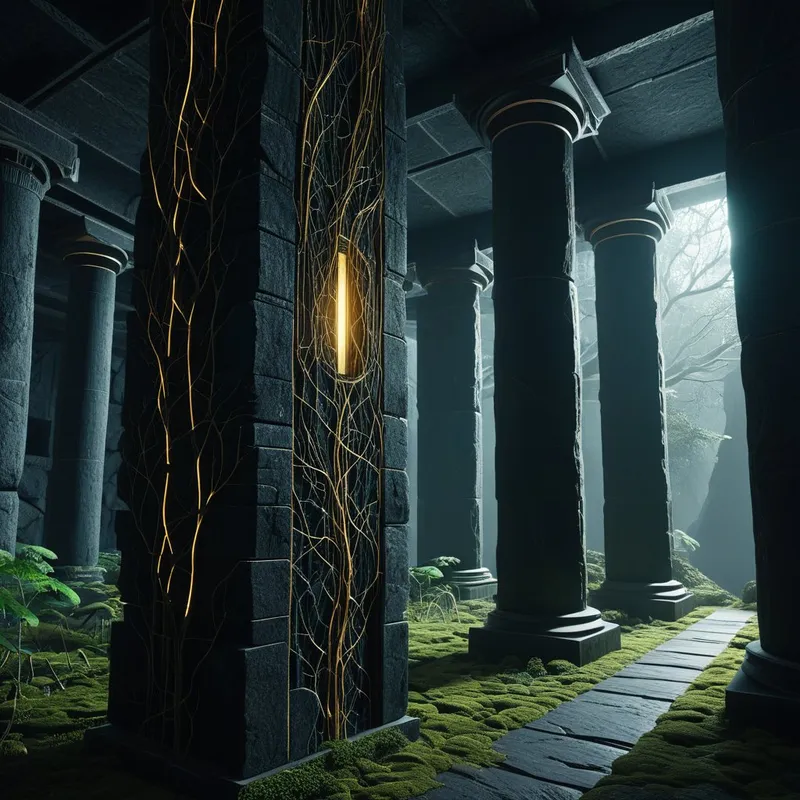
- A Single Lit Window in a Dark Building: The conscious ego feeling isolated within the vast, unconscious structure of the psyche.
- Gardens Overgrown or Walls Crumbling: The neglected or breached boundaries of the personal realm.
- A Shared Meal Where You Cannot Eat: proximity without nourishment, participation without integration.
- Forgotten Objects of Sentimental Value: the psychic residue of bonds, now inactive but holding potential energy.
Archetypal Resonance
The Orphan Archetype is the prime architect of this dreamspace. Its core energy is the fundamental, human experience of finding oneself separate, the primal wound of perceived abandonment that underlies all our longing for and fear of connection. The somatic echo—the hollow ache, the sense of being outside the lit circle—is the Orphan’s native territory. This is not its shadow aspect of perpetual victimhood, but its authentic, realist core: the one who knows the ground truth of existential separation. Its alchemical potential lies in this very knowledge. By fully feeling the orphaned place within, we stop projecting that emptiness onto our external communities. The Orphan’s gift is the raw, unvarnished truth that forces us to build authentic belonging from the inside out, moving from a state of waiting for rescue to becoming the founder of our own inner settlement.
The Alchemical Process
The prima materia here is the grief of disconnection, the cold ash of the inner hearth. The alchemical vessel is the human heart-space, that somatic cavity behind the sternum. The required heat is not fury, but the sustained, uncomfortable warmth of conscious attention placed directly on that hollow ache—the refusal to anesthetize it with distraction or falsely fill it with noise.
The pressure is the weight of responsibility: the realization that you are both the exiled citizen and the governing body of your inner world. The transmutation occurs when the grief, held in this conscious vessel, stops being a story about what others did or did not do, and becomes a pure, energetic fact within you. In that heat, it cracks open. The longing for external community alchemizes into the capacity to hold community within. The orphaned fragments recognize each other. The silent one speaks to the listener, the protector negotiates with the vulnerable one. The ash of grief becomes the fertile soil from which the internal village is reconstructed, not as a fantasy, but as a working, interdependent system. Sovereignty is achieved not by walling off, but by skillfully presiding over this inner ecology of connection.
The Integration Protocol
Question 1: In the dream of the empty plaza, who, precisely, is missing? Name not the people from your waking life, but the qualities they represented (e.g., the witness, the challenger, the nurturer). Which of these qualities have you exiled from your own internal council?
Question 2: Where in your body do you feel the "architecture" of connection or disconnection most acutely? Is it a fortress in your chest, a broken bridge in your throat, a tangled knot in your gut? Describe its texture and temperature.
Question 3: If your internal community were to hold a feast, what would be on the table to nourish each of your exiled or neglected parts? What would the conversation sound like?
Action 1 (Somatic Cartography): For one week, when you feel that somatic echo of disconnection, stop. Place a hand on the location in your body. Instead of analyzing, simply breathe into that space for two minutes. Imagine your breath as a gentle surveyor’s light, not to fix, but to map the interior landscape of that feeling.
Action 2 (Inner Council Minutes): Engage in an unstructured writing session. Let it take the form of minutes from a meeting of your inner parts. Who is present? Who is shouting? Who is silent? What old laws are being challenged? What new treaties need to be drafted? Do not edit; let the polity of your psyche speak.
Action 3 (Ritual of the Threshold): Find a doorway in your home. Stand at its threshold. Feel yourself as both the inner citizen and the boundary-keeper. Light a small candle or place a stone on the sill. Acknowledge aloud: "I tend the gates. I welcome the exiled. I integrate the returning." This ritualizes your sovereignty over your internal community's borders.
Final Validation
The longing you feel in these dreams is not a flaw. It is the sign of a psyche that is built for depth, for covenants that go beyond the transactional. It is the ache of a universe within you that is meant to be inhabited. This work is the slow, uncelebrated masonry of the soul—the laying of one conscious stone upon another to build a sanctuary where every part of you belongs. You are not failing at community; you are being initiated into its deepest mystery: that the first and final bond is the one you forge with the entirety of your own being. From that integrated village square, all other connections are remade.