
The Alchemy of Contradiction: Dreams of Cognitive Dissonance
The Somatic Echo
Before the mind formulates the problem, the body registers the fracture. It is not anxiety’s sharp buzz, nor grief’s hollow ache. It is a deeper, structural tremor—a silent, internal shearing. You feel it as a low-grade hum in the bones, a subtle nausea behind the eyes, a sense of being ever-so-slightly out of phase with your own skin. The world holds its breath, and you with it, caught in the impossible tension between two equally true, equally real, yet mutually exclusive frequencies. Your nervous system becomes the battleground for a war of realities, a civil war where both sides wear your face. It is the visceral prelude to a truth your waking self has refused to admit: your inner kingdom is built on a fault line.
The Dreamer's Log
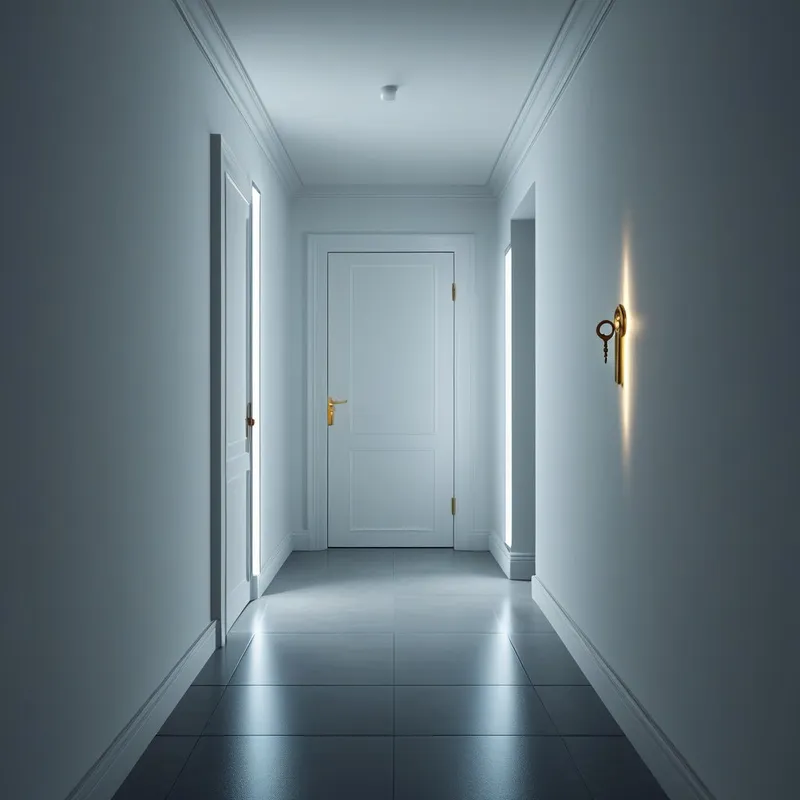
You stand in the hallway of your own apartment, but the door to your bedroom is gone. In its place is a seamless, blank stretch of wall. You know, with absolute certainty, that your bedroom is right behind it—you can feel its presence, hear the faint hum of your own computer. In your hand, you hold a key. It is warm, heavy, familiar. It fits the lock that is no longer there. You try to insert it into the smooth plaster anyway, the action both utterly logical and completely absurd.
This dream is the psyche’s elegant, devastating report: you are applying an old solution to a problem that has fundamentally changed its shape. The key of past understanding no longer interfaces with the lock of your current reality.
The False Lead
This is not a dream of simple frustration or bad luck. Do not mistake it for a narrative of external obstacles. The dissonance is not between you and the world, but between two versions of you within the world. It is not that the path is blocked; it is that you possess two contradictory maps, and both claim to be the territory. The terror here is not of failure, but of ontological collapse—the fear that if one truth falls, the entire architecture of your self might fall with it. This dream is the signal of a profound structural shift, not a random glitch in perception.
Psychological Architecture
To understand this dream is to enter the silent workshop where the self is forged and reforged. Here, shadow work is not about battling monsters, but about hosting an impossible meeting. The part of you that built a life on a certain belief—I am loyal, this career is my identity, this relationship is safe—sits at the same table as the part of you that has collected the undeniable evidence to the contrary. They do not scream; they present their cases with cold, impeccable logic. The Individuation process at play is the agonizing birth of a third perspective, a vantage point capable of holding the contradiction without being torn apart. It is the ego’s crucifixion—stretched between two poles of truth—so that a more conscious, integrated self can emerge from the rubble. You are not choosing a side; you are becoming the container that can finally accommodate both.
Mythic Resonance
We see this eternal process in the story of the Buddha under the Bodhi tree. Mara, the personification of doubt, fear, and temptation, does not attack with armies alone. His most potent weapon is a whispered, logical claim: “The throne of enlightenment is rightfully mine.” He presents valid deeds, past merits, a competing narrative of sovereignty. The Buddha’s victory is not in vanquishing Mara, but in touching the earth—grounding himself in a reality that encompasses and transcends the argument. He doesn’t defeat the dissonance; he becomes the ground upon which both the claim and its contradiction can exist, and in doing so, renders them both irrelevant to his core being. The dissonance dissolves not through force, but through a radical, unshakeable embodiment.
Symbolic Nodes
- Broken or Non-Functional Tools: Keys that don’t fit, phones that dial the wrong number, cars with no steering wheels. The instruments of agency are present but divorced from their purpose.
- Impossible Architecture: Staircases that lead back to their start, rooms that are larger on the inside than the outside, doors that open into solid wall. The laws of your internal world are breaking down.
- Mirrors Showing a Different Reflection: You look and see someone else, or a distorted version of yourself, while knowing it should be you. A direct image of fractured self-perception.
- Two of the Same Object, Slightly Different: Two wedding rings, two identical but conflicting documents, two versions of a cherished heirloom. The psyche materializes the duplicate, incompatible truths.
- A Known Person Acting Utterly Out of Character: They are themselves, yet performing an action that violates their core nature, and everyone else acts as if it’s normal. Your internal representation of them clashes with the dream’s evidence.
Archetypal Resonance
The Magician Archetype is the central operator in dreams of cognitive dissonance. This is not the Magician in its empowered, transformative aspect, but its shadow at the moment of crisis—the Manipulator/Illusionist whose spells are failing. This archetype governs the fundamental axioms of reality, the hidden rules we believe we operate by. When dissonance strikes, it is the Magician’s framework that is exposed as flawed. The somatic echo is the Magician’s panic as his sacred geometry cracks; the alchemical potential is his metamorphosis from a wielder of tricks into a true alchemist of the self. The pressure of the contradiction is the heat of his crucible, forcing him to stop manipulating perceptions and instead learn to transmute the very substance of his beliefs.
The Alchemical Process
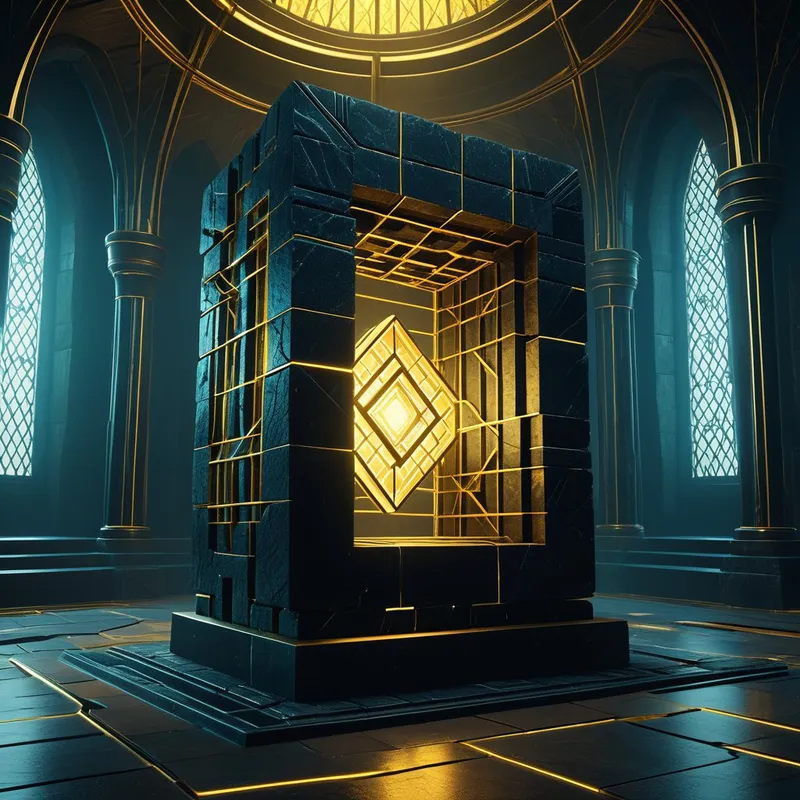
The transmutation here is Dissolution to Crystallization. The intense psychological heat is applied not from outside, but generated by the friction of the conflicting truths themselves. This is the nigredo, the blackening. The old, solid compound of your identity—a blend of belief, self-concept, and worldview—must be dissolved in the acid of contradictory evidence. It feels like madness, a terrifying loss of form. This is the necessary death. The pressure is the unbearable tension of maintaining the contradiction without fleeing into denial or dogmatism. If you can endure this liminal soup, without rushing to re-solidify around a partial truth, a new structure begins to form. It is not a compromise, but a more complex, elegant, and resilient crystal—a consciousness that can refract light through multiple facets without breaking. The grief is for the simple, solid self you were. The sovereignty is in becoming a conscious architect of your own dynamic, multi-faceted reality.
The Integration Protocol
Question 1: Where in my waking life am I persistently using a "key" that I know, deep down, no longer fits the "lock"? What old belief about myself, others, or the world am I trying to force into a new situation?
Question 2: If both conflicting truths in my dream were allowed to be simultaneously valid, what larger, third reality would they point to? What container is big enough to hold them both?
Question 3: What small, daily action do I take that feels subtly "out of phase" with who I am becoming? What is the faint, contradictory evidence my body has registered that my mind is still ignoring?
Action 1 (Grounding in the Fracture): For five minutes, sit quietly and physically feel the tension of the dissonance in your body. Don't try to resolve it. Imagine it as two different colored currents of energy. Breathe, and simply acknowledge, "Both are here." This grounds the conflict in the somatic present, removing its abstract, mental terror.
Action 2 (Unstructured Cartography): Take two pieces of paper. On one, draw, write, or collage the landscape of the "old truth" (the key). On the other, depict the landscape of the "new evidence" (the seamless wall). Do not connect them. Place them side by side and simply observe the gap. This creative act externalizes the internal architecture, making the dissonance a tangible object of contemplation, not a ghost in the machine.
Action 3 (Ritual of the Useless Tool): Find a small, physical object that represents the "key" from your dream or your answers—an actual key, a pen, a specific book. Perform a small, deliberate ritual of thanking it for its past service. Then, place it in a drawer or box, not as trash, but as a retired artifact. This symbolic act signals to the unconscious that you are releasing the compulsive application of an outdated solution, creating psychic space for a new tool to emerge.
Final Validation
The disorientation is real. The nausea of standing between two worlds is not a sign of weakness, but a testament to the magnitude of the shift occurring within you. It is the honest pain of growth that cannot be bypassed. This dissonance is not your psyche breaking; it is the sound of your old, cramped shell cracking to make way for a more expansive form of consciousness. You are not falling apart. You are being reassembled, molecule by molecule, into a being capable of holding complexity, of living in the question, of finding solid ground not in rigid belief, but in the fluid, sovereign act of conscious perception itself. The conflict is the forge. You are both the metal and the emerging shape.