
The Dream of Childhood: A Call from the Original Self
The Somatic Echo
It begins not as a memory, but as a texture. A specific gravity in the chest, a sudden lightness behind the eyes. The air in the dream tastes different—sweet and metallic, like sucking on a penny or the smell of rain on hot asphalt. There is a pull in the solar plexus, a visceral tug toward a state of being that logic has long since archived. This is the somatic echo of childhood: a pre-verbal knowing held in the body’s clay. It is the ghost of a simpler physics, where feeling was immediate and unbuffered by the mind’s sophisticated firewalls. Before the story of who you are was written, this echo was the only text. To dream of childhood is to feel this text vibrating again, a hum from the foundational layer of your psychic architecture, asking not to be revisited, but to be reclaimed.
The Dreamer's Log
You are in the attic of your childhood home, but it is vast, cathedral-like, and empty save for a single wooden box in the center of the dusty floor. The box is simple, unadorned, but hums with a low, electrical frequency. You know, with dream-certainty, that everything you have ever lost is inside it. You reach for the latch, but your hand passes through it like a ghost.
This dream is not about retrieving mementos, but about confronting the paradox of a wholeness you can sense but cannot yet physically grasp—the alchemical prima materia of your true nature, waiting for the correct key of consciousness to unlock its solid form.

The False Lead
The dream of childhood is most commonly mistaken for a simple wish for regression, a desire to escape adult complexity for a simpler time. This is the False Lead. The psyche is not a sentimentalist; it is an alchemist. It does not waste energy longing for what is gone. It mobilizes energy to integrate what was left behind. These dreams are not about going back. They are about a profound forward motion that requires collecting a specific fuel from the origin point. The grief or nostalgia you feel is not for the past itself, but for a disowned part of your own operating system—the Innocent, the Creator, the Explorer in their pure, undefended state—that went into hiding for survival’s sake. To interpret this as mere escapism is to mistake the map for the territory, the summons for the souvenir.
Psychological Architecture
The work here is Shadow work of the most foundational kind. It is the Individuation process reaching into the bedrock. In our early years, we perform a necessary fragmentation. To secure love, to avoid pain, to make sense of a world too large, we compartmentalize. The boundless curiosity is tucked away when it becomes “annoying.” The raw anger is buried when it meets punishment. The exquisite sensitivity is calloused over when it proves too porous. These are not mistakes; they are ingenious survival protocols. But the adult who built a life on these protocols often finds a haunting emptiness at the center, a sense of living in a beautifully furnished house that is not quite a home.
Dreams of childhood signal that the psyche is ready for reintegration. It is initiating a process of psychic archaeology—not to blame the past, but to excavate the self that existed before the first mask was forged. This is the architecture of homecoming. You are being called to sift through the internal family of subpersonalities—the wounded child, the protective parent, the adaptive achiever—not to crown one as king, but to host a council where the long-silenced original child, the core innocent self, is finally given a seat and a voice. Its integration does not make you childish; it makes you complete, adding a lost dimension of authenticity, wonder, and unfiltered presence to your adult sovereignty.
Mythic Resonance
This universal firmware is encoded in myths like that of The Divine Child, found across cultures from the baby Moses in the bulrushes to the infant Zeus hidden in a cave. The child is always threatened by a tyrannical order (Pharaoh, Cronus) and must be protected in secrecy until it is strong enough to return and restore a right order. This is not a story about literal infancy, but about the vulnerable, nascent core of the Self, which must often be hidden away for its own protection during the soul’s long winter. Your childhood dreams are the signal that the internal tyrant—the overbearing critic, the rigid adult persona—has grown brittle, and the Divine Child within you is stirring, ready to be retrieved from its exile and reintegrated into your kingdom.
Another potent resonance is the Garden of Eden. We often fixate on the exile, the loss. But the deeper layer is the state before the knowledge of good and evil: a state of unselfconscious unity, where the self and the world were not separate, and work was play. The dream of childhood often carries this echo of Edenic unity—not to make us yearn for a paradise lost, but to remind us that the capacity for that state of wholeness, that direct perception unmediated by judgment, remains as a seed within. The dream is the call to cultivate that inner garden anew, not in naive ignorance, but in conscious, hard-won innocence.
Symbolic Nodes
- Childhood Homes (Attics, Basements, Specific Rooms): Represent the architecture of the early psyche—the conscious mind (upstairs/attic), the subconscious (basement), the heart space (bedroom).
- Old Toys, Blankets, Specific Objects: Tangible symbols of lost capacities—a stuffed animal (comfort/self-soothing), a toy sword (boundary-setting/assertion), a blanket (safety/containment).
- Schoolyards, Empty Classrooms, Lockers: The arenas of early socialization, performance, and where the “adaptive self” was often forged under pressure.
- Childhood Friends (as they were then): Often personify aspects of your own lost self—the adventurous one, the creative one, the loyal one.
- Being Lost in a Familiar Neighborhood: The somatic echo of disorientation within your own foundational psyche, sensing “home” but not knowing the current path to it.
- A Child (often yourself) You Need to Protect or Find: The most direct symbol of the disowned original self requiring recognition and guardianship.
Archetypal Resonance
The energy at the core of the childhood dream is most powerfully embodied by The Innocent Archetype. The Innocent is not naive ignorance, but the state of being before the fall into self-conscious division. It is the part that trusts the fundamental goodness of existence, that meets the world with curiosity rather than cynicism, and that operates from a core of being rather than a strategy of becoming. In its shadow form—as The Shadow Innocent—it manifests as denial, helplessness, and a refusal to engage with necessary complexity. The childhood dream’s somatic echo—that sweet, gravitational pull—is the Innocent’s frequency. The dream itself is the psyche’s attempt to rescue this archetype from its shadow exile of denial and restore it to its rightful place. The alchemical potential lies in integrating this purified Innocent: it does not make you weak, but grants you an unshakable inner foundation of trust and authenticity from which to engage the world’s complexity with resilience, not bitterness.
The Alchemical Process
The transmutation here is one of Recognition and Sacred Re-parenting. The base lead is the grief of fragmentation—the haunting sense of a lost self. The intense heat and pressure (the nigredo) is found in the courageous act of turning toward that grief, not as a story of victimhood, but as a fact of soul-loss. You must sit in the inner attic with the humming box you cannot yet open and feel the full weight of the separation.
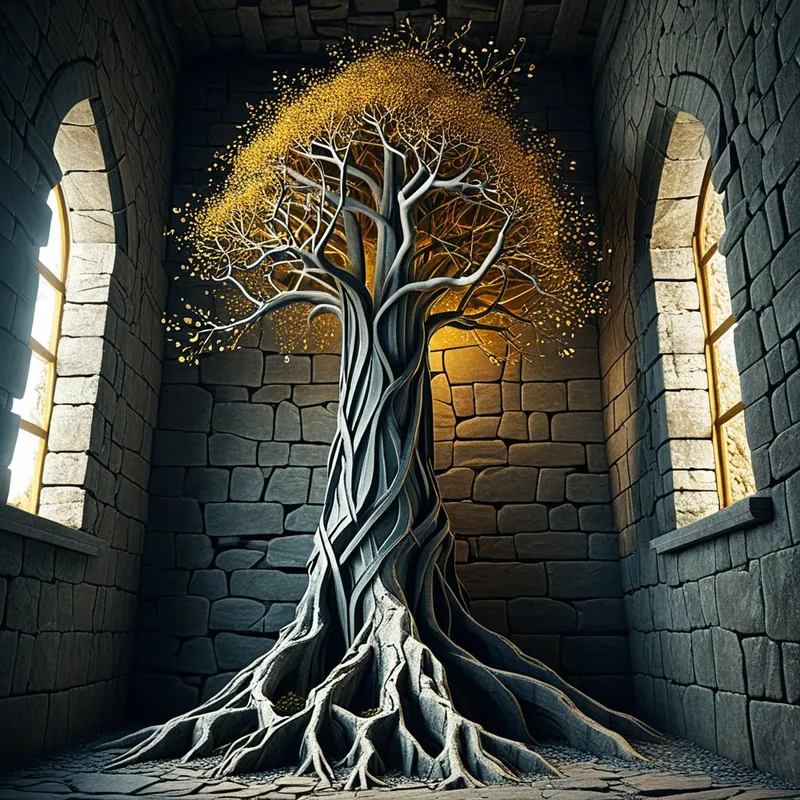
The alchemical fire is the application of conscious, compassionate adult awareness to those frozen, hidden moments where a part of you went into hiding. This is not regression; it is a present-moment act of witnessing. You provide, internally, the safety, validation, and understanding that may have been absent then. You tell the terrified child in the memory that it is safe now. You give the angry child a voice. You applaud the curious child’s questions. This conscious dialogue is the alchemical solvent that dissolves the old, frozen structures. The silver that emerges is the reclaimed capacity—the innocence that becomes wisdom, the anger that becomes healthy boundaries, the sensitivity that becomes profound empathy. The gold is the integrated sovereign self, no longer at war with its own history, now possessing the full spectrum of its original power.
The Integration Protocol
Question 1: In the dream, what was the dominant sensation in my body (e.g., lightness, dread, curiosity, longing)? Where did I feel it? This sensation is the direct messenger from the disowned self.
Question 2: If the child-self from the dream (or memory) could hand me one object—a tool, a key, a weapon, a toy—what would it be, and what forgotten capacity does that object represent for my life now?
Question 3: What is one belief I hold about "how the world works" or "what I must do to be safe/loved" that this child-self, in its pure state, would not recognize or would find utterly baffling?
Action 1 (Somatic Anchoring): For one week, upon waking, before engaging with any device or thought, place a hand on the area of your body where you felt the dream’s echo. Breathe into that space for three cycles. Do not analyze, just feel and acknowledge its presence. You are re-establishing a direct line of communication.
Action 2 (Unstructured Reclamation): With your non-dominant hand (the one linked to the right brain/child-self), spend 15 minutes drawing, scribbling, or finger-painting. No goal, no art. Let the hand move as it wishes. Then, with your dominant hand, write a few sentences from the scribble. What does it say? What does it need? This bypasses the adult critic to let the original self express.
Action 3 (Ritual of Return): Find a small object that symbolically represents a quality you feel you lost (a smooth stone for resilience, a feather for lightness, a key for access). Go to a natural setting—a park, a garden, a body of water. Hold the object, state aloud your intention to reintegrate this quality, and then place or bury the object there. You are not leaving it behind; you are planting the seed of its return in the fertile ground of your own psyche, symbolized by nature.
Final Validation
This work is not trivial. To open the archives of childhood is to consent to feel the weather of another time—the sharp sun of joy and the deep chill of old sorrows. It requires the courage to meet parts of yourself that have been waiting, frozen, for decades. Do not underestimate the profound bravery it takes to answer this call. Yet, within that very difficulty lies the promise. For you are not being asked to rebuild the past. You are being summoned to collect the essential, radiant fragments of your original self—the curiosity, the trust, the unfiltered passion—and, with the wisdom you have earned through living, forge them into the cornerstone of your future wholeness. The child in the dream is not behind you. It is the part of you that is still, and always has been, most alive. It is waiting to be welcomed home.