
The Somatic Echo
Before the image forms, the body knows. It is a peculiar hollowness behind the sternum, a sensation of being too light, as if your density has been dialed down. The skin prickles not with fear, but with a constant, low-grade adjustment—a chameleon’s fatigue. You feel yourself pulling in, not in a cower, but in a deliberate retreat of essence. Your edges go soft, blurring into the atmosphere of the room, the mood of the conversation, the expectation in the air. It is the somatic signature of a self in active negotiation with its own disappearance. The breath becomes shallow, efficient, designed not to stir the air. You are practicing a kind of ontological stillness, where to be truly seen feels like a catastrophic system failure. This is the pre-verbal truth of camouflage: not hiding from a threat, but becoming the environment to avoid the existential risk of definition.
The Dreamer's Log
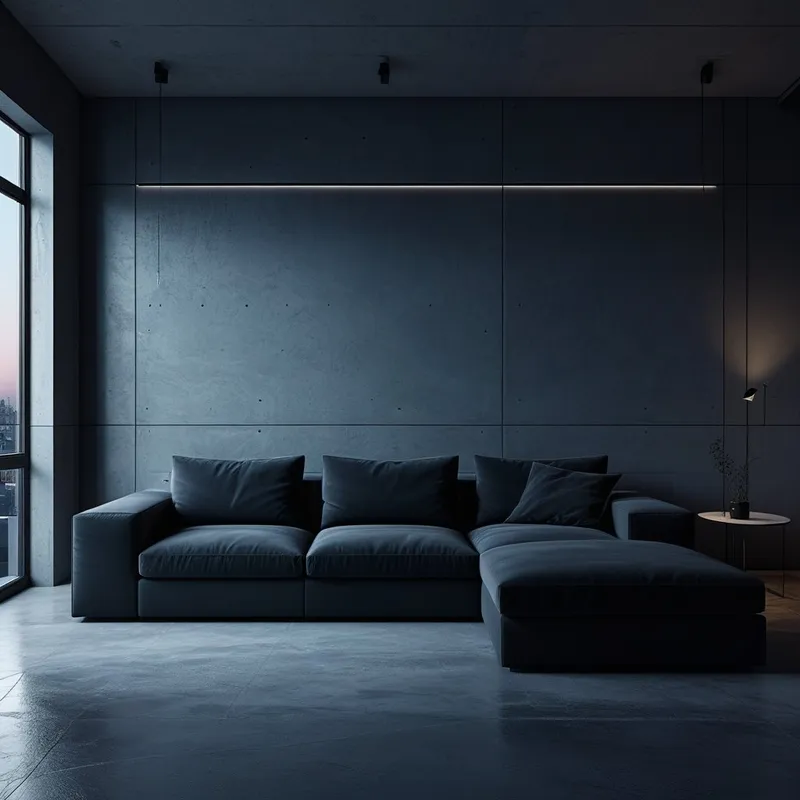
I am in my apartment, but it feels like a showroom. Everything is minimalist, shades of grey. I notice my favorite sofa—a deep, comforting burgundy—is gone. In its place is a sleek, black modular piece. As I watch, its surface begins to ripple, pixelating, trying to match the exact concrete texture of the floor. A wave of profound grief washes over me. I whisper to the room, "Where did I go?"
The alchemical interpretation: The soul mourns the furniture of its own character, traded for adaptive, featureless utility that seeks only to erase its own presence.
The False Lead
This is not about social anxiety or simple shyness. To mistake camouflage for mere introversion is to confuse a strategic, systemic withdrawal with a personality trait. Nor is it the conscious donning of a disguise for a role. The terror here is deeper. It is the unconscious, automated becoming of the background. It is the fear that your authentic shape, your unique color and texture, is itself the threat. The dream is not showing you a moment of hiding; it is revealing a lifelong architecture of assimilation, where the core self has been so expertly blended into the familial, social, or professional landscape that it can no longer locate its own outline. The grief is not for a thing lost, but for a self that was never allowed to solidify.
Psychological Architecture
The work here is archaeology in reverse. Instead of digging for a buried treasure, you are tasked with carefully dissolving the plaster that has been poured over the living form. Within the psyche’s internal family, the parts that learned to camouflage are often the most loyal protectors. They are the orphans who survived by mimicking the family’s emotional palette, the caregivers who soothed by becoming a mirror, the rebels who channeled their defiance into perfect, unnoticeable compliance. Their strategy was genius: if I become the wall, the wall cannot reject me. If I become your expectation, I am safe from your disappointment.
But the shadow of this genius is a profound soul-loss. Individuation—the process of becoming an undivided, self-defined whole—requires a boundary. It needs a this that is not that. Camouflage annihilates that boundary. The work, then, is a slow, painful reclamation of contrast. It involves sitting with the protector parts and thanking them for their impeccable service, while gently, firmly informing them that their central directive must change. The new mission is not safety through invisibility, but sovereignty through visibility. It is to allow the internal orphan to finally cry out in its own voice, and to discover that the world does not end, but rather, begins.
Mythic Resonance
We see this eternal drama in the tale of Odysseus and the Cyclops. When trapped in the monster’s cave, Odysseus does not initially fight. He names himself Outis—"Nobody." It is a act of brilliant, life-saving camouflage. He negates his identity to survive. But the myth knows this is only half the journey. To return home, to reclaim his throne and his true self, he must later, from the safety of his ship, shout his real name back to the blinded giant, invoking the wrath of Poseidon. The psyche understands: the initial camouflage (Outis) is necessary, but the final, shouted declaration of identity ("I am Odysseus!") is essential, even if it summons the storm. The dream of camouflage often finds us still in the cave, whispering "Nobody," having forgotten we are allowed to leave and claim our name.
Symbolic Nodes
- Chameleons & Octopuses: Not as animals, but as processes—shifting skin, active blending.
- Muted Color Palettes: Dreams drained of vivid color, everything in beige, grey, institutional green.
- Featureless Clothing: Uniforms, grey suits, garments that erase the body’s shape.
- Active Wallpaper/Textures: Walls that absorb objects, furniture that melts into the floor.
- Being Unnoticed in a Crowd: Not as an observation, but as a felt achievement.
- Mirrors that Show Only the Room: The ultimate confirmation of successful erasure.
Archetypal Resonance
The energy here resonates most deeply with The Shadow Orphan. The Orphan’s healthy aspect is the resilient realist, the survivor who adapts. Its shadow, however, is the perpetual victim, the part that believes survival is only possible through self-negation and the pity of others. The somatic echo of camouflage—the hollow lightness, the blurred edges—is the Shadow Orphan’s masterpiece: it has perfected the art of making the self so small, so adaptable, so needy of a host environment that it believes it cannot exist alone. Its alchemical potential lies in its profound, unmet longing. That grief for the lost sofa, that whisper of "Where did I go?" is the crack in the system. It is the Orphan’s buried memory of wholeness, now demanding not just survival, but a homecoming. The task is to lead this part from the strategy of victimhood ("I must disappear to be safe") to the sovereignty of the survivor ("I can be seen and still endure").
The Alchemical Process
The transmutation of camouflage requires the heat of conscious contradiction. The prima materia is the grief of self-erasure. The fire is applied by deliberately, in small, bearable doses, creating moments of conscious misfitting. This is the pressure that cracks the adaptive shell. It is the psychological equivalent of a chameleon deciding, for one minute, to turn a brilliant, clashing orange against a green leaf. The terror is visceral—it feels like a violation of a fundamental survival law. The alchemy happens in the aftermath of that terror, when you discover that the sky does not fall. The environment may react with surprise, discomfort, or even rejection, but you remain. The self, that tiny flame of specific being, does not extinguish. It flickers, then burns more steadily. Through repeated, intentional moments of non-blending, the liquefied, adaptive identity begins to cool and solidify around a new core: not "I am what you need me to be," but "I am this." The gold produced is not invulnerability, but sovereignty—the unshakable, quiet knowledge of your own pattern, visible against the world.
The Integration Protocol
Question 1: In the dream, what was the environment you were blending into? Can you name the unspoken rule, expectation, or emotional atmosphere of that space?
Question 2: If the camouflaged object in your dream (the sofa, your own body, etc.) could speak its one true desire that is opposite to hiding, what single sentence would it say?
Question 3: Where in your waking life do you feel that same somatic echo—the hollow lightness, the deliberate softening of your edges? Is it with a specific person, in a specific role, or when a certain topic arises?
Action 1 (The Misfit Minute): Once today, in a low-stakes interaction, consciously allow a small part of your true response to surface where you would normally blend. This could be voicing a mild contrary opinion, allowing a genuine emotion to show on your face, or simply not laughing at a joke you don't find funny. Observe the internal tremor, and then observe that you survive it.
Action 2 (Pattern Reclamation - Creative): Take a large sheet of paper and two colors. With one color, draw the background—the repetitive, safe, blending pattern of your "cave." With the second color, begin to draw your own shape over it. Don't plan it. Let it be abstract—a jagged line, a solid form, a splash. The act is not to create art, but to physically assert a contrasting pattern onto the field of camouflage.
Action 3 (Sovereignty Anchor): Find a small, tactile object—a stone, a ring, a carved piece of wood. Let this be your "contrast anchor." Hold it when you feel the pull to disappear. Its solid, defined, unblending physicality is a reminder to your somatic system: "I am a thing. I have edges. I occupy space."
Final Validation
The ache you carry is the weight of a genius protection that has outlived its purpose. Honor the profound intelligence that learned to make you seamless, that kept you safe in the cave of another's needs or expectations. That intelligence is not your enemy; it is a loyal soldier awaiting new orders. The journey from camouflage to sovereignty is not an act of rebellion against that protector, but a promotion. You are asking it to stand down from its post at the boundary and instead become the steward of the inner kingdom. It is difficult, for it means trading the known safety of the background for the vulnerable responsibility of being a figure. But the dream itself is your evidence: the soul is already grieving its own absence. It is ready, however tremulously, to be seen.