
The Silent Architect: Dreams of Boundary & Transition
The Somatic Echo
It begins not as a thought, but as a tremor in the ground of being. A low-grade hum of wrongness, a subtle nausea in the soul’s stomach. You feel it in the clenched jaw that greets a familiar face, in the sudden, inexplicable fatigue that descends after a routine conversation. It’s a pressure behind the sternum, a sense of psychic claustrophobia where there was once comfort. The body knows first: the old maps no longer match the territory of your life. The contracts you signed with the world—the silent agreements on how to be, what to feel, where you belong—are vibrating at a frequency that now grates against your bones. This is the somatic prelude to a dream of boundaries and transitions, the visceral signal that the psyche’s architecture is undergoing a silent, seismic review.
The Dreamer's Log
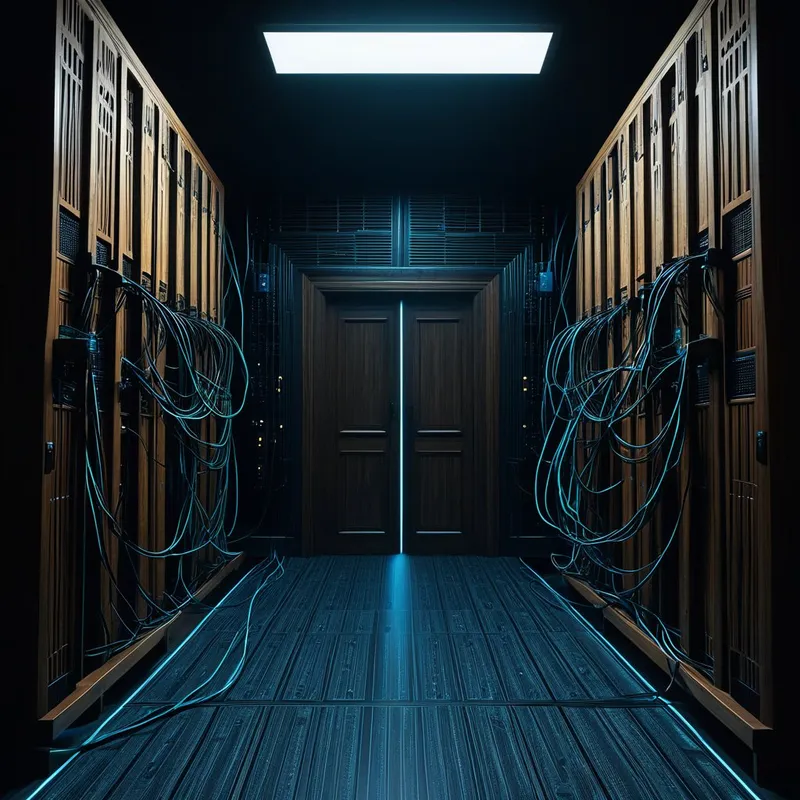
The server room was cavernous, cold, and humming with the low thrum of forgotten data. I walked past endless racks of blinking lights until I found it: a single, weathered oak door, utterly out of place, set into the metal frame. It was slightly ajar. From within, a warm, golden light spilled out, casting the tangled shadows of cables on the floor. I knew I had to step through, but my feet were rooted to the grating. The hum of the servers seemed to grow louder, a warning siren in a forgotten tongue.
This is the alchemy of the threshold: the conscious mind (the server room of logic and stored identity) encounters a portal to an unknown, organic warmth, and the entire system hesitates, sensing the irrevocable rewrite that passage demands.
The False Lead
Do not mistake this for mere inconvenience or a streak of bad luck. The theme of Boundary & Transition is not about life throwing temporary obstacles in your path. It is not a locked door you simply need to find the key for. That is a puzzle, and puzzles have solutions that leave the solver unchanged. This is different. This is the discovery that the door itself—the very concept of doorness, of inside and outside, of permission and prohibition—is being renegotiated by a deeper intelligence within you. The discomfort is not an error message; it is the system acknowledging a fundamental upgrade in its operating code. To interpret it as random misfortune is to pathologize the birth pangs of a new sovereignty.
Psychological Architecture
This dream work is the shadow labor of Individuation—the process of becoming an undivided, self-defined whole. It is the moment you realize that many of your walls were not built by you, but inherited, downloaded from family systems, cultural scripts, and trauma responses. They are internal tenants, sub-personalities like the loyal Orphan who built a fortress of “I’m fine” to survive, or the Shadow Caregiver who fenced off your needs to tend to others’ deserts.
The transition occurs when the central, observing Self begins to audit these structures. It feels like grief, because it is. It is the grief of dissolving an identity that kept you safe but now keeps you small. You are not just crossing a line; you are metabolizing the very material of the line. The shadow work here is to sit in the liminal space—the doorway itself—and feel the terror of being neither here nor there. To allow the old, rigid geometry of your defenses to be softened by this unbearable, sacred ambiguity. The foundation is not cracking; it is becoming permeable, learning to breathe.
Mythic Resonance
We see this eternal process in the Greek myth of Psyche and Eros. Psyche is commanded never to look upon her divine lover. The boundary is absolute, the condition for paradise. But her wholeness requires she break it. When she lifts the lamp, she sees sublime beauty, but loses everything—cast out into a wasteland of trials. The boundary’s violation was not a mistake; it was the necessary, devastating catalyst for her transformation from a sheltered girl into a goddess in her own right. The myth does not celebrate the boundary, but the sacred, self-willed transgression that births consciousness.
Similarly, in the Japanese Shinto concept of Kekkai—a sacred, cordoned-off space—the boundary exists not to exclude forever, but to mark a zone of intensified transformation. One crosses into it to be altered, and then crosses back, carrying a changed essence into the ordinary world. The boundary is a membrane for alchemy, not a barricade for permanence.
Symbolic Nodes
- Thresholds: Doors, gates, arches, bridges, windows, shorelines.
- Liminal Objects: Keys (especially broken or melting), passports, tickets, bridges that are crumbling or under construction, elevators between floors, staircases that lead into darkness or light.
- Structural Metamorphosis: Walls that are transparent, melting, or breathing; floors that become liquid; houses with unknown rooms; maps that redraw themselves.
- Vehicular Transition: Trains, planes, or cars at a moment of departure or arrival, often stalled or moving without a driver.
Archetypal Resonance
The energy humming at the core of this theme is that of The Magician Archetype. Not the stage illusionist, but the deep alchemist, the architect of reality who understands the hidden codes and levers of existence. The Magician’s domain is the liminal space between worlds—the doorway itself, the moment of transformation. Its somatic echo is that crackling, potential-filled tension before a spell is cast. Its core question is: "How do I transform the base material of my conditioned life into the gold of authentic being?" In the shadow, this becomes the Manipulator or Illusionist, who uses boundaries to control and deceive—others or themselves—building labyrinths instead of gateways. The alchemical potential of the Magician in a Boundary dream is to move from being subject to boundaries (the Orphan’s position) to becoming the conscious author of them (the Magician’s art), transmuting fear of the threshold into reverence for its transformative power.
The Alchemical Process
The transmutation here is Solutio—the alchemical stage of dissolution. The rigid, crystallized structures of the old self (the salts of past wounds, the leaden weight of "should") must be dissolved in the aqua permanens, the eternal waters of the unconscious. This is the heat and pressure: it is the voluntary submission to a state of chaos, of not-knowing. You must let the old boundaries, even the helpful ones, soften and run like wet ink. It feels like a loss of control, a terrifying liquidity. This is not destruction, but de-structuring. The ego, the great builder of walls, must consent to this flood. Only in this saturated, ambiguous solution can the particles of identity separate and re-coalesce around a new, more authentic center of gravity. The sovereignty earned is not a thicker wall, but the fluid, conscious authority to call a boundary into being when needed, and to dissolve it when it serves the soul’s expansion. You become the water and the vessel both.

The Integration Protocol
Question 1: Where in my waking life do I feel that same root-locking terror or resonant hum I felt at the dream’s threshold? What familiar "room" am I being asked to leave?
Question 2: If the boundary in my dream (the wall, the door, the shore) could speak, what is its one-sentence purpose? Is it to protect, to hide, to define, or to test?
Question 3: What tiny, precious fragment of my old self must I grieve and release in order to step across this new inner line?
Action 1 (Somatic Cartography): For one day, track the physical sensations in your body during interactions. Note the subtle clench, the slight exhale, the warming or cooling. Do not analyze; just map. You are charting the living geography of your current, unconscious boundaries.
Action 2 (Unstructured Portal Writing): Set a timer for 10 minutes. Write from the perspective of the threshold object in your dream (the door, the bridge, the ticket). Let it describe what it has witnessed, what passes through, what it prevents, and what it yearns for. Do not direct the narrative.
Action 3 (Ritual of Conscious Passage): Physically enact a small transition with full awareness. Wash a doorway in your home with intentionality. Walk across a bridge slowly, feeling each step as a conscious choice to leave one state and enter another. Mark the moment of crossing with a breath, a whispered word, or a touch. You are practicing sovereignty over transition itself.
Final Validation
This work is arduous because it asks you to become un-homed from your own psyche, if only for a moment. To feel the ground liquefy beneath you is a primal terror. Honor that fear; it is the ghost of what once kept you safe. But know this: the dream does not show you the threshold to mock your paralysis. It appears because the deepest part of you is already on the other side, holding the lamp, waiting. The tremor you feel is not the collapse of your world, but the silent, relentless excavation of its true foundation. You are not being broken apart. You are being solved, dissolved, so that you can finally—consciously, deliberately—flow into the shape you were always meant to hold.